
No death in all of human history even comes close to arousing as much interest or speculation as the death, burial, and resurrection of Christ. It has been studied by scholars, historians, philosophers, and theologians for ages. And some 2,000 years later nearly 3 billion people around the world gather in places of worship like this to remember and to proclaim that this was the turning point in history. This was the moment when everything changed.
The danger I think we face this morning is that, because we have likely heard the story so many times before, we risk becoming desensitized to it all. The cross is so shocking and scandalous that, as Christians, we should never cease to be amazed by the simple fact that because God loved us, He sent His Son to suffer and die in our place, to carry the weight of our guilt and shame, so that nothing might separate us from the love of God, which we did not, and could never, earn.
I originally wanted to try to preach the entire passion narrative this morning leading up the cross, but there is far too much to be said leading up to the cross to do it justice in a single sermon.
I then planned to focus solely on the crucifixion as detailed in the four gospels but even then, there was far too much to be said. So, this morning we will be focusing on John’s account, and the details which the beloved disciple chose to record for us.
PROLOGUE:
But just to set the scene for us, I do want to recount some of the events that have transpired since we last left off.
Jesus partook in the Last Supper with his disciples, where he not only linked himself to the sacrificial Passover lamb, but also explained that one of his disciples would betray him and one of them would deny him three times. Jesus washed his disciple’s feet as a symbolic last act of service to them.
Jesus took his disciples to the Garden in Gethsemane, where he spends the night in prayer knowing what the next few hours would entail. He repeatedly encouraged the disciples to pray, and yet they struggled to stay awake.
Judas betrayed Jesus with a kiss, identifying him to the mob that had come to apprehend him. Peter tried to defend Jesus with a sword, but Jesus told him not to shed blood on his behalf, even going so far as to heal the man whom Peter wounded. The disciples fled in fear.
Jesus was arrested and brought before Annas, Caiaphas the high priest, and the council of priests, elders, and scribes to be questioned. Peter follows along in the shadows but is identified as a disciple of Jesus. In fear, Peter denies Christ three times before the rooster crows with the rising sun.
Jesus is turned over to Pilate, the Roman Governor of the Region, who sends him to King Herod, who sends him back to Pilate, neither of them really wanting to take part in this lynching.
Pilate, while recognizing that Jesus has committed no crime, allows the mob to decide his fate. They condemn Christ to death by crucifixion and Pilate permits Christ to be beaten, tortured, and sentenced to death.
It is here that we pick up in John’s account:
16 … So they took Jesus, 17 and he went out, bearing his own cross, to the place called The Place of a Skull, which in Aramaic is called Golgotha. 18 There they crucified him, and with him two others, one on either side, and Jesus between them.
John’s account is surprisingly sparse on the details of the actual crucifixion. He instead focuses mostly on those who were witnesses too, or partakers in, the crucifixion itself. I think this was intentional on John’s part. Most scholars and church historians believe that John’s gospel was the last of the four to be written, and so it is very likely that John’s readers were familiar with the gospel accounts written by Matthew, Mark, and Luke.
We are only told that “he went out, bearing his own cross, to the place called The Place of a Skull, which in Aramaic is called Golgotha. There they crucified him”.
We know from the other gospel accounts, and from historical records of the time, that carrying the cross was no easy task. Most likely it was the crossbeam which was placed on Jesus’ shoulders. That beam alone easily weighted over 100 pounds, and lest we forget Jesus had previously been beaten and flogged and marched all over Jerusalem by his accusers, hoping for someone who would give them the authority to crucify Him.
When a man was sentenced to crucifixion, it was customary to take the longest possible road to the place of execution. In the Romans’ mindset, public execution was meant to deter others from breaking the law, so they wanted the suffering to be as public and event as possible. Mark’s gospel notes that at one point Jesus’ physical body gave out and a man named Simon from Cyrine had to carry the cross for Jesus at least part of the way.
But even the most detailed and visceral account of the crucifixion could not due justice to the pain which Christ endured for us. In addition to the physical pain which pushed his body beyond its limits, there was surely the psychological and emotional pain that weighed so heavy on his mind. He had been betrayed, abandoned, and denied by those whom he loved most. No doubt, many in the crowd that earlier had shouted “Hosannah, Hosannah! Blessed is He who comes in the name of the Lord” upon his triumphant entry in to Jerusalem, were also in the crowd that shouted “Crucify Him! Crucify Him!”
God created the hands that held the whip, that drove the nail, that placed the crown of thorns upon his brow. God planted the seed that became the tree upon which His Son would carry in scorn, and upon which the greatest gift of love would bleed and die. Jesus had wept over Jerusalem out of love for them, because they would not repent, and the had chosen to kill the giver of life. How do you put words to that?
But the crucifixion goes deeper than the physical pain, and deeper than emotional pain, it goes to a spiritual pain unimaginable. Matthew’s Gospel records that “from the sixth hour there was darkness over all the land until the ninth hour. And about the ninth hour Jesus cried out with a loud voice, saying, “Eli, Eli, lema sabachthani?” that is, “My God, my God, why have you forsaken me?” (Matthew 27:45-46).
The light that had come into the world knew darkness. Jesus the Messiah, the Son of God, who had been quiet through trials and torture, cried out in spiritual agony upon feeling the weight of sin and separation from the Love of God, the separation that each and every one of us merited. The Son of God came and took all of this (and infinitely more) upon himself, to spare us from the fate we deserved, and to merit for us the love and grace we could never have hoped to achieve on our own.
This is the meaning of the cross, but the meaning can be so easily lost on us if we fail to respond in the way Christ has commanded us. So, for the next few minutes, I want to highlight some of the ways the first witnesses responded to this truly world altering event.
Two Criminals and One Savior (19:16b-18)
“There they crucified him, and with him two others, one on either side, and Jesus between them” (v 18).
John does not go into the same details about these two criminals as the other Gospel authors do, and yet he still sees them as worthy of inclusion. Here is what we know of these two criminals. Both were guilty of vile crimes, and were rightly convicted. One criminal, up until the very end, was unrepentant and seemed to find some sort of sick humor in seeing the innocent one suffering alongside the guilty. The other criminal, rebuked the first saying…“Do you not fear God, since you are under the same sentence of condemnation? 41 And we indeed justly, for we are receiving the due reward of our deeds; but this man has done nothing wrong. Jesus, remember me when you come into your kingdom.” (Luke 23:40-42).
Two criminals, equally guilty and undeserving of mercy. One took his guilt to the grave refusing to place his faith in a crucified messiah. The other, believed and (though there was nothing this man could do to atone for his sins) he was told that that day he would be with Christ in paradise.
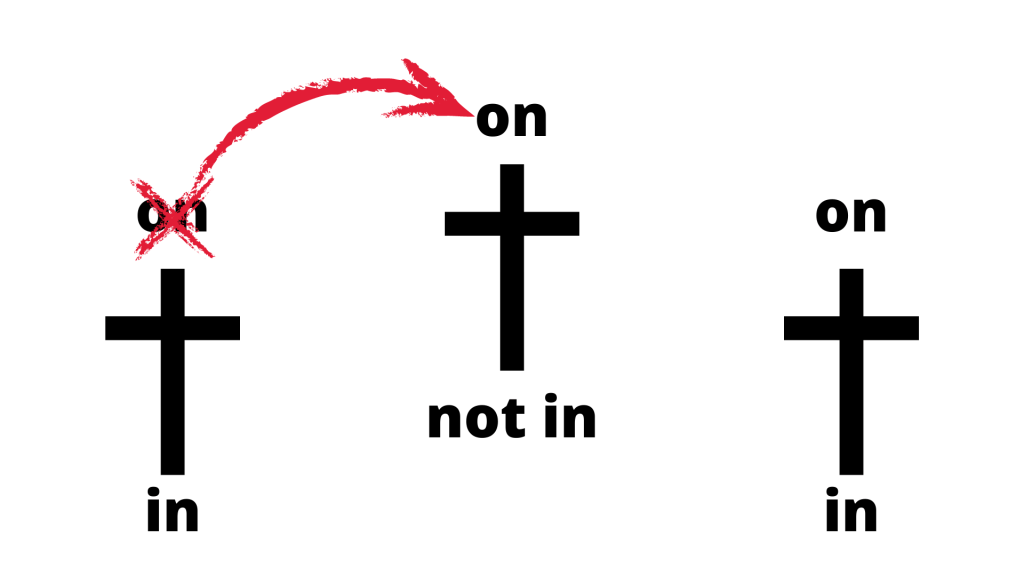
Of the three men crucified only one had no sin in him. But the sinless one took the sins of the repentant man onto him, along with the sins of the world so that when he stood before God the guilty man could stand guiltless. Christ took the guilt (the guilt that would eternally separate us from the holy love of God) and placed it upon himself. And not just this one criminal, but the guilt and sin of all who had, and all who would, repent of their sins and place their faith in Him as their Savior and Lord.
We too, whether we acknowledge it or not, have sin in us. And unless we turn to Christ for salvation we will enter the judgement with the guilt of sin on us. But if we place our faith and trust in Christ as the repentant thief did, Christ will take our sins upon himself and bear the guilt of our sin, and give us the righteousness we did not earn.
We will new receive life and life eternal, as a costly gift freely given out of the immeasurable love of God. That’s the good news. Have you repented and believed this good news? If not then let’s get that squared away today. Do not wait until your dying breath to get right with God, because we do not know the day or hour, and a time will come when it is too late. This is the lesson we learn from the two criminals.
The next person who John draws our attention towards is Pilate, the governor of the region. John only briefly addresses him, focusing on the inscription he had written to be placed over the cross.
A Governor and a King (19-22)
19 Pilate also wrote an inscription and put it on the cross. It read, “Jesus of Nazareth, the King of the Jews.” 20 Many of the Jews read this inscription, for the place where Jesus was crucified was near the city, and it was written in Aramaic, in Latin, and in Greek.21 So the chief priests of the Jews said to Pilate, “Do not write, ‘The King of the Jews,’ but rather, ‘This man said, I am King of the Jews.’”22 Pilate answered, “What I have written I have written.”
As we already mentioned earlier, Pilate had played a crucial role in the crucifixion before this moment. Pilate was the man whom Jesus’ captors sought out, so that they might trump up some charges and have him executed without a murder charge falling on them. Luke records that Pilate saw no guilt in Jesus, and Matthew even says that Pilate was impressed by how Jesus acted during his trial. Yet, instead of pardoning him, he sent Jesus off to Herod, who then sent them back to Pilate. Seeing that he was not going to get out of this, Pilate chose to let the crowd decide Jesus’ fate. He tried to persuade them by offering a choice between pardoning Jesus and a notorious criminal named Barabbas, but the crowd chose to pardon the criminal and condemn the innocent. Pilate could have intervened at any point, but instead chose to just wash his hands and go with the path of least resistance.
Pilate is a near perfect model of an indecisive man, a people pleaser. He was a man who had carefully worked his way up to his rank. We know from historical records that on several occasions the Jewish leaders in Jerusalem had exercised their right to complain to the Emperor about Pilate. On one of his first visits to Jerusalem, he rode into the city with the Roman standard, an eagle sitting atop a pole. All previous governors had removed the standard because of the Jews’ opposition to idols, but for whatever reason Pilate did not and the Jewish leadership had filed complaints. Later in his term, Pilate began a project to construct a new water supply for Jerusalem. To finance the project, he took money out of the temple treasury, which the Jews saw as robbing God’s house.
Perhaps Pilate’s reluctance to defend Jesus was out of fear of getting yet another complaint filed against him. In either way, Pilate decided not to act, which in this case was just as bad condemning Jesus.
Maybe we find ourselves relating more to Pilate than to either of the criminals on the cross. We are presented with Jesus the Son of God, but instead of repenting and accepting Him as our Savior and Lord (like the one criminal on the cross) or outright rejecting him (like the other criminal on the cross) we try to play somewhere in the middle.
- We like Jesus, but not enough to upset people. We don’t want pushback. We don’t want people to be upset with us.
- We don’t have a problem with Jesus, but we are not going to risk my job, or a friendship, or my peace of mind to be faithful to him.
- We get why some people like Jesus, but he’s not for everyone, why can’t we just live and let live. Whatever you decided to do with Jesus is fine by me. I won’t tell you how to live.
Beloved, Jesus does not give us that option. There is not a middle path between obedience and disobedience. Do not tarry trying to find a way to have Jesus and the world’s approval. You cannot serve two masters. The time will come when you will have to decide, and if we do not decide this day whom we will serve, I fear we may find ourselves like Pilate floundering and ultimately failing when the time of decision is forced upon us.
Now, because crucifixion was a public punishment, intended to instill fear into any would be lawbreakers who passed by, it was customary to fix an inscription over the criminal that included their name and their crime. John records Pilate’s inscription (written in the three most popular languages of the day) simply said “JESUS OF NAZARETH, THE KING OF THE JEWS”.
The chief priest, and probably many who saw it, were not happy with this and asked for the sign to be changed. And this is a neat note, but it’s something that would be incredibly easy to miss: John used the imperfect verb tense when he says they asked Pilate to change the sign to read “This man claimed to be king of the Jews.” But when Pilate says he would not change it, he answered in the Greek perfect tense: “What I have written, I have written.” Or, more literally, “What I have written, I have written, and it will always remain written.”
Now I don’t think Pilate knew what he was saying. I honestly think he was just frustrated and tired of having to deal with all of this, but regardless of his motives Pilate accidentally testified that Jesus was, is, and ever shall be the true King of God’s People. His is a kingdom that will have no end. Perhaps it was foreshadowing that, even those who want little to do with Christ in the here and now, will one day have to bow the knee and confess that Jesus Christ is Lord.
Next we are presented with not one, but two very different responses to the suffering savior.
The Greedy & The Grieving (23-27)
23 When the soldiers had crucified Jesus, they took his garments and divided them into four parts, one part for each soldier; also his tunic. But the tunic was seamless, woven in one piece from top to bottom, 24 so they said to one another, “Let us not tear it, but cast lots for it to see whose it shall be.” This was to fulfill the Scripture which says,
“They divided my garments among them,
and for my clothing they cast lots.”
So the soldiers did these things, (23-24)
You have the soldiers who not only willing to take a dead man’s belongings, but were not even willing to wait for him to die. They gambled away what few things he owned before his eyes as he died. Yet even these uncaring men, unknowingly testified to who Christ was by fulfilling the prophecy of Psalm 22:18.
Imagine being so blind that as the savior bleeds and dies for the sins of the world, your attention is focused on squabbling over a tunic.
In the same line of thought, what trivialities distract us from the one thing that is of the upmost importance. How is it that we, who have born witness to the cross of Christ and the saving work of the sacrificial Son of God, can then fritter about our days seeking so many trivial things.
We live in a world full of distractions and detours, but as the old hymn writer so eloquently put it:
“Turn your eyes upon Jesus, look full in his wonderful face, and the things of earth will grow strangely dim in the light of his glory and grace.”
Matthew and Luke both record at least one Centurion who, upon seeing the death of Christ responded “Truly he was the Son of God.” If we find ourselves distracted and toiling away after worthless worldly things, may we follow in the Centurion’s example and turn our eyes upon the only one who has the power to save.
As a perfect counterbalance to the soldiers are the friends and loved ones of Jesus, who braved possible persecution to be present with their savior and friend.
25 but standing by the cross of Jesus were his mother and his mother’s sister, Mary the wife of Clopas, and Mary Magdalene. 26 When Jesus saw his mother and the disciple whom he loved standing nearby, he said to his mother, “Woman, behold, your son!” 27 Then he said to the disciple, “Behold, your mother!” And from that hour the disciple took her to his own home. (25-27)
I find it fascinating that of the five mourners mentioned, four of them were women. Women would make up the majority of the followers of Jesus who were brave enough to bear witness to the cross, and women would make up the entirety of the first witnesses to the resurrection.
At this time women were scene as second-class peoples. In fact after the resurrection, one of the criticisms thrown at the disciples was that they were basing their faith in a risen Christ on the testimony of women (who by default were viewed as unreliable witnesses). How like our savior to give the greatest honor to those of faith who have been discredited by the world.
Mary the mother of Jesus saw her perfect baby boy crucified for her sins. Imagine the prayers she must have prayed for this child that the angel had told her she would conceive by the Holy Spirit. The baby whom Simeon had prophesied would be… “destined to cause the falling and rising of many in Israel, and to be a sign that will be spoken against, so that the thoughts of many hearts will be revealed. And a sword will pierce your own soul too.” (Luke 2:34-35)
I do not think I could add any more words to encapsulate such grief.
With Mary the mother of Jesus was her sister, Mary the wife of Clopas, and Mary Magdalene… a disciple of Jesus who seemed, more than any other, to understand who Jesus was. Mark and Luke both describe how Jesus had cast demons out of her when she first came face to face with the Savior. Jesus described her as one who had sinned much and loved much, and who (more than any other disciple) was willing to take the role of a servant… washing Jesus’ feet with her tears and drying them with her hair, anointing him with perfume and showing that all she had belonged to Christ (the one who had set her free).
These were the followers of Jesus who had shown the greatest faith during his ministry, and even at the hour of his death here they were at his side.
Reflect back again on the immense sufferings that Jesus was enduring, the physical pain beyond measure, the emotional pain of betrayal and scorn, and the spiritual pain of bearing the sins of the world upon his shoulders… and in spite of all of this, Christ still has care left for his mother and his disciples.
When Jesus saw his mother and the disciple whom he loved standing nearby, he said to his mother, “Woman, behold, your son!” 27 Then he said to the disciple, “Behold, your mother!” And from that hour the disciple took her to his own home. (25-27)
We are led to believe that “the disciple Jesus” loved was John, who authored this gospel. Which might be why he alone records these words.
But don’t miss the contrast. The soldiers were so concerned with the little things like tunics and worldly possessions, that they nearly all missed the greatest act of sacrificial love, which was being demonstrated in their midst. The mourners however, who’s attention was fully placed on Christ, not only had their sins forgiven, but God’s Son (even in the midst of his sufferings) turned his attention to their needs and cared for them. There is a lesson there for all of us.
This leads us to the last focus of today’s message.
One Willing Sacrifice (28-30)
28 After this, Jesus, knowing that all was now finished, said (to fulfill the Scripture), “I thirst.” 29 A jar full of sour wine stood there, so they put a sponge full of the sour wine on a hyssop branch and held it to his mouth. 30 When Jesus had received the sour wine, he said, “It is finished,” and he bowed his head and gave up his spirit.
When Jesus drank the sour wine he fulfilled the prophecy of Psalm 69:21, further proof that He wast he Messiah.
The fact that it was given to him on a hyssop branch would have reminded those who knew the scriptures of the hyssop branches that were used to apply the blood of the Passover lamb to the doorposts in the book of Exodus, so that those under the blood would have the wrath of God pass over them.
Even in death, Jesus was identified as the King of Israel, the promised Messiah, and the Lamb of God who would be slain for the sins of the world.
His last words are “It is finished”, and then we are told “he bowed his head and gave up his spirit.”
Make no mistake, Jesus’ life was not taken from Him. He gave it up for us.
What is finished? All of it. Everything.
“He who did not spare his own Son but gave him up for us all, how will he not also with him graciously give us all things? Who shall bring any charge against God’s elect? It is God who justifies. Who is to condemn? Christ Jesus is the one who died—more than that, who was raised—who is at the right hand of God, who indeed is interceding for us. Who shall separate us from the love of Christ? Shall tribulation, or distress, or persecution, or famine, or nakedness, or danger, or sword? As it is written,
“For your sake we are being killed all the day long;
we are regarded as sheep to be slaughtered.”
No, in all these things we are more than conquerors through him who loved us. For I am sure that neither death nor life, nor angels nor rulers, nor things present nor things to come, nor powers, nor height nor depth, nor anything else in all creation, will be able to separate us from the love of God in Christ Jesus our Lord.” (Romans 8:32-39)
Beloved, the death of Christ was not an attempt. It was an accomplishment.
He said “It is finished.” Not “I have done my part now you do yours.”
Jesus did not attempt to save his people from their sins. Jesus did not merely try to save his people from their sins, or hope to save his people from their sins, or want to save his people from their sins.
Brothers and sisters, if you are in Christ then you can leave here rejoicing that your sins are under the blood of Christ. You are held fast, not by the strength of your faith but by the strength of the one in whom you placed your faith.
He who began the good work will bring it to completion. The question this morning is do you belong to Christ? Christ did not fail, he has not failed, he will not fail to bring every one of his lost and rebellious and wayward children home.
Perhaps this morning you realize you have gone astray, and to you I say repent and come back to the Father. Jesus has paid your way.
Perhaps this morning you realize you have never trusted fully in Christ as your savior and Lord, if that is true of you this morning and you are ready to place your trust in Him, we would love nothing more than to welcome you to the family of Christ.
 hardincrowder.com