
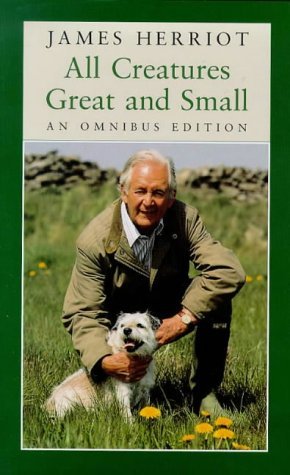
“If you decide to become a veterinary surgeon you will never grow rich but you will have a life of endless interest and variety.”
James Herriot, All Creatures Great and Small
In “All Creatures Great and Small”, we are introduced to a young veterinarian named James Herriot (the pen name of James Alfred Wight) as he tries to take the knowledge and theory of veterinary school and apply it to a practice in rural Yorkshire. The book consists of dozens of accounts of the many learning curves and challenges he must overcome, as well as his many failures and triumphs and the relationships and bonds he forms with people along the way. The stories are sometimes lighthearted and whimsical, while others are heartbreaking and gut-wrenching. Through it all we see a young man grow in wisdom, skill, and confidence as he cares not only for the creatures great and small, but also the people who love them. In this way, “All Creatures Great and Small” is a book that feels deeply pastoral both in the agrarian and Christian sense of the word.
As a pastor, I am saddened to admit that I have occasionally come across those in my profession who struggle to understand the attachment that some people have to their animals. These ministers of the gospel are so concerned for the souls of men and women that they have no time or compassion left for the lesser creatures that share our world. I have heard a minister tell a congregant that they will not pray for sick animals. I have also heard a minister lamenting that the time a church member was devoting to an animal shelter could be better spent in caring for human beings. Vocational ministry is an emotionally taxing profession that often requires ministers to develop a hierarchy of concern in order to avoid compassion fatigue and emotional burnout. It is true that one simply cannot concern themselves with every happening in the world, and if one must choose between caring for a human being or an animal I believe the human being should take priority. I will also state that I have never had to make such a decision, and I do not think many who care for their fellow creature must do so at the expense of caring for their fellow man. In fact, I could argue that those who care for the lesser creatures of the world often learn valuable skills that make them more effective followers of Christ. It is for this reason that I would encourage anyone tasked with caring for the souls of men and women, to read the memoirs of veterinarian James Herriot.
In the memoir we quickly learn, along with the author, that veterinary work in rural Yorkshire involves much more than mere technical knowledge of animal biology and medicine. The actual practice of medicine is much more labor intensive and prone to accidents, mishaps, and unforeseen complications. Sometimes Herriot is injured by uncooperative animals or is forced to exert himself almost to the point of passing out. There are times when he must get up in the middle of the night to tend to a sick animal, or return over and over to tend to the same mysterious ailment. Some of Herriot’s clients are deeply appreciative of his work and demonstrate a sense of generosity and hospitality that feels like a relic of a bygone era. Others are rude, ungrateful, and act as if Herriot’s presence is an inconvenience to them even though they were the ones who sought out his help in the first place. Through all of these experiences and encounters we learn the value of patience, humility, compassion, hard work, community and the simple pleasures of life.
By the end of the memoir Herriot has become what Wendell Berry would call a “placed person”, someone who belongs to both the place and community where he dwells. There is a sense of knowing and being known, of caring and being cared for. James Herriot’s love for all creatures great and small not only makes him a better veterinarian, but also a better neighbor. If Herriot were to move away or pass away in death, his community would lose more than a veterinarian because his contribution is far greater than the mere service of his trade. He understands that his service as a veterinarian is not simply a means of earning a living, but is also a means of loving his neighbors and bringing some intangible and ineffable goodness to the world through his humble acts of service.
The frustrations, pains, and heartaches that James Herriot faces will feel oddly familiar to anyone who has served in a ministry context, but so too will the joys and moments of still and quiet peace. “All Creatures Great and Small” reminds us of the importance of noticing the creatures around us, both human and inhuman, and loving them to the best of our ability. It is a reminder to take the time to do life well, and to receive the world we have been given with a sense of gratitude and reverence. It is also a reminder to leave the world better than when we found it, even if we do so in small and unnoticeable ways. It is a love letter to creatures great and small, and in a sense, to the one who made them all.
 hardincrowder.com