Sermon Audio: LINK
Series Introduction
So far, in our sermon series on Exodus, we recounted the history of the Israelites’ oppression in Egypt and their dramatic liberation led by Moses. Initially, the Israelites suffered harsh slavery under a new Pharaoh who feared their growing numbers and ordered the killing of their newborn boys. Moses was born, saved from death, and raised in Pharaoh’s palace but later fled to Midian after killing an Egyptian. God called Moses from a burning bush to return to Egypt and demand the release of the Israelites. Despite Pharaoh’s repeated refusals and increased oppression, God sent a series of ten devastating plagues, including turning the Nile to blood, infestations, disease, darkness, and finally, the death of the firstborn sons. This final plague led Pharaoh to release the Israelites, who left Egypt hastily, commemorated as the Passover, setting the stage for their journey to the Promised Land. Today, we pick up our account at a crucial moment, when the Israelites have been released from bondage and have been freed to pursue the promised land, but as we shall see, they are not out of the woods yet.
Scripture Reading:
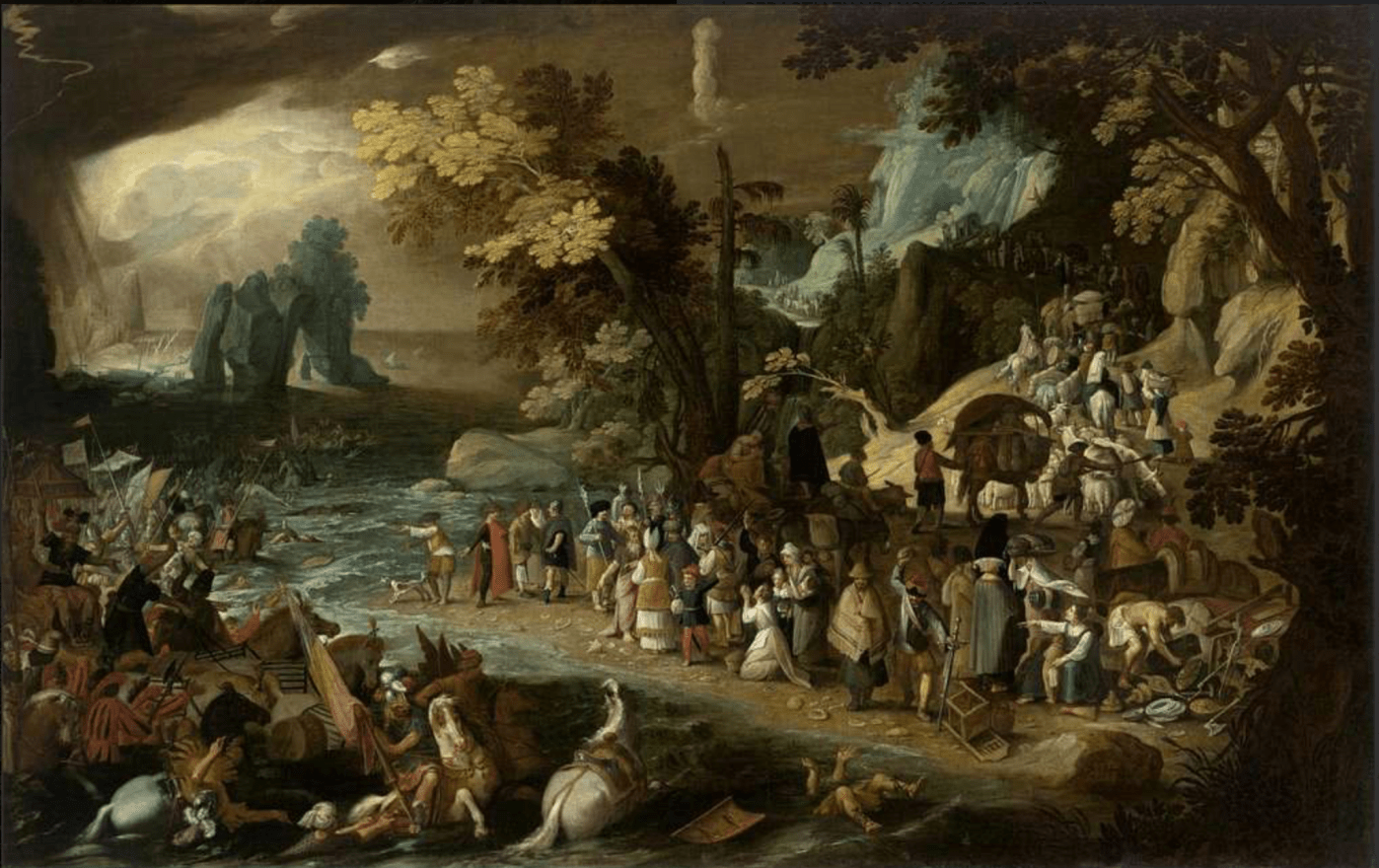
EXODUS 14:5-31 – When the king of Egypt was told that the people had fled, the mind of Pharaoh and his servants was changed toward the people, and they said, “What is this we have done, that we have let Israel go from serving us?” So he made ready his chariot and took his army with him, and took six hundred chosen chariots and all the other chariots of Egypt with officers over all of them. And the Lord hardened the heart of Pharaoh king of Egypt, and he pursued the people of Israel while the people of Israel were going out defiantly. The Egyptians pursued them, all Pharaoh’s horses and chariots and his horsemen and his army, and overtook them encamped at the sea, by Pi-hahiroth, in front of Baal-zephon.
When Pharaoh drew near, the people of Israel lifted up their eyes, and behold, the Egyptians were marching after them, and they feared greatly. And the people of Israel cried out to the Lord. They said to Moses, “Is it because there are no graves in Egypt that you have taken us away to die in the wilderness? What have you done to us in bringing us out of Egypt? Is not this what we said to you in Egypt: ‘Leave us alone that we may serve the Egyptians’? For it would have been better for us to serve the Egyptians than to die in the wilderness.” And Moses said to the people, “Fear not, stand firm, and see the salvation of the Lord, which he will work for you today. For the Egyptians whom you see today, you shall never see again. The Lord will fight for you, and you have only to be silent.”
The Lord said to Moses, “Why do you cry to me? Tell the people of Israel to go forward. Lift up your staff, and stretch out your hand over the sea and divide it, that the people of Israel may go through the sea on dry ground. And I will harden the hearts of the Egyptians so that they shall go in after them, and I will get glory over Pharaoh and all his host, his chariots, and his horsemen. And the Egyptians shall know that I am the Lord, when I have gotten glory over Pharaoh, his chariots, and his horsemen.”
Then the angel of God who was going before the host of Israel moved and went behind them, and the pillar of cloud moved from before them and stood behind them, coming between the host of Egypt and the host of Israel. And there was the cloud and the darkness. And it lit up the night without one coming near the other all night.
Then Moses stretched out his hand over the sea, and the Lord drove the sea back by a strong east wind all night and made the sea dry land, and the waters were divided. And the people of Israel went into the midst of the sea on dry ground, the waters being a wall to them on their right hand and on their left. The Egyptians pursued and went in after them into the midst of the sea, all Pharaoh’s horses, his chariots, and his horsemen. And in the morning watch the Lord in the pillar of fire and of cloud looked down on the Egyptian forces and threw the Egyptian forces into a panic, clogging their chariot wheels so that they drove heavily. And the Egyptians said, “Let us flee from before Israel, for the Lord fights for them against the Egyptians.”
Then the Lord said to Moses, “Stretch out your hand over the sea, that the water may come back upon the Egyptians, upon their chariots, and upon their horsemen.” So Moses stretched out his hand over the sea, and the sea returned to its normal course when the morning appeared. And as the Egyptians fled into it, the Lord threw the Egyptians into the midst of the sea. The waters returned and covered the chariots and the horsemen; of all the host of Pharaoh that had followed them into the sea, not one of them remained. But the people of Israel walked on dry ground through the sea, the waters being a wall to them on their right hand and on their left.
Thus the Lord saved Israel that day from the hand of the Egyptians, and Israel saw the Egyptians dead on the seashore. Israel saw the great power that the Lord used against the Egyptians, so the people feared the Lord, and they believed in the Lord and in his servant Moses.
Opening Prayer:
Heavenly Father, as we gather today to study Your Word, we come with open hearts, ready to learn. Guide our understanding as we explore the significance of this miraculous event and recognize it as a key moment in Your account of deliverance. Help us see how this ancient account foreshadows the ultimate salvation through Jesus Christ. Just as You led the Israelites from slavery to freedom, You lead us from sin to eternal life through Him. May we grasp the importance of this parallel in our own lives. As we reflect on these truths, help us apply them daily. Teach us to trust in Your promises and to move forward in faith, even when the path seems impossible. Fill us with trust in Your power and help us live as people delivered by Your grace. In Jesus’ name, we pray. Amen.
Introduction:
The parting of the Red Sea was a crucial moment for the Israelites, marking their escape from Egyptian bondage and demonstrating God’s supreme power. Just as God parted the sea to save His people from physical slavery, He offers salvation through Jesus to free us from spiritual slavery to sin and death. Both of these salvation moments are symbolized by passing through water. In the Old Testament, Israel passed through the Red Sea, and in the New Testament, the Church enters into new life through Baptism. Both represent a transition from death to life, from bondage to freedom. Even in our fears and uncertainties, God is always working for our deliverance, for His glory, and for our good.
I. God’s Sovereign Plan (Exodus 14:1-9)
Exodus 14:1-3 begins with the Lord directing Moses to change the Israelites’ course, instructing them to camp at a specific location marked by four landmarks: Pi-hahiroth, Baal Zephon, Migdol, and “the sea.” Logistically, this route seemed impractical, as it brought the Israelites closer to the Egyptians and trapped them between Egypt and the Red Sea. Verse 3 explains that Pharaoh certainly would see this as an opportunity to get revenge on the Israelites:
“Pharaoh will say of the people of Israel, ‘They are wandering in the land; the wilderness has shut them in.’” (Exodus 14:3, ESV).
Why would the Lord lead the people back into danger? Verse 4 clarifies God’s purpose:
“I will get glory over Pharaoh and all his host, and the Egyptians shall know that I am the LORD.” (Exodus 14:4, ESV).
God’s actions served to display His power and sovereignty. Pharaoh’s hardened heart had consistently opposed Israel, even after several plagues. God knew that Pharaoh needed to be decisively defeated to prevent future threats against Israel. Thus, He orchestrated these events to reveal His glory and establish His authority.
In our own lives, we may not always understand why God leads us into challenging situations. Just like the Israelites, we might feel trapped or confused by His directions. However, we can trust that His plans are always for His glory and our ultimate good.
This theme continues in the New Testament, where another seemingly perplexing event, the crucifixion of Jesus Christ, reveals God’s glory. In Acts 2, Peter explains that Jesus’ crucifixion was part of God’s definite plan. Just as God used Pharaoh’s hardened heart to demonstrate His power, He used the cross to display His love and justice. Jesus’ death was not a tragic accident but an essential element of God’s redemptive plan. Through the apparent defeat of the crucifixion, God achieved the greatest victory, the resurrection, offering salvation to all who believe.
Both the deliverance at the Red Sea and the crucifixion demonstrate God’s sovereignty and commitment to His glory. The cross, like the parting of the Red Sea, shows that God is in control, even in the darkest moments. Through Jesus’ death and resurrection, God conquered sin and death, providing ultimate deliverance. These events remind us that God’s plans, though sometimes mysterious, are always purposeful and glorious.
As believers, when we face trials, we can remember the Israelites’ deliverance and the victory of the cross. God’s faithfulness in these historical events encourages us to have faith in His perfect plan for our lives. By looking at how God has acted throughout history, we gain confidence in His ability to lead us through our own Red Seas and into His promises for us.
II. The Call to Trust and Obey (Exodus 14:10-15)
Now picture yourself amongst the Israelites, trapped between the Red Sea and Pharaoh’s advancing army. Their fear was overwhelming. They cried out to the Lord, questioning Moses and doubting their deliverance. But Moses, filled with divine confidence, delivered a powerful message from God:
“Fear not, stand firm, and see the salvation of the LORD” (Ex. 14:13, ESV).
These words were meant to shift their focus from their terrifying circumstances to the all-powerful God who had already performed countless miracles on their behalf.
This moment teaches us a critical spiritual truth. Fear focuses on the problem and makes it seem insurmountable. Faith, however, focuses on God and His promises, recognizing that He is greater than any obstacle we face. The Israelites’ fear was understandable, but God called them to rise above it and trust in His power to save.
In the midst of their fear, God issued a surprising command:
“Tell the people of Israel to go forward…” (Ex. 14:15, ESV).
This command underscores the importance of obedient action in response to God’s promises. God had already assured them of His deliverance; now, it was time for them to act on that assurance and move forward, even when the path seemed impossible. Just as the Israelites were called to move forward in faith, we, too, are called to trust and obey God’s commands, even when we are afraid. Obedience often requires stepping out in faith, trusting that God will make a way where there seems to be no way.
This means that when we face daunting challenges or seemingly insurmountable obstacles, instead of allowing fear to paralyze us, we should stand firm in our faith and take the necessary steps forward, confident that God is with us and will guide us through.
III. God’s Mighty Acts of Salvation (Exodus 14:16-31)
Then, in a dramatic display of His power, God commanded Moses to stretch out his hand over the sea. As he did, “the LORD drove the sea back by a strong east wind all night and made the sea dry land, and the waters were divided” (Exodus 14:21, ESV). This miracle was a profound testament to God’s sovereign control over nature and His ability to create a way where there seems to be no way.
As the Egyptians pursued the Israelites into the sea, God looked down from the pillar of fire and cloud, throwing their forces into confusion. Their chariot wheels became clogged, causing panic and leading them to realize that the Lord was fighting against them. Then, as the Israelites safely reached the other side, God instructed Moses to stretch out his hand again, causing the waters to return and engulf the Egyptian army. We read that “the LORD threw the Egyptians into the midst of the sea” (Exodus 14:27, ESV), demonstrating His power to save His people and judge their enemies.
The miracle was not just about defeating the Egyptians; it was also about delivering Israel. “Thus the LORD saved Israel that day from the hand of the Egyptians, and Israel saw the Egyptians dead on the seashore” (Exodus 14:30, ESV). This event underscored God’s unwavering commitment to His people and His power to deliver them from seemingly insurmountable threats. Notice how all of this is the work of the Lord:
- “The LORD drove the sea back” (Exodus 14:21, ESV).
- “The LORD saved Israel that day” (Exodus 14:30, ESV).
The purpose of these mighty acts was twofold: to demonstrate His power and to instill faith in His people. Through this miraculous deliverance, God revealed His unparalleled strength and reassured His people of His protection and provision.
We read that “Israel saw the great power that the LORD used against the Egyptians, so the people feared the LORD, and they believed in the LORD and in his servant Moses” (Exodus 14:31, ESV). The fear mentioned here is a reverent awe, a deep respect for God’s power and holiness. It is a recognition of His supreme authority and a response of trust in His promises. The people’s belief was not just intellectual assent but heartfelt trust in God’s ability to save and lead them.
Likewise, our response to God’s acts of salvation should mirror that of the Israelites. We are called to respond with faithful reverence, recognizing His mighty works in our lives and trusting in His continued guidance and provision. Just as the Israelites were moved to fear and believe, we too, should be moved to worship and trust in our Savior.
Ephesians 2:8 beautifully describes our spiritual deliverance: “For by grace you have been saved through faith. And this is not your own doing; it is the gift of God” (Ephesians 2:8, ESV). Our salvation results from God’s grace and His mighty acts through Jesus Christ. Just as Israel was saved by God’s direct intervention at a time when they were utterly incapable of saving themselves, so too are we saved by His grace through faith in Jesus for His glory. We cannot save ourselves, but the LORD is mighty to save us!
IV. The Foreshadowing of Christ’s Victory
Just as the Israelites passed through the waters of the Red Sea, moving from slavery to freedom, we, too, pass from death to life through Christ. This miraculous crossing represents our own deliverance from the bondage of sin and the start of our new life in Christ.
The salvation of Israel from slavery under Pharaohvividly foreshadows our salvation from our slavery to sin, Satan, and death through Jesus Christ. Pharaoh, representing the forces of evil, is defeated just as sin and death are conquered by Christ’s resurrection. The waters of the Red Sea symbolize the waters of baptism, which mark our death to sin and our resurrection to a new life in Christ.
Paul explains this beautifully in Romans 6:4: “We were buried therefore with him by baptism into death, in order that, just as Christ was raised from the dead by the glory of the Father, we too might walk in newness of life.” Baptism signifies our break from sin and our commitment to live for God, mirroring Israel’s journey from the oppression of Egypt to the freedom of the Promised Land. Just as the crossing of the Red Sea marked the definitive break from Egypt for Israel, Jesus’ death and resurrection mark the definitive break from sin and death for believers. His resurrection guarantees our eternal life and ultimate victory over all spiritual enemies.
In 1 Corinthians, Paul draws a direct line between Israel’s journey and our spiritual journey:
“For I do not want you to be unaware, brothers, that our fathers were all under the cloud, and all passed through the sea, and all were baptized into Moses in the cloud and in the sea.” (1 Corinthians 10:1-2, ESV)
This passage highlights the continuity of God’s plan of salvation from the Old Testament to the New, showing that the events of the Exodus prefigure the salvation we receive through Christ. This powerful imagery underscores the profound change that occurs when we accept Christ as our Savior. We are no longer slaves to sin; we are free to walk in the newness of life that He provides.
This transformation is not just a historical or theological concept; it is a lived reality for believers. Every step we take in faith, every struggle we overcome, and every victory we experience is a testament to God’s ongoing work in our lives. The Red Sea crossing reminds us that no obstacle is too great for God to overcome, and no situation is beyond His power to redeem.
Moreover, just as He parted the Red Sea for the Israelites, He will make a way for us, even when it seems impossible. Our response, like that of the Israelites, should be one of faith and obedience, trusting that God’s plans for us are good and His power is sufficient to bring us through any trial. Let us remember that we serve a God who delivers, a God who transforms, and a God who leads us into a new life of freedom and joy in Christ.
V. The Proper Response: Worship and Praise (Exodus 15:1-21)
After witnessing God’s miraculous deliverance, the Israelites were moved to respond with awe and gratitude. They sang what came to be known as “the Song of Moses,” a beautiful hymn of worship and praise.
Listen to just a few of the lines from this ancient song:
“The LORD is my strength and my song; he has become my salvation. He is my God, and I will praise him, my father’s God, and I will exalt him” (Exodus 15:2, ESV)
“The LORD is a warrior; the LORD is his name” (Exodus 15:3, ESV)
“Your right hand, LORD, was majestic in power. Your right hand, LORD, shattered the enemy” (Exodus 15:6, ESV)
“You will bring them in and plant them on the mountain of your inheritance” (Exodus 15:17, ESV)
We see that the name of the Lord is exalted throughout the Song of Moses, highlighting His authority and majesty. By invoking God’s name, the Israelites affirm their allegiance and reverence for Him. This song emphasizes God’s role as a personal savior and protector, affirming His commitment to His people. It acknowledges God’s power and might, depicting Him as a divine warrior who fights for His people. The song also speaks of God’s ultimate plan to bring His people to His holy dwelling, reflecting His overarching purpose and the future hope He provides for His people.
The Song of Moses is not just an ancient hymn; it is a song for all redeemed believers throughout history. In Revelation 15:2-3, we see “those who had conquered the beast” singing “the song of Moses, the servant of God, and the song of the Lamb.” This connection shows that our worship today is part of a continuous thread of praise that extends from the past into eternity.
“Great and marvelous are your deeds, Lord God Almighty. Just and true are your ways, King of the nations” (Revelation 15:3, ESV).
This eternal perspective invites us to join in a timeless chorus of praise that spans all generations. As we sing our own songs of praise, we participate in a grand tradition of worship that transcends time and space. We are reminded that God’s deeds are indeed great and marvelous, and His ways are just and true. Let us, therefore, with hearts full of gratitude and voices raised in praise, join the eternal song, celebrating our deliverance and exalting our Savior. By doing so, we acknowledge our personal experiences of God’s saving power and contribute to the collective worship of believers across the ages.
Conclusion:
Just as the Israelites were called to trust and obey, recognize God’s mighty acts, and respond with worship and praise, so are we. Let us celebrate our passage from death to life through Jesus Christ and respond with lives marked by faith, obedience, and unending praise. May our worship be filled with rich theology and personal gratitude, echoing the eternal praise that God so rightly deserves. What Red Sea are you facing today? Whatever it may be, remember that the same God who parted the waters for Israel is with you now. He calls you to trust in His promises and to move forward in faith, no matter how impossible the situation seems. Trust in His deliverance, knowing that He is working for your good and His glory.
Closing Prayer:
Heavenly Father, we thank You for Your sovereign plan and for the mighty acts of salvation You have performed throughout history. We are grateful for the ultimate deliverance we have through Jesus Christ. Help us, Lord, to trust in Your promises and to move forward in faith, even when the path ahead seems impossible. Strengthen our hearts to respond with worship and praise, recognizing Your greatness and expressing our gratitude for Your unfailing love. Guide us as we live out our faith, reflecting Your glory in our lives. In Jesus’ name, we pray. Amen.
 hardincrowder.com