Sermon Audio: LINK
Series Introduction:
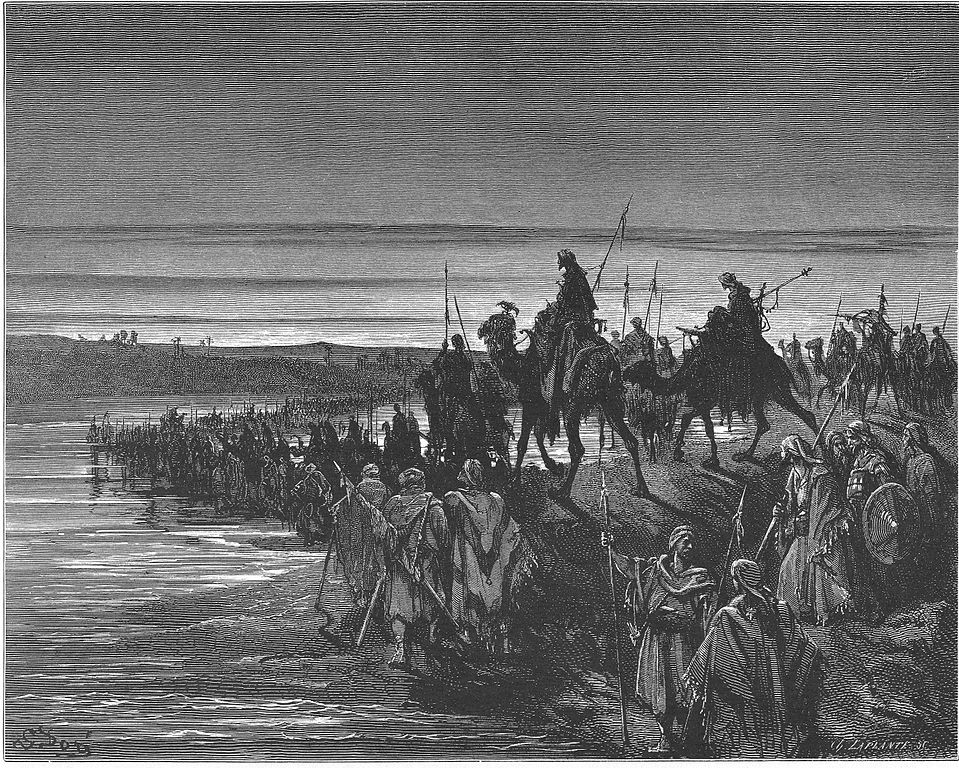
This morning, we find ourselves once more in the company of the Israelites, standing at the very banks of the Jordan River, with the long-awaited, fruitful land of their forefathers finally within sight. The fulfillment of a divine promise made to Abraham generations ago draws near. After enduring centuries of bondage in Egypt, experiencing the wonders of a miraculous exodus, and wandering in the wilderness for forty long years, the realization of that ancient promise is at hand.
Can you fathom the anticipation and overwhelming emotion that must have gripped the hearts of the Israelites at that very moment? As we dive into God’s Word today, I ask you to consider this: What are the “Jordan Rivers” in your life? What promises of God are you earnestly awaiting to see come to pass? Let us examine our hearts and lives, looking to the Lord for the fulfillment of His promises, trusting that His timing is perfect and His faithfulness unfailing.
Scripture Reading:
Joshua 3:14-4:24 (ESV) – So when the people set out from their tents to pass over the Jordan with the priests bearing the ark of the covenant before the people, and as soon as those bearing the ark had come as far as the Jordan, and the feet of the priests bearing the ark were dipped in the brink of the water (now the Jordan overflows all its banks throughout the time of harvest), the waters coming down from above stood and rose up in a heap very far away, at Adam, the city that is beside Zarethan, and those flowing down toward the Sea of the Arabah, the Salt Sea, were completely cut off. And the people passed over opposite Jericho. Now the priests bearing the ark of the covenant of the Lord stood firmly on dry ground in the midst of the Jordan, and all Israel was passing over on dry ground until all the nation finished passing over the Jordan.
When all the nation had finished passing over the Jordan, the Lord said to Joshua,“Take twelve men from the people, from each tribe a man, and command them, saying, ‘Take twelve stones from here out of the midst of the Jordan, from the very place where the priests’ feet stood firmly, and bring them over with you and lay them down in the place where you lodge tonight.’” Then Joshua called the twelve men from the people of Israel, whom he had appointed, a man from each tribe. And Joshua said to them, “Pass on before the ark of the Lord your God into the midst of the Jordan, and take up each of you a stone upon his shoulder, according to the number of the tribes of the people of Israel, that this may be a sign among you. When your children ask in time to come, ‘What do those stones mean to you?’ then you shall tell them that the waters of the Jordan were cut off before the ark of the covenant of the Lord. When it passed over the Jordan, the waters of the Jordan were cut off. So these stones shall be to the people of Israel a memorial forever.”
And the people of Israel did just as Joshua commanded and took up twelve stones out of the midst of the Jordan, according to the number of the tribes of the people of Israel, just as the Lord told Joshua. And they carried them over with them to the place where they lodged and laid them down there. And Joshua set up twelve stones in the midst of the Jordan, in the place where the feet of the priests bearing the ark of the covenant had stood; and they are there to this day. For the priests bearing the ark stood in the midst of the Jordan until everything was finished that the Lord commanded Joshua to tell the people, according to all that Moses had commanded Joshua.
The people passed over in haste. And when all the people had finished passing over, the ark of the Lord and the priests passed over before the people. The sons of Reuben and the sons of Gad and the half-tribe of Manasseh passed over armed before the people of Israel, as Moses had told them. About 40,000 ready for war passed over before the Lord for battle, to the plains of Jericho. On that day the Lord exalted Joshua in the sight of all Israel, and they stood in awe of him just as they had stood in awe of Moses, all the days of his life.
And the Lord said to Joshua, “Command the priests bearing the ark of the testimony to come up out of the Jordan.” So Joshua commanded the priests, “Come up out of the Jordan.” And when the priests bearing the ark of the covenant of the Lord came up from the midst of the Jordan, and the soles of the priests’ feet were lifted up on dry ground, the waters of the Jordan returned to their place and overflowed all its banks, as before.
The people came up out of the Jordan on the tenth day of the first month, and they encamped at Gilgal on the east border of Jericho. And those twelve stones, which they took out of the Jordan, Joshua set up at Gilgal. And he said to the people of Israel, “When your children ask their fathers in times to come, ‘What do these stones mean?’ then you shall let your children know, ‘Israel passed over this Jordan on dry ground.’ For the Lord your God dried up the waters of the Jordan for you until you passed over, as the Lord your God did to the Red Sea, which he dried up for us until we passed over, so that all the peoples of the earth may know that the hand of the Lord is mighty, that you may fear the Lord your God forever.”
Opening Prayer:
Heavenly Father, we gather in Your presence today with hearts filled with gratitude and awe. As we explore Your Word, open our minds and hearts to the lessons You have for us. Help us to see the parallels between the Israelites’ journey and our own walk of faith. Give us the courage to step out in faith, trusting in Your promises even when the path ahead seems uncertain. May Your Word inspire and challenge us to live lives marked by obedience and trust in You. In Jesus’ name, we pray. Amen.
Crossing the Jordan (Joshua 3:14-17):
As the Israelites stood on the brink of the Jordan River after forty long years of wandering through the barren wilderness, they faced a final obstacle. The river before them was no calm stream; it was a raging torrent, swollen to its peak during the harvest season. The people had journeyed so far, but now, at the very edge of the Promised Land, they encountered a final, formidable barrier. Imagine the anxiety that must have filled their hearts. Yet, in this moment of uncertainty, God called them to act in faith.
The priests, bearing the Ark of the Covenant, stepped forward. As their feet touched the brim of the Jordan, something miraculous occurred. The rushing waters, wild and untamed, abruptly ceased their flow, creating a dry path straight across from Jericho. This event undoubtedly reminded the Israelites of the mighty deliverance at the Red Sea, where God parted the waters to lead their ancestors out of Egypt. Now, once again, God parted the waters to lead them into the Promised Land. But notice this: the miracle only happened after the priests stepped into the water. Their act of faith, stepping out before seeing the outcome, is a powerful lesson for us today.
I am reminded of a similar account in Matthew 14:22-33, where turbulent waters surrounded Jesus’s disciples. Rather than standing on the banks of a river, they were on a tiny boat adrift in the sea during a fearsome storm. In the midst of this chaos, Jesus approached them, walking on the water. The disciples were terrified, thinking they were seeing a ghost. But Jesus spoke to them, saying, “Take courage! It is I. Don’t be afraid.”
Peter, filled with a mixture of fear and faith, responded, “Lord, if it’s you, tell me to come to you on the water.”
Jesus simply said, “Come.”
Without knowing how or if he could walk on water, Peter stepped out of the boat. He didn’t wait for the storm to calm or for a clear, safe path to appear. He stepped out in faith, trusting Jesus’ command. As long as Peter kept his eyes on Jesus, he walked on the water. But the moment he focused on the wind and waves, doubt crept in, and he began to sink. Yet, even then, Jesus was there to catch him.
The Israelites crossing the Jordan and Peter’s willingness to leave the safety of the boat and walk toward Jesus, remind us that our faith journey often requires us to take bold, sometimes risky, steps. The outcome is not always immediately visible, but when we focus on Christ and trust in His guidance, He will sustain us, just as He sustained Peter on the water and the Israelites at the Jordan.
In our own lives, God often asks us to step out in faith before we see the way forward. Like Peter on the boat or the Israelites at the Jordan, we are called to step out in faith, trusting that, if we are faithful, God will make a way where there seems to be none.
Just as the Israelites passed through the waters of the Jordan to enter the Promised Land, so too do we pass through our own waters through Baptism. In baptism, we experience a crossing over, moving from death to life, from the old to the new, and from wandering in the desert of sin to the promises of God’s Kingdom. Just as the Israelites crossed the Jordan River, leaving behind their years of wandering and stepping into the fulfillment of God’s promise, so we, through baptism, leave behind the old life of sin and step into the fulfillment of God’s promise of eternal life through Christ Jesus, our Lord.
In this way, baptism is far more than a mere ritual; it is our public declaration of faith, a symbolic burial of our old, sinful self, and a glorious resurrection into new life through Jesus Christ. As the Apostle Paul so eloquently writes in Romans 6:4, “We were therefore buried with him through baptism into death in order that, just as Christ was raised from the dead through the glory of the Father, we too may live a new life.”
Remember that the God who brought the Israelites to their promised inheritance is the same God who leads us through life’s trials and into His eternal glory. May our hearts be ever anchored in the hope of heaven, knowing that through Christ, we have crossed over from death into life, from darkness into His marvelous light.
The Enduring Witness of Faith (Joshua 4:1-9)
Now, as we journey from Joshua 3 into Joshua 4, the account comes to a pause, offering the Israelites a moment to remember and memorialize God’s unmatched power and unfailing faithfulness. Having just witnessed the parting of the Jordan, the Israelites now stand in the midst of the dry riverbed, and Joshua commands twelve men, one from each of the twelve tribes, to lift stones from the riverbed. These stones are not just any stones; they are to serve as a lasting memorial, a tangible reminder of God’s mighty act of deliverance.
These twelve stones were to be a sign for future generations. Joshua instructs the Israelites to explain the significance of these stones to their children when they ask, “What do these stones mean?” The answer would be a story of how God parted the waters of the Jordan, a story of His faithfulness and power. This act of remembrance was not just about looking back but was a deliberate effort to ensure that the story of God’s faithfulness would be passed down through the generations.
In our own lives, we too are called to create “stones of remembrance.” Just as the Israelites were instructed to memorialize God’s faithfulness, we should actively seek to recall and share the stories of God’s work in our lives. Imagine if each family committed to creating their own memorials, whether through written accounts, shared stories during family gatherings, or simple reminders placed in our homes. These acts of remembrance would serve as powerful testimonies, not only for our own encouragement but also for the benefit of our children and future generations.
In Deuteronomy 6:6-7, Moses emphasizes the importance of this practice, commanding the Israelites to diligently teach their children about the laws and deeds of God: “These words that I command you today shall be on your heart. You shall teach them diligently to your children, and shall talk of them when you sit in your house, and when you walk by the way, and when you lie down, and when you rise.” This passage underscores the critical importance of continual teaching and remembrance. By weaving the stories of God’s faithfulness into the fabric of our daily lives, we keep His presence ever before us, guiding our thoughts, words, and actions.
Imagine the impact of such a practice. Our faith would no longer be a private matter but a shared legacy, a powerful testament to the world that God is indeed alive and active among us. When we share these stories with others, especially with our children, we build up their faith, creating a ripple effect that extends far beyond our immediate circle. Our testimonies become sources of hope and inspiration, reminding us all that the same God who parted the Jordan River is still at work in our lives today.
As we reflect on the enduring witness of faith, let us commit to keeping the memory of God’s works alive, not only in our own hearts but also in the hearts of our children and future generations. Just as the Israelites set up stones of remembrance, let us be intentional about sharing our own stories of God’s faithfulness, ensuring that His deeds are remembered and celebrated for generations to come.
Standing on the Promises of God
As the Israelites stood on the far side of the Jordan, the Lord commanded Joshua to instruct the priests carrying the Ark of the Covenant to come up out of the river. The priests obeyed, and as soon as their feet touched the dry ground, the waters of the Jordan, held back by the mighty hand of God, rushed back to their flood stage. This was no natural occurrence; it was a powerful reminder of God’s divine intervention and a testament to His faithfulness.
God’s Word declares: “And when the priests bearing the ark of the covenant of the Lord came up from the midst of the Jordan, and the soles of the priests’ feet were lifted up on dry ground, the waters of the Jordan returned to their place and overflowed all its banks, as before” (Joshua 4:18, ESV).
This miraculous event was not just a display of God’s power, but also a confirmation of His promises. It was a sign that the God who had led them out of Egypt, through the Red Sea, and sustained them in the wilderness, was the same God who would now lead them into the Promised Land. The Israelites had waited for this moment for generations, holding onto the promise given to their ancestor Abraham: “To your offspring I give this land” (Genesis 15:18, ESV).
For the Israelites, this moment marked the culmination of years of wandering, a fulfillment of the long-awaited promise that had sustained them through the wilderness. It was a time of great celebration, reverence, and deep spiritual reflection. As recorded in Scripture, Joshua set up twelve stones as a memorial at Gilgal, saying to the people, “When your children ask their fathers in times to come, ‘What do these stones mean?’ then you shall let your children know, ‘Israel passed over this Jordan on dry ground.’ For the Lord your God dried up the waters of the Jordan for you until you passed over, as the Lord your God did to the Red Sea, which he dried up for us until we passed over” (Joshua 4:21-23, ESV).
Families, who had dreamed of this day for generations sang songs of worship, their voices rising in unison to praise the God who had brought them to this place. The Psalmist echoes their sentiments, “The Lord has done great things for us; we are glad” (Psalm 126:3, ESV). Children, who had only heard tales of the Promised Land, now played on its soil, their laughter mingling with the songs of praise, creating a symphony of joy and thanksgiving.
This was a sacred moment, marking not just the end of a journey but the beginning of a new chapter in Israel’s history, a chapter written by the hand of a faithful God who keeps His promises. As the writer of Hebrews reminds us, “Let us hold fast the confession of our hope without wavering, for he who promised is faithful” (Hebrews 10:23, ESV).
In this story, we see the fulfillment of God’s promises as a source of hope and strength. Just as the Israelites stood on the brink of the Promised Land, standing on the promises of God means trusting in His word, even when the journey is long and the obstacles seem insurmountable. God is faithful to fulfill His promises, and His timing is always perfect.
Conclusion:
As we draw to this message to a conclusion, I want to remind you that the story of the Israelites crossing the Jordan is not just a historical event; it’s a powerful illustration of God’s faithfulness and a call to us today. Just as the Israelites stood on the brink of the Promised Land, facing the raging waters of the Jordan, we, too, find ourselves standing on the brink of various challenges and uncertainties. But the message is clear: God is with us, calling us to step out in faith.
The crossing of the Jordan was not just about entering a new land; it was about trusting God to do the impossible. The waters didn’t part until the priests’ feet touched the river, and it’s the same with us. God often asks us to step out in faith before we see how He will provide or make a way. Perhaps today, God is calling you to take that step of faith.
But this step of faith isn’t just about facing life’s challenges; it’s about responding to the greatest invitation of all, the invitation to follow Jesus Christ. Just as God led the Israelites into the Promised Land, He is leading you into a new life through His Son, Jesus Christ. The journey of faith begins with a simple step, acknowledging your need for Him, trusting in His sacrifice on the cross, and following Him as your Savior and Lord.
Today, I invite you to respond to this call. If you’ve never placed your faith in Christ, today is the day to step out of the boat, to trust in Him, and to begin your journey with Jesus. The waters of baptism, which we mentioned earlier, are a symbol of this very decision, dying to your old self and rising to new life in Christ.
If you’re already a follower of Christ, perhaps God is calling you to trust Him more deeply, to step out in faith in a specific area of your life where the way forward seems uncertain. Remember, just as God was faithful to the Israelites, He will be faithful to every promise in His Word.
As we close, I invite you to take a moment in prayer. If you feel God prompting you to take that step of faith, whether it’s to trust Christ for the first time or to surrender a specific area of your life to Him, don’t hesitate. The same God who parted the Jordan and walked on the water is here with you today, ready to lead you into the abundant life He has promised.
Let us pray together, trusting in the God who is always faithful.
Closing Prayer
Gracious God, we thank You for the powerful reminders from the story of Joshua and the crossing of the Jordan River. As we leave this place, may the lessons of faith and obedience stay with us. Help us to step out boldly, trusting in Your provision and guidance. Let our lives be a testament to Your faithfulness and power. May we, like the Israelites, create lasting memorials of Your works in our lives, passing down these stories of faith to future generations. Fill us with Your Spirit as we go forth, living out our faith with courage and conviction. In Jesus’ name, we pray. Amen.
 hardincrowder.com