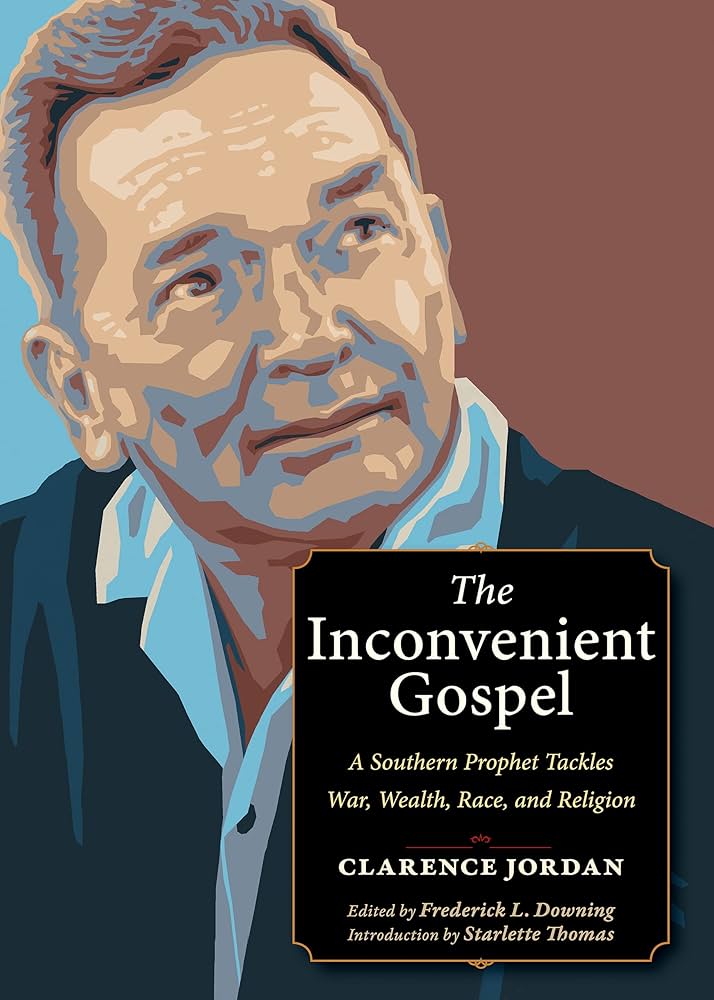
The Inconvenient Gospel is a stirring collection of Clarence Jordan’s most powerful writings, capturing the essence of a life lived boldly in pursuit of justice, unity, and love. As a Southern Baptist minister, theologian, and farmer, Jordan was not content with preaching from the pulpit; he chose to live out his faith by challenging the norms of segregation and economic inequality in the Deep South. This book reflects his enduring message: that true faith is not a passive belief but a call to action, urging believers to confront injustice and embody the radical love of Christ in every aspect of their lives.
Clarence Jordan’s early life in Talbotton, Georgia, gave him a firsthand view of the brutal realities of segregation and economic inequality. Unlike many of his peers, Jordan refused to accept these conditions. Instead, his experiences inspired empathy and a drive for justice, leading him to study both agriculture and theology. He envisioned a world where faith was not confined to Sunday sermons but was a lived practice that challenged societal norms.
In 1942, he founded Koinonia Farm, an interracial, pacifist community near Americus, Georgia, that embodied the values of the early Christian church; love, sharing, and unity. This bold experiment in radical discipleship directly opposed the deeply entrenched systems of segregation and racism, making it a revolutionary act in its time. Jordan’s influential writings, including the beloved “Cotton Patch” translations of the New Testament, brought the teachings of Jesus to life for everyday people, placing them within the familiar context of the American South. Through his work, Clarence Jordan made it clear that the Gospel was not just a doctrine to be preached but a lifestyle demanding justice, peace, and radical love.
At the heart of The Inconvenient Gospel is a powerful theme of love that is active, sacrificial, and enduring. Jordan consistently argued that true faith is not just a collection of passive beliefs but a call to righteous action. Whether addressing the evils of racism, poverty, or war, Jordan’s voice is clear, bold, and uncompromising: Christians cannot be mere spectators; they must be dynamic agents of justice. His essays, sermons, and reflections do not seek to offer comfort but to provoke and challenge, urging believers to see that issues like racial inequality and economic injustice are not distant concerns but immediate, urgent calls for Gospel-centered engagement.
One memorable passage reimagines the parable of the Good Samaritan. Jordan did not merely celebrate the Samaritan’s act of kindness; he highlighted the systemic issues that lead to suffering and division. He called on Christians not only to help those who are wounded but to confront and dismantle the structures that cause such harm in the first place. This reimagining of the Gospel compels readers to see beyond individual acts of charity to the deeper need for justice, reconciliation, and active love.
Despite the weighty topics he addressed, Jordan had an extraordinary gift for making deep truths accessible. He avoided complex theological jargon, opting instead for storytelling, humor, and the simple yet powerful wisdom of a man who lived closely with his Lord. His “Cotton Patch” translations of the New Testament, which reimagined Scripture in the familiar language and context of the American South, are a testament to his desire to make the Bible resonate with everyday people. Through these creative translations, Jordan showed that the Gospel was not just a relic of ancient times but a vibrant, living truth that speaks to every era and every community.
The enduring relevance of The Inconvenient Gospel is a testament to the prophetic nature of Jordan’s ministry. Although he wrote over half a century ago, the issues he confronted (racial injustice, economic disparity, and the ethical dilemmas of war) remain deeply pertinent today. Jordan’s writings do not merely offer commentary; they pose a challenge: “How will the followers of Christ respond?” His insistence on a “raceless Gospel,” which breaks down societal barriers and unites all under the love of Christ, is a message that is just as crucial now, urging believers to transcend division and embrace unity through faith.
Jordan’s legacy is perhaps best exemplified by the enduring impact of Koinonia Farm. What began as a local experiment in living out the principles of community, sharing, and love went on to inspire Habitat for Humanity, a global organization dedicated to building homes for those in need. This connection underscores that Jordan’s ideals were not abstract musings but seeds that bore fruit, continuing to grow and impact lives long after his passing.
Ultimately, The Inconvenient Gospel is not a book to be casually read and forgotten; it is a trumpet blast, urging readers to step out of complacency and engage in the work of service. Clarence Jordan’s writings confront believers with the cost of true discipleship, prompting them to face the challenging truths of Jesus’ teachings and to let those truths transform their hearts, lives, and society.
If you’re ready to be challenged, inspired, and moved to action, The Inconvenient Gospel is essential reading. Whether you’re deeply religious or simply seeking inspiration, Jordan’s call to action resonates today as much as it did decades ago. His voice calls out across the decades, inviting us all to live with courage, love, and a commitment to justice that can transform the world.
 hardincrowder.com