Sermon Audio: LINK
Opening:
The account of Samson, begins with the promise of a man set apart by God from birth as a Nazirite, consecrated for holiness and service. Empowered by the Spirit of the Lord, Samson was granted extraordinary physical strength to deliver Israel from its enemies. However, in Judges 16, we witness the tragic consequences of Samson’s moral and spiritual compromises. Though strong in body, Samson was weak in spirit, repeatedly yielding to temptation and forsaking his Nazirite vow. Samson’s life is a powerful lesson for us today: great gifts from God can be squandered through compromise. His downfall reminds us that strength without holiness leads to destruction, and yet his final act of faith shows that God’s grace can restore even those who have faltered.
Scripture Reading:
Let us read from God’s Word:
Judges 13:1-7 ESV
13 And the people of Israel again did what was evil in the sight of the Lord, so the Lord gave them into the hand of the Philistines for forty years.
2 There was a certain man of Zorah, of the tribe of the Danites, whose name was Manoah. And his wife was barren and had no children. 3 And the angel of the Lord appeared to the woman and said to her, “Behold, you are barren and have not borne children, but you shall conceive and bear a son. 4 Therefore be careful and drink no wine or strong drink, and eat nothing unclean, 5 for behold, you shall conceive and bear a son. No razor shall come upon his head, for the child shall be a Nazirite to God from the womb, and he shall begin to save Israel from the hand of the Philistines.” 6 Then the woman came and told her husband, “A man of God came to me, and his appearance was like the appearance of the angel of God, very awesome. I did not ask him where he was from, and he did not tell me his name, 7 but he said to me, ‘Behold, you shall conceive and bear a son. So then drink no wine or strong drink, and eat nothing unclean, for the child shall be a Nazirite to God from the womb to the day of his death.’”
Judges 16:15-30 ESV
15 And she said to him, “How can you say, ‘I love you,’ when your heart is not with me? You have mocked me these three times, and you have not told me where your great strength lies.” 16 And when she pressed him hard with her words day after day, and urged him, his soul was vexed to death. 17 And he told her all his heart, and said to her, “A razor has never come upon my head, for I have been a Nazirite to God from my mother’s womb. If my head is shaved, then my strength will leave me, and I shall become weak and be like any other man.”
18 When Delilah saw that he had told her all his heart, she sent and called the lords of the Philistines, saying, “Come up again, for he has told me all his heart.” Then the lords of the Philistines came up to her and brought the money in their hands. 19 She made him sleep on her knees. And she called a man and had him shave off the seven locks of his head. Then she began to torment him, and his strength left him. 20 And she said, “The Philistines are upon you, Samson!” And he awoke from his sleep and said, “I will go out as at other times and shake myself free.” But he did not know that the Lord had left him. 21 And the Philistines seized him and gouged out his eyes and brought him down to Gaza and bound him with bronze shackles. And he ground at the mill in the prison. 22 But the hair of his head began to grow again after it had been shaved.
23 Now the lords of the Philistines gathered to offer a great sacrifice to Dagon their god and to rejoice, and they said, “Our god has given Samson our enemy into our hand.” 24 And when the people saw him, they praised their god. For they said, “Our god has given our enemy into our hand, the ravager of our country, who has killed many of us.” 25 And when their hearts were merry, they said, “Call Samson, that he may entertain us.” So they called Samson out of the prison, and he entertained them. They made him stand between the pillars. 26 And Samson said to the young man who held him by the hand, “Let me feel the pillars on which the house rests, that I may lean against them.” 27 Now the house was full of men and women. All the lords of the Philistines were there, and on the roof there were about 3,000 men and women, who looked on while Samson entertained.
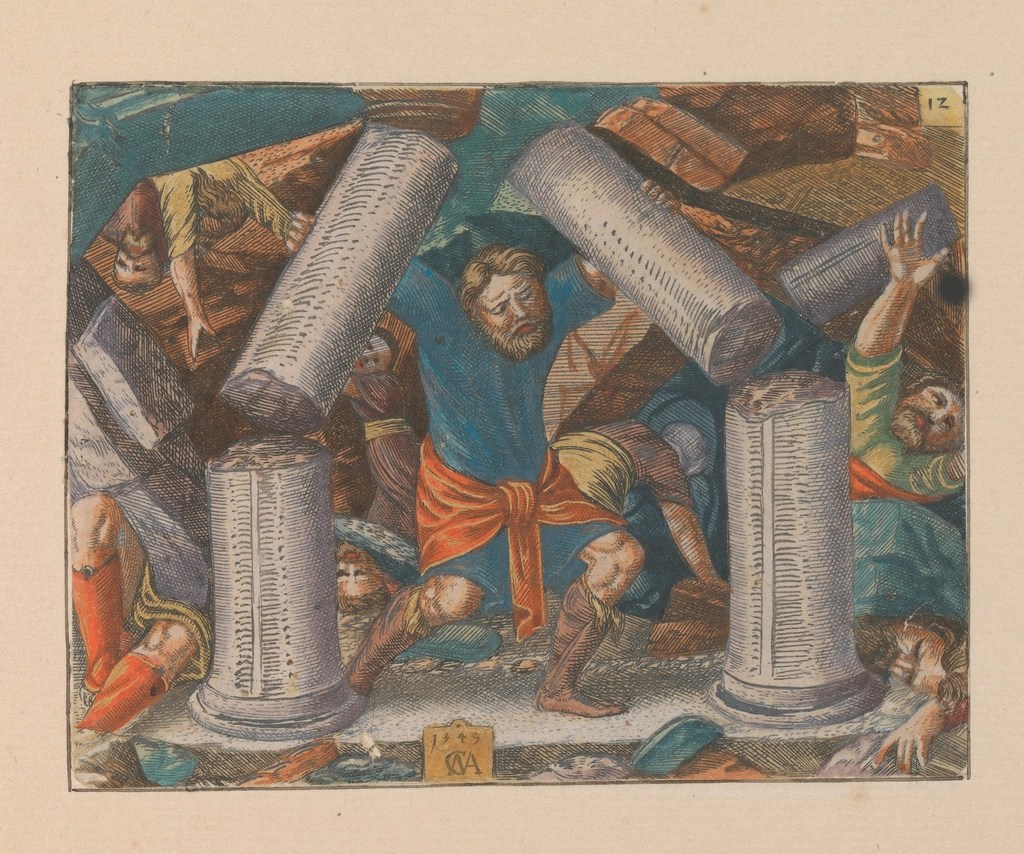
28 Then Samson called to the Lord and said, “O Lord God, please remember me and please strengthen me only this once, O God, that I may be avenged on the Philistines for my two eyes.” 29 And Samson grasped the two middle pillars on which the house rested, and he leaned his weight against them, his right hand on the one and his left hand on the other. 30 And Samson said, “Let me die with the Philistines.” Then he bowed with all his strength, and the house fell upon the lords and upon all the people who were in it. So the dead whom he killed at his death were more than those whom he had killed during his life.
Opening Prayer:
Heavenly Father, we come before You today with hearts eager to learn from Your Word. We acknowledge that You are the sovereign God, full of grace and truth, and we thank You for the opportunity to gather in Your presence. As we reflect on the account of Samson, we ask for the guidance of Your Holy Spirit. Open our hearts and minds to understand the lessons You have for us about strength, weakness, and the power of Your grace. Help us to see ourselves honestly, to confront the areas where we have compromised, and to draw closer to You. May the truths we hear today lead us to a deeper repentance, greater reliance on Your strength, and a renewed commitment to live lives set apart for Your glory. We pray this in the mighty name of Jesus, our Redeemer and Deliverer. Amen.
Introduction
Imagine a mighty warrior endowed with supernatural strength, a hero who could tear apart a lion with his bare hands and defeat a thousand men with a simple jawbone. Yet, despite all this power, he was deeply flawed and vulnerable. Such is the account of Samson, a man set apart by God to deliver Israel, yet entangled in sin and compromise. Today, as we examine his life, we will see that Samson’s life is not just a tale of great strength followed by great failure; it is a profound demonstration of God’s sovereignty, working even through imperfect vessels.
I. Samson’s Miraculous Beginning (Judges 13)
The accont of Samson takes place during a dark and troubled time in Israel’s history, a period marked by spiritual decline and oppression. Once again, the Israelites had turned away from God, and as a result, they fell under the control of the Philistines for forty years (Judges 13:1). But unlike other times in the Book of Judges, there is no mention of Israel crying out to God for help. They had grown used to their situation, accepting their bondage as normal. Yet, even without their prayers, God was at work.
This is the essence of grace, an unearned favor that reaches out to us even when we don’t see our own need. God’s plan for rescue didn’t begin because Israel asked for it; it began because of His steadfast commitment to His promises. This reflects the message of the gospel: “While we were still sinners, Christ died for us” (Romans 5:8). In our deepest rebellion, when we were lost and helpless, God took the first step. He didn’t wait for us to deserve His love; instead, He sent His Son to seek and save those who were lost.
In the midst of Israel’s spiritual drift, God sent a message of hope. An angel appeared to a barren woman, telling her that she would have a son who would “begin to save Israel from the hand of the Philistines” (Judges 13:5). This was more than a promise of a child; it was a sign of God’s intervention. He chose to work through the weak, the barren, and the overlooked to show His power.
Just as God chose Samson to be Israel’s deliverer, He would later choose another miraculous child, born of a virgin in Bethlehem, to be the Savior of the world. Even before Samson was conceived, God had already planned his role. Similarly, God planned our redemption through Christ long before we took our first breath.
Maybe today you feel unworthy, burdened by past mistakes, or distant from God. But here’s the truth: God’s grace isn’t for the deserving; it’s for those who need it most; the broken, the lost, and the helpless. This truth should humble us and draw us to worship. Grace is not something we earn; it’s freely given, not because of who we are, but because of who God is.
From the beginning, Samson was set apart for God’s purposes. The angel said he would be a Nazarite from birth, a calling that required him to avoid wine, steer clear of the dead, and not cut his hair (Judges 13:5; Numbers 6:1-5). This wasn’t just a cultural practice; it was a visible sign of his dedication to God. Samson’s long hair wasn’t the source of his strength, but a symbol of his commitment to God. In the same way, our acts of faith (prayer, worship, and obedience) are not the foundation of our salvation but the results of our dedication to Christ.
The call to be set apart isn’t just for ancient Nazarites; it’s for every believer. “As He who called you is holy, you also be holy in all your conduct” (1 Peter 1:15). Holiness isn’t an extra; it’s our calling. Samson was meant to be a sign of God’s power, a vessel dedicated to His purposes. But as his life unfolds, we see how he failed to guard his calling, a warning for all of us.
Are we living in a way that reflects our calling? Are there parts of our lives where we’ve compromised, where the world’s influence has weakened our faith? Samson’s life shows us that holiness is not optional. Playing with sin can drain our spiritual strength and endanger our purpose. Let us take God’s commands seriously, and by His grace, strive to live lives that honor Him.
II. Samson’s Strength and Stumbles (Judges 14-15)
As Samson grew into manhood, his feats of strength were nothing short of miraculous. He tore a lion apart with his bare hands (Judges 14:6), snapped ropes that sought to bind him, and single-handedly struck down a thousand Philistines using nothing but the jawbone of a donkey (Judges 15:14-15). Each of these remarkable acts was possible because “the Spirit of the Lord rushed upon him” (Judges 14:19). His strength was not of his own making; it was a divine gift, granted for a sacred purpose: to begin the liberation of Israel from their Philistine oppressors.
Yet, Samson often misused this gift. Instead of channeling his strength for God’s mission, he frequently acted out of personal motives, seeking revenge, settling scores, and indulging his pride. This gap between his divine calling and personal actions reveals a deeper issue: a failure to see that his strength was meant to bring glory to God, not to serve his own desires.
Samson’s life was marked by a recurring theme of self-will. Though set apart by God from birth, he chose to live by what seemed right in his own eyes (Judges 14:3). He pursued a Philistine woman for marriage, defying God’s clear command against intermarrying with pagan nations (Deuteronomy 7:3-4). His disregard for God’s instructions was evident again when he touched the carcass of a lion, violating his Nazirite vow (Judges 14:8-9; Numbers 6:6). Time and again, his choices showed a heart driven by personal desires rather than obedience to God’s Word.
When we live by our own impulses rather than God’s truth, we walk a dangerous path that leads to ruin. Sin is deceptive, promising immediate satisfaction but delivering long-term pain. Samson’s pursuit of forbidden relationships, indulgent acts, and vengeful actions were all rooted in the same issue: a refusal to submit to God’s authority. In contrast, Jesus, the true Deliverer, exemplified perfect obedience. Where Samson failed, Christ succeeded. He resisted the lure of self-will, choosing to follow the Father’s will even when it led to the agony of the cross (Matthew 26:39). Through His example, we find the strength to resist our own sinful desires.
Despite Samson’s flawed actions, God’s sovereign plan continued to unfold. Judges 14:4 tells us that Samson’s desire to marry a Philistine woman “was from the Lord, for He was seeking an opportunity against the Philistines.” This doesn’t mean God approved of Samson’s actions, but it shows that He could use even Samson’s wrong choices to advance His purpose of deliverance. We see this again when Samson, in a fit of rage, set fire to the Philistines’ crops by tying torches to the tails of 300 foxes (Judges 15:4-5), escalating the conflict.
The fact that God can use our failures for His glory should fill us with gratitude, but it must not lead us to take sin lightly. Samson’s sins had real consequences. Though God’s purposes were achieved, Samson paid a heavy price for his reckless self-will. This is a sobering reminder that sin always carries painful effects. God’s sovereignty should inspire greater trust, not complacency. He is merciful and can redeem our mistakes, but we should never take His grace for granted.
The ultimate example of God’s sovereignty over sin is found at the cross. Human sin led to Jesus’s crucifixion, but through that very act, salvation was accomplished (Acts 2:23). What people intended for evil, God used for the greatest good, the redemption of His people. This truth reassures us that even when we falter, God’s plan remains unshaken, turning what was meant for harm into the hope of salvation.
III. The Triumph of God’s Grace in Our Weakness (Judges 16)
The final chapter of Samson’s life begins with a tragic entanglement: his relationship with Delilah. Despite having narrowly escaped the traps of the Philistines in the past, Samson continued to play dangerously close to sin. Delilah, bribed by the Philistine leaders, persistently pressured him to reveal the secret of his strength. Each time, Samson dodged her questions, playing a risky game of deceit, but with each evasion, he grew more careless. Eventually, his disregard for his Nazirite vow led him to reveal the truth: his strength lay in his uncut hair, a symbol of his dedication to God (Judges 16:17).
Sin, like Delilah, is persistent and deceptive. It entices us, making us believe that we can handle it, that we can flirt with danger and still remain unscathed. But this is a lie. Just as Samson’s dalliance with Delilah led to his capture, our flirtation with sin can lead to spiritual bondage. Sin makes us careless, dulls our spiritual senses, and blinds us to the dangers around us. Let Samson’s downfall serve as a warning: do not toy with temptation. As God’s Word declares, “Therefore let anyone who thinks that he stands take heed lest he fall” (1 Corinthians 10:12). We must flee from sin and cling to Christ, who alone can keep us from stumbling.
One of the most sobering verses in Samson’s account is found in Judges 16:20: “He did not know that the Lord had left him.” After finally revealing the secret of his strength, Samson fell asleep on Delilah’s lap, and she had his hair cut while he slept. When he awoke, he thought he could shake off his captors as he had so many times before, but this time was different. The Spirit of the Lord had departed from him, leaving him powerless. Samson’s strength was never his own; it was a gift from God’s Spirit. When he violated the terms of his Nazirite vow, the outward symbol of his dedication to God, he lost that strength.
Without Christ, we are powerless against sin. Our strength does not come from within ourselves but from the abiding presence of God’s Spirit. Samson’s presumption is a warning to us all: we must not take God’s presence for granted. We cannot assume that just because God has used us in the past, we can live carelessly in the present. Jesus said, “Apart from Me, you can do nothing” (John 15:5). If we live disconnected from Him, relying on our own strength, we will find ourselves weak and defeated. We must remain in Christ, for He is the true vine, and we are the branches. Only by staying connected to Him can we bear fruit and stand firm against temptation.
Bound, blinded, and humiliated, Samson was led to the grinding mill in Gaza, reduced to a spectacle for the Philistines. His physical blindness mirrored the spiritual blindness that had marked his life. Yet, in his darkest moment, a glimmer of hope remained. As he stood in the Philistine temple, mocked and jeered, Samson called upon the Lord once more: “O Lord God, please remember me and strengthen me only this once, O God” (Judges 16:28). It was a simple yet profound prayer of repentance, a cry for grace amid weakness. Though he had lost everything (his strength, his sight, his freedom) he had not lost the ear of God. In response to his plea, God granted him the strength to push down the pillars of the temple, bringing the structure down and killing more Philistines in his death than he had during his life (Judges 16:30).
Samson’s greatest victory came not through his own power but through his weakness. In that moment of complete dependence on God, when he could do nothing but cry out for mercy, God’s strength was made perfect. This points us to the heart of the gospel. Our Lord Jesus Christ, the true and better Samson, achieved victory over sin and death not through displays of earthly strength but through apparent weakness, by humbling Himself, becoming obedient to death, even death on a cross (Philippians 2:8). Through His sacrificial death, Christ conquered the powers of darkness and delivered us from our spiritual enemies. Samson’s final act foreshadows the greater redemption accomplished by Christ, where the enemy was defeated and salvation was secured for all who believe.
In our darkest moments, when sin has humbled us and we feel the weight of our failures, there is still hope. Samson’s life shows that even when we have failed, God’s grace is enough. We can call upon the Lord, and He is merciful to forgive, restore, and strengthen. Paul’s words in 2 Corinthians 12:9 ring true: “My grace is sufficient for you, for my power is made perfect in weakness.” We don’t need to be perfect for God to use us; we need to be dependent. When we are weak, then we are strong, for it is in our weakness that God’s power shines brightest.
Conclusion
Samson’s life was a striking paradox of great strength and even greater weakness, moments of triumph followed by deep failure. His life serves as a cautionary tale, warning us of the dangers of self-will, compromise, and spiritual blindness. Yet, it also beautifully illustrates God’s sovereign grace, a grace that can work through flawed and broken vessels to fulfill His purposes. Samson’s strength was a divine gift, yet his repeated compromises led to his downfall. Even so, in his darkest moments, there was still a glimmer of hope, a hope that pointed beyond himself to the ultimate Deliverer, Jesus Christ.
Where Samson exhibited physical power but struggled with spiritual frailty, Christ was unwaveringly strong in every way. Samson’s disobedience resulted in defeat, but Christ’s perfect obedience brought victory. Samson’s journey, though marred by failure, ultimately directs our gaze to the One who is always faithful, the One who redeems our weaknesses and can even turn our failures into instruments of His glory. Therefore, let us take heed from Samson’s life, drawing closer to God’s Spirit, and placing our hope entirely in Christ, who is both the author and the perfecter of our faith.
Take a moment to examine your own life. Are there areas where you have compromised, leaning on your own strength instead of God’s? If so, turn to Him in repentance and ask for the strength to walk in holiness. You might feel trapped, bound, or blinded by sin, but remember that Christ came to set the captives free. Come to Him with your burdens, and He will deliver you, restoring your strength and guiding you into the fullness of His grace.
Closing Prayer:
Gracious Lord, we thank You for the message of hope and redemption found in Samson’s life, and even more so, in the gospel of Christ. We are reminded that, though we are weak and flawed, Your grace is sufficient, and Your power is made perfect in our weakness. Lord, help us to heed the warnings from Samson’s life, to flee from sin, and to live in humble dependence on You. If there are areas in our hearts that have strayed, we ask for Your forgiveness and strength to turn back to You. May we be vessels for Your purposes, guided by Your Spirit, and rooted in the saving grace of Jesus. As we leave this place, fill us with Your peace, sustain us with Your strength, and lead us to walk in the fullness of Your grace. In Jesus’ name, we pray. Amen.
Daily Devotionals:
In Sunday’s message, we explored the life of Samson, a man gifted with incredible strength by God but plagued by weakness and compromise. Samson’s story, set in a time of Israel’s spiritual decline, shows us that God’s grace is not dependent on our worthiness. Even when Israel didn’t cry out for deliverance, God was at work, initiating a plan of rescue, much like how He sent Jesus to save us while we were still sinners. Samson’s strength was a divine gift meant to fulfill God’s purposes, but his self-will and repeated compromises led to his downfall, serving as a warning about the dangers of living by our desires instead of God’s will. Despite his failures, Samson’s final act of calling on God in weakness reminds us that God’s grace is sufficient, and His power is made perfect in our weakness. Ultimately, Samson’s life directs us to Christ, the true and perfect Deliverer, whose obedience brought victory over sin and death.
Monday: “God’s Grace in Unexpected Places”
Scripture Reading: Judges 13:1-5
Devotional: The story of Samson begins in a dark time for Israel, a period when the people had turned away from God and were under Philistine oppression. Unlike previous occasions, they did not cry out for deliverance; they had grown accustomed to their bondage. Yet, God was not content to leave them in their despair. In His grace, He initiated a plan of rescue. An angel appeared to a barren woman, promising the birth of a son who would begin to save Israel. This miraculous announcement was a powerful reminder of God’s sovereign grace, acting even when His people did not ask for it.
God’s grace often reaches us in unexpected ways and during unexpected times. Just as He initiated a plan of rescue for Israel through Samson, He initiated a greater plan for humanity through Jesus Christ. Romans 5:8 tells us, “While we were still sinners, Christ died for us.” Even when we are lost in our own failures, God reaches out in love and makes a way for redemption. Samson’s birth was a sign that God was still at work, and so is the birth of Jesus, a sign that God’s grace meets us at our lowest points.
Today, reflect on the moments in your life when God’s grace showed up unexpectedly. Perhaps it was during a difficult season, or when you felt unworthy. Let these moments remind you that God’s love does not depend on our actions, but on His steadfast character. He reaches out to us not because of who we are, but because of who He is. This is the essence of grace; undeserved, unearned, and freely given.
Reflection Questions:
- Can you recall a time when God’s grace appeared in an unexpected way in your life?
- How does knowing that God initiates grace even when we do not ask for it affect your understanding of His love?
- In what ways can you demonstrate God’s grace to others around you today?
Prayer:
Heavenly Father, thank You for Your grace that reaches out to us even when we do not see our need. Help us to recognize Your love and mercy in our lives, especially in the moments we least expect it. Give us the humility to accept Your grace and the strength to extend it to others. In Jesus’ name, Amen.
Tuesday: “Set Apart for a Purpose”
Scripture Reading: Numbers 6:1-5
Devotional:
From the very beginning, Samson was set apart as a Nazirite, dedicated to God’s purposes. His long hair, abstention from wine, and avoidance of dead bodies were not just rules to follow, they were outward signs of an inward commitment. Samson’s life was meant to be a visible reminder of God’s power and a call to holiness. However, as we will see, his disregard for these vows led to great consequences. Being set apart is not just about following rules; it is about living a life that honors God.
As Christians, we are also called to be set apart. First Peter 1:15 urges us, “As He who called you is holy, you also be holy in all your conduct.” This does not mean perfection but a dedication to living in a way that reflects God’s character. Just as Samson’s uncut hair was a symbol of his vow, our acts of faith (prayer, worship, and obedience) are expressions of our devotion to Christ. When we live out our calling, we become testimonies of God’s grace and power.
Reflect on your own life and your commitment to Christ. Are there areas where you have compromised, allowing the world to dull your dedication? Samson’s story serves as a cautionary tale, but it also challenges us to renew our commitment to God’s calling. Let us strive to live lives that shine as examples of His love, strength, and holiness.
Reflection Questions:
- What does it mean for you to be “set apart” for God’s purposes?
- Are there areas in your life where you have compromised your commitment to God?
- How can you renew your dedication to living a life that honors Him?
Prayer:
Lord, thank You for calling us to be set apart for Your purposes. Forgive us when we fall short of this calling, and help us to live in a way that reflects Your holiness. Strengthen our commitment to You and guide us in paths of righteousness. In Jesus’ name, Amen.
Wednesday: “The Gift of Strength”
Scripture Reading: Judges 14:6
Devotional:
Samson’s strength was legendary, but it was not his own. It was a divine gift. Each feat of power was made possible because “the Spirit of the Lord rushed upon him” (Judges 14:6). His strength was not for personal glory but for a specific purpose: to begin the liberation of Israel. Unfortunately, Samson often used his gift to pursue his own desires, which led to his downfall. His story reminds us that our gifts, talents, and abilities are entrusted to us by God, meant to be used for His glory and not our own.
How often do we forget that our strengths are not solely our own? When we start to use our gifts to serve ourselves instead of God, we risk misusing the blessings He has given us. Our talents, resources, and even opportunities are divine gifts intended to fulfill a purpose greater than ourselves. When we align our strengths with God’s mission, we can see His power at work through us in ways that bring glory to Him and draw others to His love.
Consider the strengths and abilities God has given you. Are you using them to bring glory to Him, or have you been using them for personal gain? Reflect on how you can redirect your focus to serve God’s kingdom. Like Samson, we have been entrusted with gifts, and it is our responsibility to steward them wisely, always seeking to glorify God.
Reflection Questions:
- What strengths and gifts has God given you, and how are you using them?
- Have there been times when you misused these gifts for personal gain?
- How can you better align your strengths with God’s purposes?
Prayer:
Dear God, thank You for the gifts and strengths You have given us. Help us to recognize that these are not for our own glory but for Your kingdom. Guide us to use our abilities to serve others and bring honor to Your name. In Jesus’ name, Amen.
Thursday: “The Danger of Self-Will”
Scripture Reading: Judges 14:3
Devotional:
Samson’s story is marked by a recurring theme of self-will. Though he was called and set apart by God, he often acted on impulse, doing what seemed right in his own eyes. When he chose to marry a Philistine woman, he was directly violating God’s instructions. This choice set off a chain of events that led to conflict and strife. Samson’s actions show us the danger of letting our desires dictate our choices, instead of God’s Word.
In our own lives, it can be easy to let our desires lead us down paths that are contrary to God’s will. We might justify our decisions by saying it’s what we want, but self-will often leads to unintended consequences. When we place our desires above God’s, we set ourselves up for spiritual compromise. The Bible warns us that there is a way that seems right to a person, but in the end, it leads to destruction (Proverbs 14:12).
Reflect on the choices you are making in your life. Are there areas where you are following your own desires instead of seeking God’s will? Samson’s story is a warning to us all: self-will can lead to sin and spiritual ruin. Let us strive to submit our lives to God’s authority, trusting that His way is always best, even when it is difficult.
Reflection Questions:
- Are there any decisions in your life that are driven more by your desires than by God’s will?
- How can you ensure that your choices are aligned with God’s Word?
- What steps can you take to submit your will to God’s authority?
Prayer:
Lord, forgive us when we allow our own desires to lead us astray. Help us to submit our lives to You and seek Your will above all else. Give us the strength to walk in obedience, even when it’s hard. In Jesus’ name, Amen.
Friday: “Sin’s Subtle Grip”
Scripture Reading: 1 Corinthians 10:12
Devotional:
Samson’s downfall was not immediate; it was a gradual process marked by compromise. He played dangerously close to sin, thinking he could handle it, but it eventually led to his capture. His relationship with Delilah, and his decision to reveal the secret of his strength, was the final act of carelessness that cost him everything. Samson thought he could toy with temptation without consequence, but sin is deceitful, and it binds us when we least expect it.
The Bible warns, “Therefore let anyone who thinks that he stands take heed lest he fall” (1 Corinthians 10:12). It is a caution against the dangers of spiritual pride and complacency. We may think we are strong enough to resist temptation, but the truth is, none of us are immune to sin’s grip. Just like Samson, when we flirt with sin, we risk being ensnared by it. We must take temptation seriously and flee from it, relying on God’s strength to overcome.
Are there areas in your life where you have allowed small compromises to creep in? Sin often starts subtly, but it can grow into something that binds us and takes away our spiritual strength. Let Samson’s story be a wake
-up call to examine your life and cut off anything that draws you away from God. Depend on Him for strength, knowing that apart from Christ, we can do nothing.
Reflection Questions:
- What are some subtle compromises that you might be making in your spiritual life?
- How can you recognize and avoid the traps of temptation before they ensnare you?
- Why is it important to flee from sin rather than trying to manage or control it?
Prayer:
Father, we confess that we often underestimate the power of temptation and overestimate our own strength. Help us to recognize sin’s subtle grip and flee from it. Give us the wisdom to avoid situations that can lead us astray and the courage to stand firm in Your truth. In Jesus’ name, Amen.
Saturday: “Grace in Our Weakness”
Scripture Reading: 2 Corinthians 12:9
Devotional:
Samson’s greatest victory came at a moment of complete weakness. Captured, blinded, and humiliated, he stood in the Philistine temple, mocked by his enemies. Yet, in that place of brokenness, he called out to God for strength one last time, and God answered. Samson’s story ends not with his own strength but with a display of God’s power through his weakness. It was in his vulnerability that God’s strength shone brightest, bringing about a final act of deliverance.
This points us to the truth of the gospel: “My grace is sufficient for you, for my power is made perfect in weakness” (2 Corinthians 12:9). God does not need us to be perfect; He desires us to be dependent on Him. When we acknowledge our weakness and turn to Him, we find that His grace is more than enough. Samson’s final act reminds us that no failure is beyond God’s redemption. Even when we have fallen, God can still use us if we turn back to Him in humility.
Are you feeling weak, burdened, or defeated today? Remember that God’s strength is made perfect in our weakness. His grace is sufficient to carry you through, no matter how difficult the situation may be. Like Samson, let us call out to God, trusting that His power will sustain us and lead us to victory.
Reflection Questions:
- What weaknesses in your life have you been hesitant to bring before God?
- How does understanding God’s strength in your weakness change the way you face challenges?
- In what ways can you depend more on God’s grace and less on your own abilities?
Prayer:
Gracious God, thank You for Your strength that is made perfect in our weakness. Help us to lean on You, especially in our moments of struggle and failure. Remind us that Your grace is sufficient and that You can work through our imperfections to bring about Your purposes. In Jesus’ name, Amen.
 hardincrowder.com