Sermon Audio: LINK
Opening:
Last week, we began our journey through the book of Ruth, where we saw Naomi’s devastating loss and her return to Bethlehem. Faced with famine in Israel, Naomi’s husband, Elimelech, decided to lead his family to Moab, a land outside the covenant of God and filled with pagan worship. This was a misguided attempt to find provision apart from God, and a choice that ultimately led to hardship and sorrow. In Moab, Elimelech and his two sons died, leaving Naomi with no one except her two Moabite daughters-in-law, Orpah and Ruth.
Naomi then chose to return to Bethlehem. Orpah stayed behind, but Ruth, in a remarkable display of loyalty, committed herself to Naomi and to the God of Israel. She left everything familiar to become part of God’s people, showing us how God can work in the hearts of even those outside Israel to bring them into His covenant family.
With Ruth by her side, Naomi returned to Bethlehm feeling empty and bitter.. She couldn’t yet see how God’s hand was guiding her even in her grief. But in a small sign of hope, we’re told that they arrived in Bethlehem at the beginning of the barley harvest, a season of new provision. Today, as we turn to Ruth chapter two, we’ll see how God’s grace continues to unfold in unexpected ways.
Scripture Reading:
Ruth 2:1-23 ESV
Opening Prayer:
Heavenly Father, we come before You with grateful hearts, ready to hear from Your Word and to learn from the story of Ruth and Boaz. Thank You for the gift of Scripture, where we see examples of faith, humility, and provision. Open our hearts today to Your truth, and help us to see Your guiding hand in Ruth’s life and in our own. Just as You provided for Ruth, teach us to trust You, even when our path is unclear. May Your Spirit speak to us, encouraging us to step forward in faith, knowing that You are our faithful provider and redeemer. In Jesus’ name, we pray. Amen.
Ruth’s Faith Leads Her To God’s Provision (Ruth 2:1–7)
In our passage this morning, we join Ruth as she begins her new life in Bethlehem. Remember Ruth’s story from chapter one. She was a Moabite, a foreigner now dwelling in a strange land. She was also a woman who had no husband or father to advocate for her, protect her, or avenge her; meaning she was especially vulnerable in the ancient world, especially during the time of the Judges which was an age known for lawlessness and wickedness in Israel. Even though everything was seemingly against her, Ruth did not sit back, wishing her circumstances were different or waiting passively for her needs to be miraculously met.
“Let me go to the field and glean among the ears of grain after him in whose sight I shall find favor,” Ruth says to her mother-in-law, Naomi (Ruth 2:2, ESV). Ruth is ready to work, to put her faith into action, trusting that God will meet her along the way. She acknowledges that she may not find favor (or grace) in every field but she is willing to do all that is in her power to provide for herself and her mother in law.
Now we need to take a brief detour into God’s Law in order for us to understand what Ruth is planning to do. Many centuries ago, back in the days of Moses, God had already laid out a path of mercy for the vulnerable within Israel’s law, establishing the practice of gleaning so that the poor, the widows, and the foreigners might find sustenance.
“When you reap the harvest of your land, you shall not reap your field right up to its edge…You shall leave them for the poor and for the sojourner: I am the Lord your God” (Leviticus 19:9–10, ESV). And in Deuteronomy, “When you reap your harvest in your field and forget a sheaf…you shall not go back to get it. It shall be for the sojourner, the fatherless, and the widow…” (Deuteronomy 24:19, ESV). Ruth, a Moabite with no claim to Israel’s practices, steps into this provision, humbly trusting that God will provide someone who might look upon her with favor. Yet what Ruth does not know is that God has already prepared the way.
Ruth could have stayed in the house, burdened by her situation and filled with worry. She could have been paralyzed by the thought of what might go wrong. But instead, she rises, makes a plan, and chooses to work, knowing that God’s favor will meet her in her effort. Her faith is active; it is faith with movement, faith that expects God to provide as she faithfully does her part.
This is the kind of faith that God calls each of us to; a faith that isn’t content to sit still, waiting for circumstances to change. Ruth’s story reminds us that sometimes, God’s provision meets us in our willingness to act with faith. In Ruth’s case, her willingness to glean, to work for the food left behind in the fields, leads her directly into God’s provision. When we live by faith, we are called to action, to make choices and take steps that reflect our trust in God’s goodness. We may not know the outcome, but like Ruth, we can believe that God is already at work, orchestrating what we cannot yet see. For us, Ruth’s example is a powerful reminder that faith does not mean waiting for every obstacle to disappear. It means trusting that God is with us as we take steps forward, that He will meet us along the way with strength, guidance, and provision.
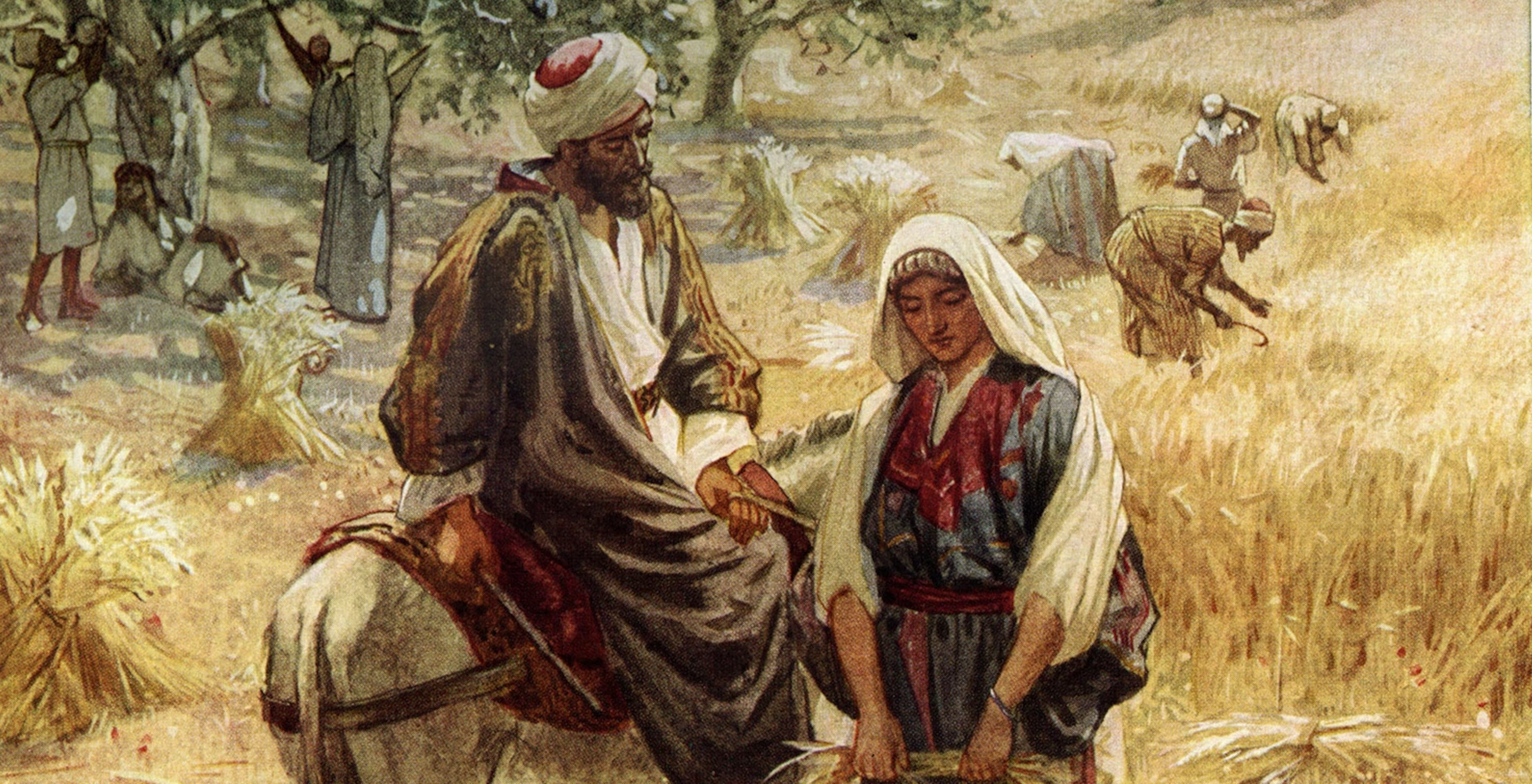
God provides for Ruth by leading her to the field of a kind and righteous man by the name of Boaz. Verse 4 introduces Boaz as he arrives at his field, greeting his workers with, “The Lord be with you!” They respond, “The Lord bless you” (Ruth 2:4, ESV). This greeting reveals Boaz’s character; he is a man who respects his workers and honors God in his interactions. Boaz’s greeting suggests he is a righteous man, one whose actions and words reflect his devotion to the Lord.
Boaz then notices Ruth, prompting him to ask his foreman, “Whose young woman is this?” (Ruth 2:5, ESV). Although gleaning was permitted for the poor, Ruth’s presence in the field as a Moabite would have made her stand out. In response, the foreman explains, “She is the young Moabite woman, who came back with Naomi from the country of Moab. She said, ‘Please let me glean and gather among the sheaves after the reapers.’ So she came, and she has continued from early morning until now, except for a short rest” (Ruth 2:6-7, ESV).
This account from the forman reveals to Boaz both Ruth’s humility and her dedication. She has chosen to work tirelessly, hoping for the opportunity to gather food for herself and Naomi. Ruth approaches her situation with respect for the customs of her new land, neither presuming upon the kindness of others nor demanding it. Her diligent labor and humble spirit make her stand out.
Boaz takes note of this, and in the ways in which he chooses to respond, will soon reveal his commitment to the heart of God’s law: mercy, justice, and kindness toward those in need. Through Boaz, God provides for Ruth in several ways, not only by ensuring she has food but also by offering her dignity, kindness, and protection. In a society where Ruth’s position as a foreign widow could have easily led to mistreatment, God orchestrates this encounter to offer her refuge and favor through Boaz. In a sense, Boaz becomes the hands and feet of God’s kindness, affirming to Ruth, and to us, that God sees the needs of His people and is actively involved in meeting them.
God’s Protection Provides Safety and Encouragement (Ruth 2:8–16)
From their first interaction, Boaz’s words reveal a deep and genuine concern for Ruth’s well-being. Addressing her tenderly as “my daughter,” he asks that she “not go to glean in another field or leave this one, but keep close to my young women” (Ruth 2:8, ESV). This fatherly attitude shows that Boaz doesn’t see Ruth as an enemy from the land of Moab to be distrusted or a vulnerable foreigner to be exploited. No, he sees her as a vulnerable person who needs a helping hand. He takes on a fatherly protective role towards this stranger. I wish we had such a heart for the strangers and sojourners in our own lands. Boaz’s invitation for her to stay within his fields is more than an offer of food; it’s a safeguard. As a foreign woman alone in the fields, she would have faced potential dangers and mistreatment. Boaz’s concern protects her from these risks.
In this way, Boaz’s kindness goes beyond the letter of the law. Rather than simply allowing Ruth to glean as the law requires, he extends personal compassion and a sense of security to her, reflecting the heart of God. I believe that this is an example of the heart Jesus wants in his followers. In Jesus day there were careful law followers called Scribes and Pharisees, but Jesus told his disciples “For I tell you, unless your righteousness exceeds that of the scribes and Pharisees, you will never enter the kingdom of heaven” (Mathew 5:20, ESV). The letter of the law said to leave some of your fields unharvested for the poor and the sojourner, but the heart of the law was about learning to see the poor and the stranger as worthy of the fruits of your labor.
I knew a man who took this command and tried to apply it to his life today. I won’t say his name because he would not be the type of person who would like to receive praise from the pulpit, but just know this is a real person who discipled me well in my younger years. Now this man wasn’t a farmer, but every time he was paid, before he spent any of his money, he set aside a portion to give to the church and a portion to give away to those in need. If he did not come across anyone in need that month he kept it set aside until someone with a need came into his life. He was not an incredibly wealthy man, and I am sure there are many things he would have like to have bought with that money, but he told me that in all his years God had never let him fall into need or destitution, and that God had given him the opportunity to be an answer to so many prayers.
My point is this, we can be a people who do just the bare minimum required to not feel guilty, or we can be like Boaz and go above and beyond the righteousness of the Pharisees and law keepers. When we live like that, we not only get to experience the heart of God in amazing ways, but we also get to be the hands and feet of Jesus to so many people. I have never met a person yet who was generous with their time, tallent, and resources and was miserable because of it.
Boaz then blesses Ruth with words that reveal his understanding of God’s protective love. He says, “The Lord repay you for what you have done, and a full reward be given you by the Lord, the God of Israel, under whose wings you have come to take refuge” (Ruth 2:12, ESV). This image of seeking shelter under God’s wings appears throughout Scripture, symbolizing God’s comforting and protective love. Psalm 36:7 captures this beautifully: “How precious is your steadfast love, O God! The children of mankind take refuge in the shadow of your wings” (ESV). Similarly, Psalm 91:4 says, “He will cover you with his pinions, and under his wings you will find refuge” (ESV).
Boaz’s generosity goes even further when he invites Ruth to share in a meal, saying, “Come here and eat some bread and dip your morsel in the wine” (Ruth 2:14, ESV). He serves her generously, providing more than she could have imagined. Then, he instructs his workers to leave extra grain for her to gather (vv. 15–16), reflecting God’s abundant provision. Boaz’s generosity ought to remind us of the lavish grace of God, who not only meets our needs but blesses us abundantly through Christ. Just as Boaz protected and provided for Ruth, Jesus, our Redeemer, offers us His protection, provision, and unending grace, inviting us to find our security and hope under the shadow of His wings.
The Redeemer Brings Hope and a Future (Ruth 2:17–23)
As Ruth returns home with an abundant harvest of grain after her providential meeting with Boaz, Naomi’s despair starts to lift, showing us how God’s provision can breathe life into the most broken of spirits. Naomi’s journey had been marked by grief and deep bitterness. She had lost her husband and sons and felt that God’s hand was against her. Yet, in this moment, God begins to unveil His redemptive plan. When Naomi sees the large amount of barley Ruth has gleaned and learns that Boaz, a relative of her late husband, is the generous provider, her perspective changes. She exclaims, “May he be blessed by the Lord, whose kindness has not forsaken the living or the dead!” (Ruth 2:20, ESV). Here, Naomi acknowledges God’s kindness, or “hesed.” This is not your everyday kindness. This word refers to God’s loyal, covenant love that never fails. Naomi realizes that God has not abandoned her; rather, He has been working through her pain to bring unexpected blessings.
In sharing that Boaz is a “redeemer,” Naomi reveals a ray of hope for both herself and Ruth. In Israel’s culture, a redeemer was a family member who could choose to rescue their relatives from poverty, provide protection, and restore their family line. The choice was Boaz’s to make, but for the first time in a long time Naomi has reason to hope.
Ultimately the hope Naomi sees in Boaz points us forward to the ultimate hope we have in Christ, our Redeemer. Just as Boaz offers a way out of poverty for Naomi and Ruth, Jesus steps into our lives to lift us out of spiritual poverty and provide us with abundant life. Naomi’s revelation about Boaz as a redeemer is a foreshadowing of the redemption we find in Christ, who delivers us from sin and death. Through Christ, we have a future that is secure, rooted in God’s unshakeable love. As Romans 6:23 reminds us, “For the wages of sin is death, but the free gift of God is eternal life in Christ Jesus our Lord” (ESV). Through His sacrifice, Jesus covers our sin, brings us into a relationship with God, and secures a future for us in His kingdom. Like Naomi and Ruth, who found hope and security in Boaz’s role as redeemer, we have a Redeemer in Christ who promises us eternal life and a future filled with His grace.
Conclusion: Lessons from Ruth and Boaz
As we close, let’s reflect on the powerful lessons Ruth and Boaz offer us. In Ruth we find a model of faith, humility, and service. Despite her challenging circumstances, she trusted God, acted faithfully, and took refuge under His wings. Ruth reminds us that even in our darkest times, we are called to trust God, to step forward in faith, and to rest in His provision, believing that He is with us.
Then there’s Boaz, whose kindness is a beautiful picture of Christ-like love in action. His compassion, generosity, and obedience to God’s law, without seeking credit or recognition, challenge us to extend grace to others, protect those who are vulnerable, and encourage others in their faith. Boaz calls us to embody a love that goes beyond mere duty and reflects the very heart of God to those around us.
Finally, we see that the story of Ruth and Boaz ultimately points us to Christ, our true Redeemer. Just as Boaz provided, protected, and redeemed Ruth, Jesus has provided, protected, and redeemed us through His own sacrifice. In Christ, we find grace that surpasses our expectations, hope that transforms despair into joy, and a future that is secure and certain.
As we reflect on the story of Ruth and Boaz, let us remember that it is a picture of the gospel, a call to each of us to respond to God’s invitation. Just as Ruth took a step of faith and found a new life of blessing and belonging, we too are invited to come to God, placing our trust in Him and finding our refuge under His wings. And just as Boaz redeemed Ruth, Jesus offers redemption to us all, meeting us in our need and providing grace that covers every sin, a love that heals every wound, and a hope that anchors us forever.
Today, if you have never made the decision to place your trust in Jesus, consider this invitation. Jesus, our true Redeemer, has already paid the price to bring you into a relationship with God. He stands ready to forgive, restore, and give you a new life, a life secure in His grace and overflowing with His love. Will you take that step of faith today? Will you trust Him with your heart and your life?
For those of us who already know Christ, this is a reminder to deepen our faith and renew our commitment to live in light of His love. Just as Ruth stepped forward in trust, let us also walk in faith, reflecting the compassion of Boaz and the redemption we have in Christ to a world in need.
If you feel God calling you to respond, I encourage you to come to Him now, whether it’s to receive His gift of salvation, to renew your faith, or to ask for the strength to walk in His ways. His arms are open, and His grace is waiting. Trust Him, step forward in faith, and allow His love to lead you.
Closing Prayer:
Lord, we thank You for the powerful reminders of Your faithfulness that we’ve seen today in the lives of Ruth and Boaz. Thank You for showing us that You meet us in our need, and that when we step forward in faith, Your provision and grace are there to meet us. Help us, Lord, to trust in You fully, to find our refuge under Your wings, and to walk in the love, kindness, and humility that Boaz demonstrated. For those of us who need the hope and redemption that only Christ can provide, draw us close to You now, and let us rest in Your promise. Guide us all to live as witnesses of Your love and grace, stepping out in faith to serve and bless others. We thank You for Your redeeming love and the secure future we have in Christ. In His precious name, Amen.
DAILY DEVOTIONALS:
On Sunday, we reflected on Ruth’s journey of faith and courage as a foreigner in Bethlehem, where she trusted God to provide even in uncertain circumstances. We looked at how God’s law of gleaning ensured care for the vulnerable, allowing Ruth to gather food and experience God’s provision through Boaz’s kindness. Boaz’s protection and generosity to Ruth went beyond the minimum, reflecting God’s compassion and inviting us to care for others with the same heart. Finally, as Naomi recognized Boaz as a “redeemer” for their family, we saw a powerful picture of Jesus as our Redeemer, who offers us grace, security, and an unshakable hope for the future.
Monday: Ruth’s Courage in a New Land
Scripture Reading:
Ruth 2:1–3
Devotional:
Ruth finds herself in Bethlehem, a foreigner in a land unfamiliar and potentially hostile. Yet, despite her precarious position, Ruth doesn’t withdraw. Instead, she asks Naomi’s permission to glean in the fields, showing her courage and readiness to take action. Ruth’s faith is active, she chooses to do what she can to support Naomi and herself, even if the path is uncertain. This humility and courage resonate with anyone who’s ever felt uncertain yet chosen to act in faith.
As Ruth goes to glean, she trusts that someone will show her favor. She is unaware of what awaits her or if she will even be welcomed. However, she steps out, motivated by a blend of trust and necessity. Ruth’s decision to glean reflects her belief that God’s provision will meet her efforts, illustrating a faith that isn’t passive but responsive to her circumstances.
God invites us, too, to step out in trust even when the future is unclear. Ruth’s faith wasn’t one of knowing but of trusting, a faith willing to walk forward without knowing the end result. Like Ruth, we can choose to place our confidence in God’s provision and trust that He will guide us as we step out in faith.
Reflection Questions:
1. Have you ever been in a situation where you felt like a “foreigner”? How did you step forward?
2. What steps might God be calling you to take today that require faith and courage?
3. How does Ruth’s example challenge you to act in faith, even if you feel uncertain about the outcome?
Prayer:
Lord, thank You for Ruth’s example of courage and faith. Give us the courage to step forward, trusting that You will meet us. When we feel uncertain, help us remember that You guide us as we trust in You. We place our confidence in Your provision and timing. Amen.
Tuesday: God’s Provision Through Gleaning
Scripture Reading:
Leviticus 19:9–10
Devotional:
Ruth’s story unfolds against the backdrop of God’s laws on gleaning, given to Israel to care for the poor and foreigner. Through this law, God made sure that even the vulnerable could gather food and be provided for. By leaving portions of the harvest in the fields, God taught His people to show compassion, creating an economy where generosity and justice were woven into everyday life.
Ruth’s act of gleaning demonstrates a trust in God’s provision and the kindness of others. She steps out in faith, knowing that the act of gleaning is a path God Himself had established. God’s provision often flows through the obedience and compassion of His people. When we extend kindness and care to others, we participate in God’s plan of provision and blessing for the vulnerable.
As Ruth gleans, God meets her with not only sustenance but favor through Boaz, a man who embodies God’s law in both letter and spirit. Like Ruth, we are invited to trust God’s provision, knowing He often works through others. We are also called to be like Boaz, leaving space for others to experience God’s care through us.
Reflection Questions:
1. What does gleaning look like in your own life, how are you sharing with those in need?
2. How might God be inviting you to trust in His provision through difficult times?
3. Where have you experienced God’s provision through the generosity of others?
Prayer:
Heavenly Father, thank You for caring for us and teaching us to care for others. Help us trust Your provision and to act as vessels of Your generosity. May we embody Your kindness in our interactions with those around us. In Jesus’ name, Amen.
Wednesday: God’s Protection Through Boaz
Scripture Reading:
Ruth 2:8–9
Devotional:
Boaz’s concern for Ruth is immediate and fatherly. He tells her to stay in his fields, protecting her from possible harm and ensuring she can glean safely. His actions reveal a genuine kindness that goes beyond mere duty, embodying the heart of God’s law by protecting and providing for the vulnerable. Boaz’s response reminds us that God’s protection often comes through the compassion and care of others.
Through Boaz’s kindness, Ruth finds a safe space where she can glean without fear. In our own lives, we too can be the “Boaz” for others, offering protection, hospitality, and care. God’s care for us often arrives through people willing to extend themselves beyond duty, reflecting His love and mercy.
As we seek to follow Jesus, we’re called to exceed the minimum, like Boaz. Instead of simply following the rules, God invites us to step into a faith that sees the needs of others and acts to meet them. As we do, we become instruments of His love, creating a world where His heart for the vulnerable is made visible.
Reflection Questions:
1. Who has shown you kindness and protection in your own journey of faith?
2. How can you be a “Boaz” for someone in need of support or encouragement?
3. What steps can you take to extend care and compassion to those around you this week?
Prayer:
Lord, thank You for Your protection and care. Help us to see those in need around us and to respond with kindness. May we reflect Your heart, offering safety and encouragement to others. In Jesus’ name, Amen.
Thursday: Shelter Under God’s Wings
Scripture Reading:
Psalm 91:4
Devotional:
Boaz blesses Ruth by saying, “May you be richly rewarded by the Lord…under whose wings you have come to take refuge” (Ruth 2:12). This image of God’s wings is one of protection, comfort, and provision, a place where we are sheltered from life’s storms. For Ruth, it was more than just words; God truly became her refuge, providing for her through Boaz’s kindness and favor.
In Scripture, God’s wings symbolize His unwavering care and protection. In Psalm 91:4, we read, “He will cover you with His feathers, and under His wings you will find refuge.” This promise reminds us that we can run to God in every season, finding rest, security, and peace in Him.
No matter where we are in our journey, God invites us to take refuge under His wings. In Him, we find a love that never fails, a strength that never falters, and a protection that endures. Just as Ruth trusted God to be her refuge, so too can we place our trust in Him, knowing He is always near.
Reflection Questions:
1. Where do you need to seek refuge in God’s presence today?
2. How does the image of “God’s wings” bring comfort to you?
3. Who in your life needs the reminder of God’s protection and love?
Prayer:
Father, thank You for being our refuge. Help us to trust in Your protection and to find our rest under Your wings. May we share this comfort with those around us, reminding them of Your unfailing love. Amen.
Friday: Lavish Grace and Provision
Scripture Reading:
Ruth 2:14–16
Devotional:
Boaz’s kindness towards Ruth goes beyond expectation. He not only allows her to glean but invites her to eat with him and instructs his workers to leave extra grain for her. Boaz embodies a grace that is abundant, reflecting the generous love of God who provides “more than we can ask or imagine” (Ephesians 3:20).
This grace reminds us of the way God cares for us, providing not only for our needs but often showering us with blessings beyond expectation. Boaz’s actions reflect God’s character. He is a provider who gives generously, inviting us to sit at His table and partake in His goodness.
In Jesus, we see the ultimate example of God’s grace and generosity. Just as Boaz ensured Ruth’s needs were met, God in Christ meets our deepest needs, giving us salvation, hope, and a future. God’s grace is lavish, and He calls us to share this grace with others.
Reflection Questions:
1. How has God’s grace provided for you abundantly in ways you didn’t expect?
2. What does it mean for you to experience God’s provision at His “table”?
3. How can you extend this grace to others in your community?
Prayer:
Lord, thank You for Your generous grace. Help us to recognize Your blessings and to respond with gratitude. May we share Your grace and generosity with those in need around us. Amen.
Saturday: Hope in the Redeemer
Scripture Reading:
Ruth 2:20–23
Devotional:
When Ruth returns with her gleanings, Naomi begins to see a glimmer of hope. Learning that Boaz is a family redeemer, a relative who could choose to restore their family, Naomi realizes that God’s hand has been at work all along. Boaz’s kindness offers the possibility of redemption, hope, and a secure future for Ruth and Naomi.
Just as Boaz acted as a redeemer, we have a Redeemer in Jesus. Through His sacrifice, Jesus restores our broken relationship with God, offering us new life and a future filled with hope. Naomi’s response reminds us that no matter how deep our sorrow or despair, God’s redemptive power can bring new life and purpose.
The story of Ruth and Boaz points us to the ultimate redemption we have in Christ. In Him, we find not only provision and protection but also a promise that our future is secure. Through Jesus, our Redeemer, we have hope that is unshakeable and a life that is made whole.
Reflection Questions:
1. How has God brought hope into your life during challenging seasons?
2. What does it mean to you that Jesus is your Redeemer?
3. How can you share this hope with someone who needs encouragement?
Prayer:
Lord Jesus, thank You for being our Redeemer. Thank You for the hope and future You give us. Help us to trust in Your redemption and to share Your love with others. May we live with hearts filled with gratitude for Your grace. Amen.
 hardincrowder.com