Introduction:
So far in this series, we’ve been setting the stage for the arrival of Jesus. We’ve explored the perspectives of the four Gospel authors, each offering a unique but essential view of His life. We also looked at John’s prologue, which reminded us that Jesus didn’t begin in Bethlehem. He has always been the eternal Son of God, existing before time itself. Last week, we traced Jesus’ genealogies in Matthew and Luke, seeing how God had been orchestrating history all along to bring about the birth of Christ and fulfill His plan of salvation. Now, having laid that foundation, we move from the prologue into the actual life and times of Jesus, beginning, as life itself does, with His conception and the announcement of His coming.
The story of Jesus, the Son of God who took on flesh, unfolds during the reign of Herod the Great (37–4 BC). Herod, a ruler of Judea under Roman authority, was known for his ambitious building projects as well as his oppressive rule. Interestingly, though he held the title “King of the Jews,” he wasn’t even Jewish by blood. He was an Edomite, a people historically at odds with Israel. His father, Antipater, gained favor with Julius Caesar and was appointed procurator of Judea. Later, Herod secured Roman backing from Mark Antony and Octavian (the future Emperor Augustus), leading to his official appointment as “King of the Jews” by the Roman Senate in 40 BC. After a three-year conflict, he took full control of Judea in 37 BC.
Herod’s reign left a lasting mark on Judea. He was responsible for massive building projects, including the impressive reconstruction of the Second Temple, the city of Caesarea Maritima, and fortress-palaces like Masada. While his economic policies strengthened trade and infrastructure, his paranoia drove him to great cruelty, leading to the execution of family members and even innocent children.
At this time, the spiritual atmosphere was filled with longing and expectation. It had been nearly four hundred years since the last prophet, Malachi, had spoken, and the people eagerly awaited a new word from God.
With this backdrop, the announcement of the births of John the Baptist and Jesus serves as a powerful bridge between the Old and New Testaments. John’s mission was to be the final prophet of the Old Covenant, much like Elijah, fulfilling the prophecies of Isaiah and Malachi and preparing the way for Jesus. Meanwhile, Jesus is the long-awaited Messiah, the Savior of the world, whom all of history had been pointing toward.
So, let’s begin our journey chronologically with the annunciation to Zechariah.
The Annunciation to Zechariah (Luke 1:5-25)
Zechariah and Elizabeth are introduced as a devout and honorable couple living during the reign of Herod the Great. Zechariah is a priest from the division of Abijah, one of the 24 priestly divisions established by King David (1 Chronicles 24:10). Elizabeth, as a descendant of Aaron, also comes from a priestly lineage, making their union a remarkable example of faithfulness to Israel’s religious heritage.
The Gospel of Luke emphasizes their spiritual integrity, describing them as “righteous before God” and living “blamelessly” according to His commandments and laws. Their lives reflect a deep commitment to their faith, serving as a model of godly living amidst a spiritually challenging time. This righteousness does not imply sinlessness but demonstrates their sincere effort to live according to God’s covenant.
Their faithful service is highlighted through Zechariah’s priestly duties, which included offering incense in the temple. This once-in-a-lifetime honor of burning incense (Luke 1:9) signifies Zechariah’s devotion and God’s sovereignty in choosing him for a pivotal moment in salvation history. Their faithful character underscores the theme of God working through humble, obedient individuals to fulfill His divine purposes.
Despite their exemplary faith and righteousness, Zechariah and Elizabeth face the sorrow of childlessness. Luke notes that Elizabeth was barren and both were advanced in years, echoing the struggles of notable biblical couples like Abraham and Sarah (Genesis 18) and Hannah and Elkanah (1 Samuel 1). In their culture, childlessness was often viewed as a tragedy and a form of divine disfavor, as children were seen as a sign of God’s blessing and favor.
The narrative, however, reframes their childlessness as a backdrop for God’s miraculous intervention. Just as He had done in the lives of Sarah, Hannah, and others, God demonstrates His power to bring life where it seemed impossible. The announcement of John’s birth to this elderly, childless couple underscores the miraculous nature of God’s actions and sets the stage for the coming of the Messiah. Elizabeth’s barrenness also symbolizes the spiritual barrenness of Israel at the time. For 400 years, there had been no prophetic voice, and the people were yearning for God’s intervention.
Zechariah, as part of the priestly division of Abijah, is selected by lot to burn incense in the temple. This is a rare and prestigious honor that could only be granted only once in a priest’s lifetime. This task, performed in the Holy Place before the altar of incense, symbolizes the prayers of Israel rising to God, highlighting the centrality of worship in the covenant relationship between God and His people.
As Zechariah performs his duty, the angel Gabriel appears beside the altar of incense, startling him. This divine visitation marks a pivotal transition in salvation history. The setting itself (a place of old covenant worship) connects the history of Israel with the new era about to begin. Gabriel’s presence signifies God’s intervention to fulfill His promises, bridging the old covenant of the law with the coming new covenant of grace through the Messiah.
Gabriel’s message to Zechariah reveals that he and Elizabeth will have a son, and that this child, to be named John, is described as “great in the sight of the Lord” and uniquely set apart for God’s purposes. He will live a life of devotion, abstaining from wine and strong drink, reminiscent of the Nazirite vow, symbolizing his complete dedication to God.
From the moment of his conception, John will be filled with the Holy Spirit, emphasizing his divine calling and the Spirit’s empowerment of his mission. John’s mission is explicitly tied to the prophecies of Malachi, where it is foretold that Elijah would return to prepare the way for the Lord (Malachi 4:5–6). Gabriel states that John will go forth “in the spirit and power of Elijah,” calling people to repentance and restoring relationships, symbolized by turning “the hearts of fathers to their children.” This ministry of reconciliation and spiritual renewal will prepare the people of Israel to receive the Messiah.
When the angel Gabriel delivers the miraculous message of John’s impending birth, Zechariah responds with skepticism: “How can I be sure of this? I am an old man, and my wife is well along in years.” This doubt is unfortunate to hear from a priest of Israel. Surely he was familiar with the accounts of Abraham and Sarah, and the many other testimonies from the Old Testament that testify to God doing this very thing, but perhaps this is an indicator of the state of spiritual desperation that was prevalent in this time.
Gabriel’s response to Zechariah’s doubt is both corrective and affirming. He declares that Zechariah will be unable to speak until the fulfillment of the angel’s words, stating, “And now you will be silent and not able to speak until the day this happens, because you did not believe my words, which will come true at their appointed time.”
Despite her advanced age and a lifetime of barrenness, Elizabeth becomes pregnant, confirming the angel’s words to Zechariah. The fulfillment of this promise holds both personal and communal significance. For Elizabeth, it is the answer to years of longing and prayer, validating her faith. For the people of Israel, it signifies that God is actively working to bring about His promises, setting the stage for the Messiah’s arrival. Her conception is a testament to God’s ability to intervene in the most unlikely circumstances to accomplish His divine purposes.
Elizabeth’s response to her miraculous pregnancy is one of joy and gratitude. She declares, “The Lord has done this for me. In these days he has shown his favor and taken away my disgrace among the people” (Luke 1:25). For Elizabeth, childlessness had been a source of deep personal pain and societal shame. In her culture, barrenness was often viewed as a reproach, leading to stigma and feelings of inadequacy. Her thanksgiving highlights her recognition of God’s grace in lifting this burden. She attributes the blessing entirely to God, acknowledging His favor and mercy.
The Annunciation to Mary (Luke 1:26–38)
Luke’s account now transitions from the big city of Jerusalem, where Zechariah encountered the angel, to the simplicity of a rural village in Galilee called Nazareth. While the temple represented Israel’s established religious life, its priestly order, and the long tradition of worship under the Law, God’s plan is not confined to sacred buildings or priestly castes. Instead, the Lord chooses to work equally through humble individuals and ordinary places.
Nazareth, a small, relatively insignificant town not even mentioned in the Old Testament, symbolizes the unexpected stage upon which God’s redemptive plan unfolds. The Incarnation will take place not in the circles of privilege, power, or religious prestige, but within the routine patterns of family life and simple rural living.
Mary is introduced to us as a young Jewish girl, likely in her early or mid-teens, engaged to be married but not yet wed. Her modest circumstances and vulnerability stand in marked contrast to Zechariah’s position. Rather than addressing religious elites, God’s angelic messenger approaches someone who, by worldly standards, has little to offer in terms of status or influence.
Despite Mary’s humble condition and the obscurity of Nazareth, the angelic announcement connects Mary’s betrothed husband, Joseph, to the house of David. This detail is crucial. According to the Old Testament, the Messiah would arise from David’s line, fulfilling God’s covenant promise “Your house and your kingdom will endure forever before me; your throne will be established forever” (2 Samuel 7:16). Though the monarchy had long since been deposed and replaced by a puppet king who served the Roman Empire, Joseph was of the royal lineage of David, establishing Jesus’ legitimate claim to David’s throne. Even so, the humble setting of the Messiah’s arrival reveals that his Kingdom does not depend on human power, wealth, or political influence. Instead, it springs forth quietly within an all but forgotten lineage that has long been without the trappings of kingship. In this quiet way, God is at work, setting the stage for a ruler who will surpass Israel’s historical kings in holiness, justice, and eternal authority.
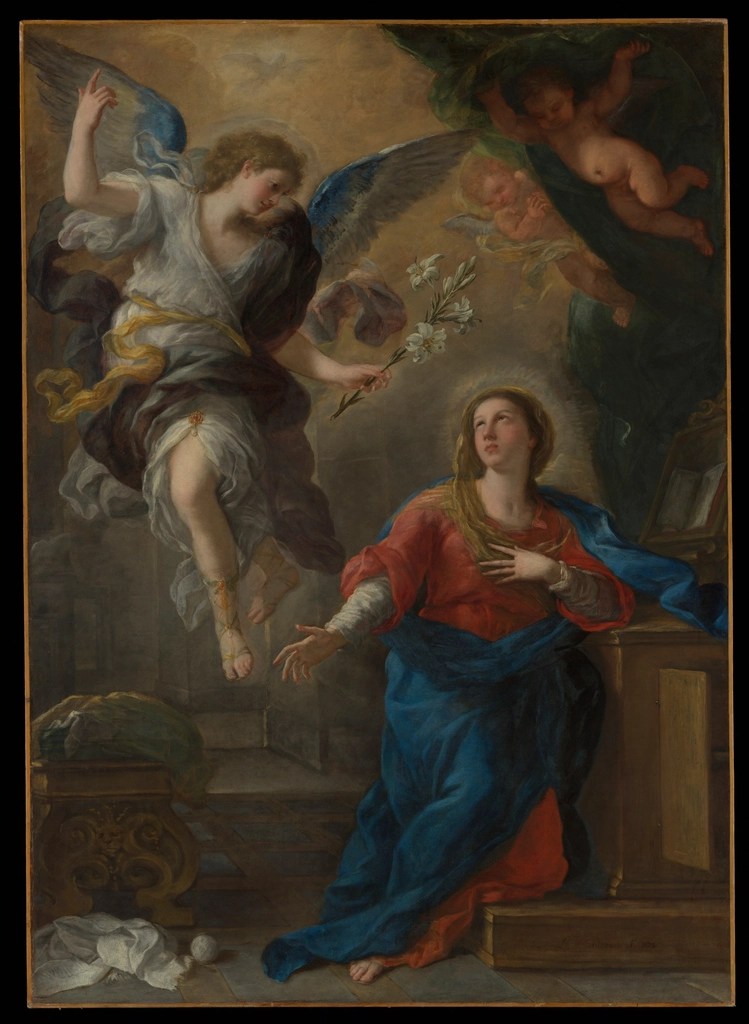
The angel Gabriel appears to Mary and greets her, “Greetings, favored one! The Lord is with you.” Calling Mary “favored” or “full of grace” means that God’s choice of her rests on His generosity, not her personal worthiness. This doesn’t diminish Mary’s virtue; rather, it highlights that, in Scripture, divine favor is never a reward for human merit, but always a freely given gift intended to further God’s redemptive plan.
Mary reacts to the angelic greeting with confusion and a measure of uncertainty. Luke notes that she was “greatly troubled at the statement” and tried to discern what kind of greeting this might be. This inward struggle is not an expression of unbelief, but rather a testimony to her humility and sincerity. She does not presume to understand all that God is doing. Instead, she ponders the angel’s words, seeking clarity before responding.
This posture of thoughtful discernment will characterize Mary throughout the Gospel narrative, marking her as a person who treasures divine mysteries in her heart (Luke 2:19, 51). Importantly, Mary does not dismiss Gabriel’s words out of fear or disbelief. Her heart remains open to the word of God, even when it comes in unexpected ways.
Gabriel then reassures her: “Do not be afraid, Mary, for you have found favor with God.” This divine encouragement parallels similar assurances given to other biblical figures called to extraordinary tasks. Fear is natural when faced with a direct revelation from God’s messenger, yet the angel’s words indicate that the purpose of this encounter is not judgment or condemnation, but blessing and mission.
Following the assurance of divine favor, Gabriel now discloses the heart of God’s plan: Mary will conceive a son, and she is to name Him Jesus. The name “Jesus” is the Greek form of the Hebrew name “Joshua” (Yeshua), which means “Yahweh saves” or “The Lord is salvation.” By giving this name, the angel expresses the very essence of Jesus’ mission. He will not merely be a teacher, prophet, or political liberator. Instead, He embodies God’s saving presence among His people, and His life, death, and resurrection will enact salvation from sin and estrangement from God.
Gabriel’s announcement further identifies Jesus as “the Son of the Most High.” This title places Jesus in a category of unparalleled proximity and relationship to God, surpassing even the greatest prophets and kings. In the Old Testament, “Most High” (El Elyon) is a divine epithet reserved for the supreme God, maker of heaven and earth. To call Jesus “Son of the Most High” marks Him as not simply another servant of God, but as one who uniquely shares in God’s authority, character, and power.
Additionally, Gabriel links Jesus directly to the line of David by declaring that He will inherit “the throne of His father David.” This evokes the covenant promise found in 2 Samuel 7:16, where God pledged to establish David’s throne forever. While Israel had experienced centuries of foreign domination and the absence of a Davidic king, Gabriel’s words signal that God’s faithfulness to His covenant people remains intact. Jesus is presented as the legitimate heir who will reclaim and fulfill the royal vocation David’s dynasty never perfectly achieved.
This announcement also resonates with Isaiah’s prophecy (Isaiah 7:14), which foretold a virgin birth and the coming of “Immanuel” (God with us). The convergence of these Old Testament themes; divine sonship, the Davidic throne, and messianic salvation, underscores that Jesus is not an afterthought in God’s plan. Rather, He stands at the epicenter of biblical revelation, bringing to fruition the hopes and promises scattered throughout Israel’s Scriptures.
Following the angel’s astounding revelation that she will bear a child who is both the Son of the Most High and heir to David’s throne, Mary poses a natural and honest question: “How can this be, since I am a virgin?” This stands in sharp contrast to Zechariah’s earlier questioning of Gabriel (Luke 1:18–20). Where Zechariah, an experienced priest, responded to God’s promise with skepticism and was subsequently rendered mute, Mary’s question springs not from doubt but from faith seeking understanding. She does not ask for proof of God’s ability to fulfill the promise; instead, she asks for clarity regarding how God will accomplish this miraculous event within her own life circumstances.
In response to Mary’s question, Gabriel explains that the Holy Spirit Himself will be the agent of this miraculous conception: “The Holy Spirit will come upon you, and the power of the Most High will overshadow you.” Luke’s Gospel often highlights the Holy Spirit’s integral role in God’s redemptive work, and here the Spirit is at the center of the Incarnation. The same Spirit who hovered over the formless void at the dawn of creation (Genesis 1:2) now descends to bring forth new life in Mary’s womb. Just as God’s creative word brought light and order out of chaos in the beginning, God’s Spirit will now initiate a new creation in and through Mary, resulting in the birth of Jesus, the Light of the World.
The language of “overshadowing” evokes the imagery of God’s glorious presence dwelling in the tabernacle and the temple (Exodus 40:34–35; 1 Kings 8:10–11). This suggests that Mary, like these sacred dwellings, becomes a living sanctuary where God’s presence uniquely abides. In this mystery, the eternal and transcendent God takes on human flesh, entering into the fragility and intimacy of human life. This divine action surpasses ordinary biological processes, signifying that Jesus’ origin is rooted directly in God’s initiative rather than human will.
To bolster Mary’s confidence, Gabriel points to Elizabeth’s pregnancy as a tangible sign of God’s power. The angel’s concluding statement, “Nothing will be impossible with God,” reaffirms the boundless scope of divine omnipotence. It echoes God’s rhetorical question to Abraham and Sarah in Genesis 18:14 (“Is anything too hard for the LORD?”) and reminds readers that the same God who acts in Israel’s history continues to break through human limitations.
In response to Gabriel’s announcement (Luke 1:38), Mary says, “Here am I, the servant of the Lord; let it be with me according to your word.” Like Isaiah’s “Here I am; send me” (Isaiah 6:8), her words place her entirely at God’s disposal. With courage, she accepts God’s call despite the risk of misunderstanding and disgrace, trusting Him to provide all she needs. Unlike Zechariah’s doubt, Mary’s humble faith models trust and obedience, affirming that God’s word and power remain reliable even when circumstances appear impossible.
The Meeting of Mary and Elizabeth (Luke 1:39)
After receiving Gabriel’s announcement, Mary travels from Nazareth in Galilee to the Judean hill country to see her relative Elizabeth. Although Luke doesn’t explain her reasons, the urgency and distance, about eighty to one hundred miles, suggest that this must have been seen as necessary. Was she going to get away from those in Nazareth who might question the legitimacy of her pregnancy? Maybe she had heard of Elizabeth’s miracle and wanted to talk with her about the similar thing that had happened to her, since Elizabeth was probably the only person on earth who could somewhat relate? Ultimately, we can only make educated guesses.
What we do know is that both women have experienced miraculous conceptions. Elizabeth, once barren, is now six months pregnant with John, who will prepare the people for Israel’s Messiah. Mary, a virgin, carries the Son of God. In Elizabeth’s home, she finds a safe, encouraging space to reflect on God’s work. Upon her arrival, Elizabeth’s Spirit-filled response confirms Gabriel’s promise and strengthens Mary’s faith.
Their meeting is no accident. John and Jesus are bound together in God’s redemptive plan. John will call Israel back to God, while Jesus will fulfill the ancient promises by taking David’s throne and establishing an eternal kingdom. Luke’s account shows that these miraculous pregnancies mark the convergence of God’s long-awaited promises. Before the children are even born, their mothers meet, each carrying within her the hope of Israel and the world (Malachi 4:5–6; Isaiah 40:3).
The Annunciation to Joseph (Matthew 1:18–25)
While Luke focuses on Mary’s side of the story, Matthew focuses on Joseph, who is struggling to make the most difficult decision of his life. We do not know how long it has been since Mary’s pregnancy began, but we know that Joseph knows she is pregnant and must have heard her account of how this came to be, yet he seems either unconvinced or at least unsure how to proceed. In first-century Judaism, betrothal was legally binding and could only be ended by divorce. Although Mary and Joseph were not yet living together, her unexpected pregnancy suggested unfaithfulness to both him and their community.
Joseph is described as righteous, meaning he lives with integrity in accordance with God’s law. The situation confronts him with two options: he could publicly expose Mary to severe judgment (Deuteronomy 22:23–24), or he could quietly divorce her to protect her from shame. Choosing the latter reflects Joseph’s compassionate character, balancing justice with mercy. Although unsure of the truth behind Mary’s pregnancy, he remains committed to acting rightly before God and with care for Mary.
As Joseph struggles with his decision, God intervenes. In a dream, an angel addresses him as “Joseph, son of David,” emphasizing his royal lineage. This link is crucial because the Messiah must descend from David’s line (2 Samuel 7; Psalm 132:11), and Joseph’s legal fatherhood would secure that heritage. The angel assures Joseph of Mary’s innocence and the divine origin of her pregnancy: “The child conceived in her is from the Holy Spirit.” This echoes creation’s beginning (Genesis 1:2), where God’s Spirit brought forth life. Now, by the same divine power, the Savior is formed in Mary’s womb, launching a new era of salvation. Joseph is instructed to name the child “Jesus” (Yeshua), meaning “Yahweh saves.” This name captures the child’s purpose: He will save His people from sin. While many hoped for liberation from Roman rule, the angel highlights a deeper salvation, freedom from sin’s grip. Jesus’ mission focuses on spiritual renewal, fulfilling promises that through Abraham’s offspring all nations would be blessed (Genesis 12:3).
Matthew pauses to connect these events to Scripture, citing Isaiah 7:14: “The virgin shall conceive and bear a son, and they shall name him Emmanuel.” Initially a sign of God’s presence in Isaiah’s time, Matthew sees its ultimate fulfillment in Jesus’ birth. By calling Him “Emmanuel,” Matthew shows that the Messiah is not just God’s agent but God Himself dwelling among His people. The Incarnation reveals that the Creator is no longer distant, but intimately involved in human life, fulfilling Israel’s long-standing hope.
Awakening from the dream, Joseph puts aside fear and public opinion. He takes Mary as his wife, publicly affirming her innocence and the child’s legitimacy. This swift obedience reveals Joseph’s genuine righteousness: having heard God’s word, he promptly aligns with God’s plan. To honor the uniqueness of Jesus’ conception, Joseph refrains from marital relations until after the birth, preserving the event’s sanctity and ensuring no confusion about the child’s divine origin. By naming the boy Jesus, Joseph legally adopts Him, making Jesus a true Son of David and fulfilling the requirement of Messianic descent.
Conclusion:
During the reign of Herod the Great, Israel lived under foreign oppression and yearned for God’s promised Messiah. In this setting, God acted in unexpected ways, working through ordinary people; Zechariah, Elizabeth, Mary, and Joseph, to fulfill ancient promises. These events bridge the Old and New Testaments, showing that God’s plan to send the Messiah was long in the making.
John the Baptist’s birth to Zechariah and Elizabeth, a couple advanced in years and previously childless, demonstrates God’s faithfulness and power. John’s prophetic role prepares the way for Jesus, echoing Elijah’s ministry and fulfilling promises from Malachi and Isaiah. Likewise, Mary’s humble acceptance of God’s plan and Joseph’s obedient response highlight the importance of faith and trust, even when circumstances seem impossible.
Jesus, conceived by the Holy Spirit and born of a virgin, is both God’s Son and Israel’s Messiah. He fulfills the promises made to Abraham and David; promises of blessing, eternal kingship, and salvation. The Holy Spirit’s involvement in these events points to a new era of redemption, where God’s Spirit will empower and guide His people.
Throughout these accounts, we see God’s faithfulness, human responses of faith or doubt, and the Holy Spirit’s work. They teach that God often chooses humble settings and lowly individuals to accomplish His greatest works. This early stage of the Gospel narrative sets the tone for all that follows, as Jesus begins His journey to bring salvation and establish God’s eternal kingdom.
 hardincrowder.com