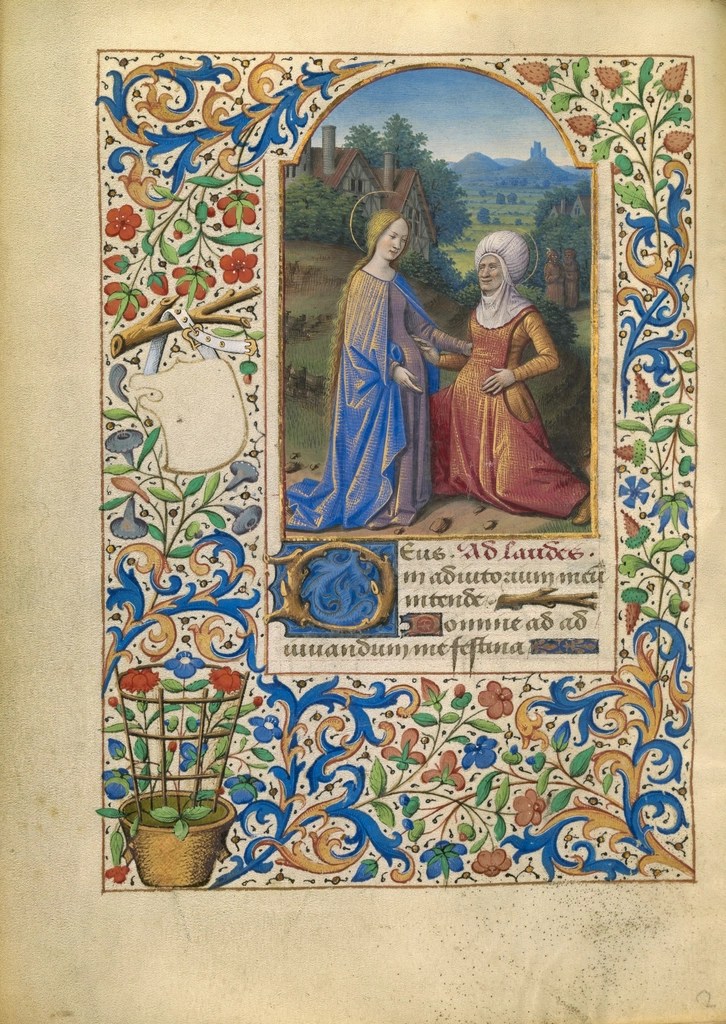
The Journey of Mary (Luke 1:39-40)
“In those days Mary arose and went with haste into the hill country, to a town in Judah…” (Luke 1:39, ESV)
Mary’s journey to the hill country of Judea was a pilgrimage of faith. Luke tells us that Mary “got ready and hurried” (Luke 1:39), words filled with urgency. This was not reckless haste or uncertainty but the swiftness of faith set aflame by the Holy Spirit. The phrase “in those days” or “at that time” connects this journey to Gabriel’s announcement, showing that it was not an isolated act but part of God’s grand design. We as the reader or hearer are supposed to connect this journey to Gabriel’s announcement. We also read that Mary “arose and went with haste.” The words used here in Greek are not a panicked type of haste, but it conveys an excited eagerness to go. Mary was eager to visit Elizabeth and share the wonder of what had been conceived within her.
Now it is worth nothing that the journey from Nazareth to Judea was not a small journey for a pregnant woman to take. The road stretched nearly a hundred miles and took three to four days on foot through rough terrain. The ancient Jewish historian Josephus described this region as dangerous, with treacherous paths and lurking bandits. For a young woman, possibly in her early teens, such a journey would have been challenging. Yet the Gospel gives no sign of hesitation or fear. Mary’s faith outweighed the difficulties of the journey. It is possible that Mary journeyed with a group or that she at least took an animal to ride upon for most of the way, but if she did the gospel of Luke does not give us these details.
Mary’s young age makes her journey even more remarkable. Scholars like Joachim Jeremias note that Jewish girls were often betrothed not long after they hit puberty. We don’t know how old Mary was, but we can safely assume she would be too young for any of us to feel comfortable sending her out on a journey like this. Yet despite her young age, Mary had already displayed a spiritual wisdom greater than the learned priest Zechariah, who had struggled to believe the Angel’s message, a reminder that God’s favor is not based on age or status but on the openness of the heart. From what little information we have, Mary appears confident that God would keep her safe on this journey. And we see in the next few verses, He did just that.
The Baby John Leaped and Elizabeth Prophecies (Luke 1:40-45)
“… and she entered the house of Zechariah and greeted Elizabeth. And when Elizabeth heard the greeting of Mary, the baby leaped in her womb.” (Luke 1:40-41, ESV)
At the sound of Mary’s voice, the child within Elizabeth’s womb leaped. Remember that this baby was also a miracle child. He was given to Elizabeth in her old age and was to become the last prophet of the Old Covenant and a forerunner of the Messiah of the New Covenant. This leap was a silent proclamation even before words could be spoken. The Greek word for “leaped” is the same word used in the Septuagint to describe King David dancing before the Ark of the Covenant (2 Samuel 6:16). I think that connection is intentional. Just as David rejoiced in God’s presence, the unborn John the Baptist exulted before the presence of Jesus. Even in the womb, John recognized the Messiah; before he could preach, his first prophetic act was joy.
Then, Elizabeth, filled with the Holy Spirit, burst into praise: ““Blessed are you among women, and blessed is the fruit of your womb!” (Luke 1:42). Remember that before Christ atoned for sin and sent the Holy Spirit into the church at Pentecost (Acts 2), the Holy Spirit would come upon prophets, priests, kings, and scribes to deliver the Word of God through men. So this was not just words for excitement, but a Spirit-led proclamation. She saw what human eyes could not, that Mary was carrying the presence of God.
Elizabeth does not stop with Mary; she extends her blessing to the child in Mary’s womb. “Blessed is the child you will bear,” she proclaims, affirming that Jesus Himself is the source of Mary’s blessedness. This anticipates Luke’s broader theme, that salvation and divine blessing are found in the person of Jesus Christ. Mary is favored, not because of any merit of her own, but because of the One she carries.
“And why is this granted to me that the mother of my Lord should come to me?” (Luke 1:43). This is one of the earliest prophetic confessions of Christ’s divinity, revealed by the Spirit of God. Her question mirrors the awe-filled words of King David in 2 Samuel 6:9, when he exclaimed, “How can the ark of the Lord come to me?” The parallel is unmistakable. Just as the Ark of the Covenant in the Old Testament carried the presence of God, so now Mary carries within her the true presence of God, Jesus Christ.
Elizabeth’s use of “my Lord” which is deeply significant language, as it aligns with Psalm 110:1, where the Messiah is addressed as “my Lord.” This moment marks the first recorded confession of Jesus as Lord in the New Testament, and it comes not from a priest, a scholar, or a king, but from an elderly woman filled with the Holy Spirit. Even before His birth, Jesus was transforming lives, stirring hearts, and calling forth faith.
Again, speaking through the Holy Spirit, Elizabeth declares: “Blessed is she who believed that there would be a fulfillment of what was spoken to her from the Lord.” (Luke 1:45). Again, remember that even the High Priest Zechariah had doubts, but Mary believed from the beginning, and as such she is blessed and approved by God. This is the essence of faith, not just hearing God’s promises but believing they will come to pass. Mary did not ask for proof or assurance. She simply trusted and stepped forward in faith, not only in physical travel but in a deeper trust in God’s plan.
One thing that is neat to consider is the symbolism of behind this meeting. Elizabeth was an old woman and the wife of a priest, caring in her womb the last and greatest in the line of the Old Testament prophets. Meanwhile Mary was a young virgin, in the bloom of youth, who carried in her womb the Messiah of the New Covenant. Elizabeth, carried the forerunner; Mary, carried the fulfillment. The old and the new were meeting and the old was blessing the new and celebrating his coming.
Here is another neat parallel. In Genesis 25:22, Jacob and Esau struggled in Rebekah’s womb, to foreshadowing their lifelong conflict. But here, John’s leaping is not against Jesus. He is celebrating Jesus. Already, he is living out the words he would later proclaim: “He must increase, but I must decrease” (John 3:30).
The Magnificat: Mary’s Song of Praise (Luke 1:46-55)
Mary’s response to Elizabeth’s prophetic greeting is one of the most exalted hymns in all of Scripture. Known as The Magnificat, from the Latin translation of its first word, this song of praise places Mary in the great tradition of biblical worshipers who magnify the Lord for His mighty acts. Despite her youth, she expresses profound theological depth and poetic eloquence, which bears witness to the work of the Holy Spirit speaking through her.
Mary begins her song with the words, “My soul magnifies the Lord, and my spirit rejoices in God my Savior.” The Greek verb “megalunei” conveys the idea of enlarging, exalting, or glorifying. Of course, Mary does not make God greater in essence, He is already infinitely great, but she magnifies Him in her own heart and declares His greatness to the world. This is a common theme in the Psalms, where worshipers call others to join in magnifying the Lord (Psalm 34:3).
Her next phrase, “my spirit rejoices in God my Savior,” expresses a deeply personal joy. The Greek verb “ēgalliasen” is an exuberant term, often used to describe worshipers rejoicing in God’s deliverance (Isaiah 61:10). Significantly, Mary calls God “my Savior”, acknowledging her own need for salvation. This statement refutes any notion that she saw herself as sinless; rather, she recognizes that she, too, is a recipient of divine mercy. Her joy is not rooted in her own status, but in the fact that God has graciously looked upon her in love.
Mary’s song then turns to the reason for her praise: “For He has looked on the humble estate of His servant. For behold, from now on all generations will call me blessed.” She refers to herself as a “doulē”, a servant or slave, expressing total submission to God’s will. This echoes the humility of Hannah, another woman who experienced a miraculous pregnancy and responded with gratitude (1 Samuel 2:1-10).
The phrase “all generations will call me blessed” is not a claim to personal greatness but an acknowledgment of God’s grace. Mary’s blessedness is entirely derived from “He who is mighty”, the One who has done great things for her. This title for God, frequently used in the Old Testament (Isaiah 1:24; Zephaniah 3:17), emphasizes His power to accomplish His purposes. Her recognition that “holy is His name” aligns her with the Psalmists who exalt God’s holiness (Psalm 111:9).
Mary’s praise then expands beyond her personal experience to a broader theological truth: “His mercy is for those who fear Him from generation to generation.” The fear of the Lord in Scripture is not about terror but about reverence, humility, and awe before God. This recalls Psalm 103:17, which declares that God’s mercy extends to those who fear Him. Mary sees herself not as an isolated recipient of God’s grace but as part of a long, unbroken chain of divine mercy stretching across generations.
She then proclaims, “He has shown strength with His arm; He has scattered the proud in the thoughts of their hearts.” The “arm” of the Lord is a familiar Old Testament metaphor for His power, particularly in delivering His people (Exodus 6:6; Isaiah 52:10). The scattering of the proud recalls prophetic pronouncements of judgment against those who exalt themselves (Isaiah 2:11-12).
Mary then describes the radical nature of God’s kingdom: “He has brought down the mighty from their thrones and exalted those of humble estate; He has filled the hungry with good things, and the rich He has sent away empty.” This passage encapsulates the great reversal that is central to Luke’s Gospel. God’s kingdom does not operate according to worldly expectations, the powerful are brought low, and the humble are lifted up.
This reversal is also seen throughout Scripture. The book of Daniel records how Nebuchadnezzar, once exalted in pride, was humbled to the state of a wild beast, while Daniel, a humble servant of God, was exalted. Similarly, Belshazzar feasted arrogantly in Babylon’s palace on the night of his kingdom’s fall, while God was raising up another ruler in his place. The principle remains the same: God resists the proud but gives grace to the humble (James 4:6).
Mary’s words also foreshadow Jesus’ own teaching in the Beatitudes, where He blesses the poor and the hungry while warning the rich and satisfied (Luke 6:20-26). The phrase “He has filled the hungry with good things” aligns with Old Testament passages that describe God’s provision for the poor and needy (Psalm 107:9). The “rich being sent away empty” is not a condemnation of wealth itself but of self-reliance and spiritual complacency. Luke’s Gospel repeatedly warns against trusting in material riches rather than in God (Luke 12:16-21; 16:19-31).
Mary’s song concludes with a declaration of God’s faithfulness to His people: “He has helped His servant Israel, in remembrance of His mercy, as He spoke to our fathers, to Abraham and to his offspring forever.” The verb “helped” carries the idea of coming to the aid of someone in distress. The phrase “in remembrance of His mercy” echoes covenantal language, reaffirming that God has not forgotten His people.
The mention of Abraham and his offspring recalls Genesis 12:3, where God promises that through Abraham, all nations will be blessed. Mary recognizes that the birth of Jesus is the ultimate fulfillment of this promise. Her personal song of praise expands into a declaration of God’s faithfulness to Israel and, ultimately, to the world.
Mary’s Magnificat is not just a spontaneous outburst of joy, it is a theological masterpiece, a declaration of God’s faithfulness, justice, and mercy. It anticipates the themes that will define Jesus’ ministry: the lifting up of the humble, the satisfaction of the hungry, and the judgment of the proud. It is a song that looks backward to God’s mighty acts in history and forward to the great redemption He is about to accomplish.
Mary’s response to God’s grace serves as a model for all believers. Instead of dwelling on her own circumstances, she turns all attention to God. Her humility, faith, and understanding of Scripture challenge us to do the same. The Magnificat calls us to trust in God’s faithfulness, to rejoice in His salvation, and to align our lives with His kingdom’s values. It is a song for all who recognize their need for God’s mercy and who long for His justice to be made manifest in the world.
Like Mary, may our souls magnify the Lord, and may our spirits rejoice in God our Savior.
 hardincrowder.com