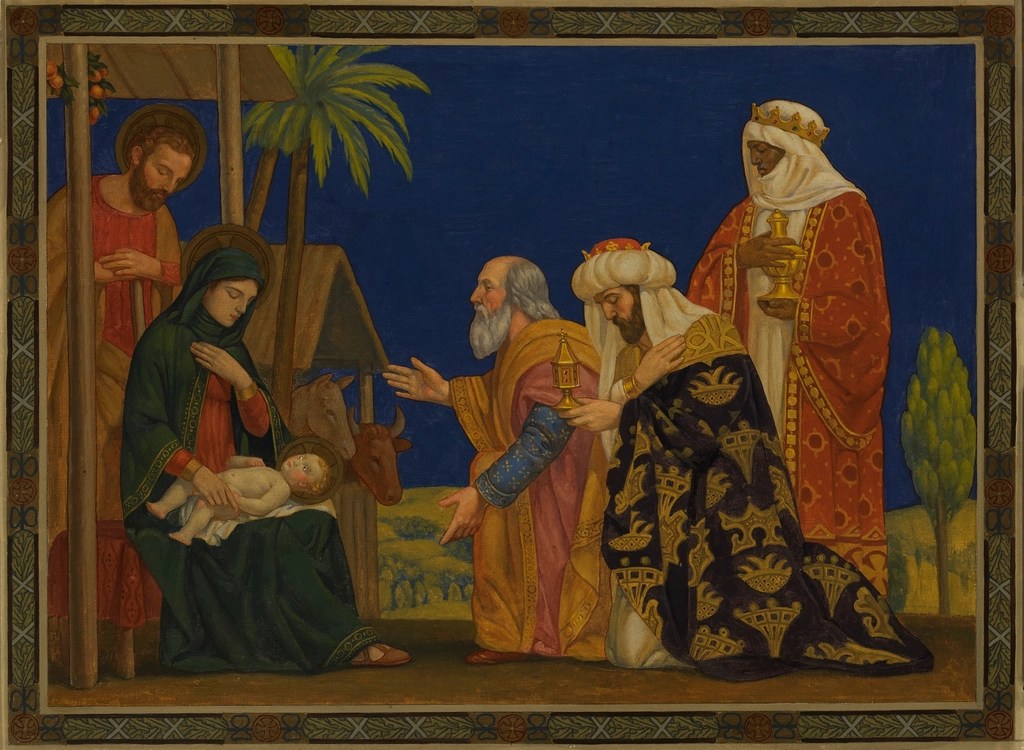
The Arrival of the Magi and the Revelation of the True King (Matthew 2:1-12)
This account begins “after Jesus was born in Bethlehem of Judea in the days of Herod the king” (Matthew 2:1). As we saw two weeks ago when we examined the Christmas story, the Prophet Micah foretold that this is where Messiah would be born: “But you, O Bethlehem Ephrathah… from you shall come forth for me one who is to be ruler in Israel” (Micah 5:2).
This town was not chosen for its size or influence, but because it is theologically significant, rooted in the covenant of David and the prophecy of the Messiah. The timing, too, is exact. The rule of Herod the Great, an Edomite by blood and a usurper of the throne of Judah. Herod’s reign signals the end of the line of Jewish kings. Jacob had foretold this moment: “The scepter shall not depart from Judah… until tribute comes to him; and to him shall be the obedience of the peoples” (Genesis 49:10). Christ comes precisely when the throne is occupied by one who does not belong to Judah. The time is ripe for the true King.
We then read that “Magi from the East”, Gentile sages, likely Babylonian or Persian astrologers, appear in Jerusalem asking, “Where is he who has been born king of the Jews?” (Matthew 2:2). Some have wondered if these men were Jews who remained in Babylon after the exile. This theory argues that perhaps these men had fractions of the scriptures passed down through the prophet Daniel, and so they knew the signs and longed to come seeking the Messiah. However, the more likely explanation is that these were not Jews at all.
Not only is the idea that the Magi are Gentiles the more likely scenario, it would also make their presence prophetic. Isaiah foresaw it: “Nations shall come to your light, and kings to the brightness of your rising” (Isaiah 60:3). Psalm 72 prays, “May the kings of Sheba and Seba bring gifts!” It is my belief that these men represent the nations coming to Christ.
They also serve as a rebuke. While they seek with joy, Herod trembles with fear, and Jerusalem, God’s own city, remains indifferent. This is a theme we will see play out in many gospel accounts, where those closest to the truth often miss it, while those furthest away come running when the light breaks in.
Another significant detail in this account is the star that led the Magi. Some have tried to use astronomy to figure out what star or celestial body this might have been. Some argue it was a planetary alignment, supernova, or perhaps a comet of some sort. Personally, I think this was a supernatural phenomenon. It seems that this light in the night sky moved. It stopped. It led. The fact that the star could “go before them,” reminds me of the pillar of cloud and fire that led Israel through the wilderness.
One of the early Christian theologians, Gregory the Great, noticed that angels were sent to the Jews, but a star was sent to the Gentiles. Why? Because “prophecy is for believers… but signs for unbelievers” (1 Corinthians 14:22). The Magi weren’t yet ready for speech. So the heavens themselves declared the glory of God. I don’t know if I can support that interpretation with full confidence, but I do find it very interesting and worth sharing. Regardless, the journey of the Magi was long, their knowledge incomplete, but God met them where they were and led them by light, just as He leads every soul that truly seeks.
But the light also exposed darkness. Herod, hearing of a rival king, reacts not with awe but with schemes. He feigns reverence: “Go and search diligently… that I too may come and worship him” (Matthew 2:8). But his lips lie. His heart plots murder.
And then, at last, the Magi arrive at a humble ordinary house, “And going into the house they saw the child with Mary, his mother, and they fell down and worshiped him” (Matthew 2:11).
This verse has caused some confusion among scholars for some time. In Luke’s account Christ is born in a manger in Bethlehem because there is no room in the inn. Eight days later he is circumcised and sometime later (at least 40 days later) the family makes a journey to Jerusalem in order to fulfill their temple obligations both for Mary and for Jesus their firstborn child. The confusion arises because Luke 2:39 says, “And when they had performed everything according to the Law of the Lord, they returned into Galilee, to their own town of Nazareth.”
However, Matthew 2:1–12 shows that they were still in Bethlehem when the Magi arrived, now residing in a “house” rather than a stable (Matthew 2:11). We also read that before they spend a time in Egypt waiting for a time when it would be safe for the Christ child to return to Israel. Only then does Matthew say they returned to Nazareth.
Here is the best way to harmonize these accounts in my opinion. I believe that Mary and Joseph journeyed to Bethlehem during a census and gave birth to Jesus in a manger. That night they were visited by shepherds who were told of the Christ child’s birth by angels. Eight days later Jesus was circumcised, probably in Bethlehem. I think Luke then skips over a period of time when nothing eventful occurred. Perhaps they went back to Nazareth before setting out to Jerusalem, or perhaps they stayed in Bethlehem with family once the crowd from the census departed before journeying to the temple.
Now after the temple there are two possible ways to interpret the text. Some say that they returned to Bethlehem for a season, which is where the events of Matthew 2 took place. Personally I think it is a stretch to try to fit all of Matthew 2 (including an extended period of time in Egypt) within a supposed gap of time in Luke 2:39. Again Luke says ““And when they had performed everything according to the Law of the Lord, they returned into Galilee, to their own town of Nazareth.”
Here is my take on the order of events. Everything in Luke 2:1-39 happened first, including a return to Nazareth for a time. Then, when Jesus was still under the age of two, the family returned to Bethlehem, probably to be with family. This is when the events of Matthew 2 took place.
Here is my reasoning:
- Matthew only says that this took place “After Jesus was born in Bethlehem…” He does not say how much time has passed since. I don’t think Matthew was saying that this account immediately followed the birth of Jesus, but rather that these events took place in the location where Jesus had been born (which was prophetically significant).
- Matthew does not depict Jesus in a manger and does not reference a census of any kind. If this was the same Bethlehem visit where Jesus was born, one would think there would be some mention of this.
- Jesus is staying in a house when the Magi find him, the most logical explanation is that this is a family home from Joseph’s family. Again, this would imply that time has passed since the overcrowded days of the census.
- Finally, Herod and the Magi imply that the child was born “when the star appeared” which indicates that a significant amount of time has passed to account for the length of the Magi’s journey. Jesus is also referred to as a child throughout the account.
Now ultimately the exact chronological order of events is not as important as the meaning of the events and the fact that these events did occur. I just wanted to take some time to show that these are not two contradictory accounts, but two accounts of events that took palace in the early life of Jesus. Luke focuses on the birth and his presentation in the temple. Matthew focuses on the Magi and his flight to Egypt. Luke focuses on Mary’s perspective. Matthew focuses on Joseph’s perspective. There may be minor differences of interpretation about the exact order or how much time passes between events, but there is no reason to conclude that either Matthew or Luke reported anything but truthful historical accounts.
Having taken that detour I want to get back to where we were in Matthew. Again the Magi arrive at a humble house in Bethlehem, “And going into the house they saw the child with Mary, his mother, and they fell down and worshiped him” (Matthew 2:11). Notice the faith of the Magi here. They did not see a golden crib or royal robes. They saw an ordinarily looking woman and an ordinary looking child. But they worshiped.
Then, they opened their treasures. Gold, for royalty. Frankincense, for divinity. Myrrh, for suffering. Many have noticed that gifts had a prophetic nature to them. Gold acknowledged Jesus as King. Frankincense, offered in temple worship, recognized Him as God. Myrrh, used in burial, foretold His death.
Finally, the account of the Magi ends with them, “being warned in a dream not to return to Herod, they departed to their own country by another way” (Matthew 2:12). Ultimately, Herod’s deception fails because God will intervene. As Scripture reminds us, “There is no wisdom, no understanding, no counsel against the Lord” (Proverbs 21:30).
The Flight to Egypt and the Preservation of the King (Matthew 2:13–15)
Once again, God speaks in a dream. “Rise, take the child and his mother, and flee to Egypt, and remain there until I tell you, for Herod is about to search for the child, to destroy him” (v. 13). As in chapter 1, when Joseph first received the astonishing news about Mary and the child she bore, so now in chapter 2, divine direction comes to him at night. And just as we saw in Matthew 1, Joseph is quick to obey. “He rose and took the child and his mother by night and departed to Egypt” (v. 14). No delay. No questions. No hesitation. This is the obedience of faith.
Joseph, in a sense mirrors Abraham before him, follows without knowing all the details. He acts because God has spoken. In this, he becomes a model for us. In times of uncertainty, when danger looms and the way is dark, the faithful response is not perfect understanding, but immediate trust and obedience.
But we might be tempted to ask, why Egypt? Why not Jerusalem or Nazareth? From a practical standpoint, Egypt was outside Herod’s jurisdiction and a natural place of asylum. But Matthew has more than geography in mind. Egypt is not just a safe place, it is a symbolic one. The Holy Family is sent into Egypt, just as the patriarch Jacob once did. While Judea plots the child’s death, Egypt, once the house of bondage, becomes the sanctuary of life. The nation that once enslaved God’s people now shelters their Savior. It’s a divine reversal and a call back to Israel’s history.
This journey also fulfills what the Lord spoke by the prophet Hosea: “Out of Egypt I called my son” (Hosea 11:1, quoted in Matt. 2:15). Hosea spoke of Israel as God’s “son” called out from Egypt in the Exodus. But now, Matthew sees in Jesus the true Son, the fulfillment of that pattern.
In Matthew’s theology, Jesus does not just fulfill prophecy, he also embodies it. The story of Israel is recapitulated in Him. He relives it, reinterprets it, and redeems it. Israel, called God’s “firstborn son” in Exodus 4:22, was called out of Egypt, wandered in the wilderness, received the Law, and failed to keep it. But Jesus, God’s only begotten Son, will retrace these steps in perfect obedience. He will come out of Egypt. He will be tempted in the wilderness. He will ascend a mountain to give the new Law. And He will succeed where Israel failed. The child in Mary’s arms is the one who will lead a greater exodus, not from Pharaoh, but from sin and death. In Jesus, the story is not erased, but rather it is completed.
The Massacre of the Innocents and the Clash of Kingdoms (Matthew 2:16–18)
When the magi, warned in a dream, refused to return to Herod, his true intentions are revealedl. “Then Herod, when he saw that he had been tricked by the wise men, became furious” (v. 16). Sadly the tyrant turns his fury upon Bethlehem’s children. He sends men with swords to slaughter every male child two years old and under. Incidentally, this gives us an approximate age for how old Jesus might have been in this account. Based on population estimates, perhaps twenty children died. A small number by historical standards, but an immeasurable grief by any measure.
A detail that makes this atrocity even worse is how deliberate and calculated the horror is. Herod, “figuring the age according to the time that he had ascertained from the wise men,” seeks to eliminate every possibility that the Christ child might survive. He didn’t just fly off the handles in rage, he took time to do the math and plan it out.
Herod’s massacre is the foreshadowing of another unjust death to come. The King he seeks to kill will someday be handed over again before a different Herod, this time not as an infant, but as a man. The cross will again reveal the violent resistance of the powers of this world to the reign of God.
It is also worth noting that we have people who follow Herod’s example even today. Herod is not the last ruler to fear the gospel. And the violence he unleashes is not confined to Bethlehem. Evil always resists the kingdom of heaven with power, with coercion, with brutality. And still it loses.
Even this horror, Matthew links a prophetic cry from Israel’s past: “Then was fulfilled what was spoken by the prophet Jeremiah: ‘A voice was heard in Ramah, weeping and loud lamentation, Rachel weeping for her children; she refused to be comforted, because they are no more.’” (Matt. 2:17–18; cf. Jer. 31:15)
Rachel, the matriarch of Israel, is imagined as weeping from her tomb. Ramah, just north of Jerusalem, was once a holding point where exiles were gathered before being taken to Babylon. It is the site of sorrow and separation. Now, as Bethlehem’s children are slain, the weeping begins again.
In Jeremiah’s day, the children of Israel were taken from their homes. Now, the children of Bethlehem are taken from the world itself. Both were victims of foreign violence. Both suffered for the sake of a larger story. But Matthew’s citation doesn’t end in grief. If we return to Jeremiah 31, we find that after the weeping comes hope:
“Thus says the Lord: Keep your voice from weeping, and your eyes from tears… there is hope for your future, declares the Lord, and your children shall come back to their own country.” (Jer. 31:16–17)
Yes, Rachel weeps. But God has not forgotten her tears. The same passage that begins in lament ends in restoration. In the shadow of massacre, Matthew dares to speak of hope.
It is also worth noting that the early Christians recognized these children as the first martyrs of Christ. Slain in the place of the Messiah. They believed, as do I, that these little ones, who were joined with Christ in his suffering, are also joined with Christ in His victory. Yes, evil is real. It kills. It weeps. It scars. But it does not win.
Jesus escapes, not because evil was absent, but because God was present. “He is my refuge and my fortress, my God, in whom I trust” (Ps. 91:2). Herod failed, not because Herod lacked power, but because God’s plan could not be thwarted.
And so it is for us. We are not promised a life free of pain or persecution. We are not exempt from the clash of kingdoms. But we are promised this: that the purposes of God stand firm in the face of evil. That no sword is stronger than His hand. That no grief escapes His notice.
The Return from Egypt and the Nazarene Identity (Matthew 2:19–23 (cf. Luke 2:39)
After some time in Egypt, we read that King Herod passed away, and Joseph received word from an angel that it was safe to return home. This is not to say that Jesus would be safe forever. Archelaus, son of Herod, was now ruling in Judea. And Archelaus was as cruel as his father, if not more unstable. But God does not lead the family back into danger. We read:
“And being warned in a dream he withdrew to the district of Galilee” (v. 22). And so the holy family settles in Nazareth. Not in Bethlehem, city of kings. Not in Jerusalem, city of the temple. But in Nazareth, a town so obscure, so insignificant, it would later provoke one of Jesus’ disciples to wonder, “Can anything good come out of Nazareth?” (John 1:46). Yet it is here that the Messiah will grow up.
Matthew adds, “And he went and lived in a city called Nazareth, so that what was spoken by the prophets might be fulfilled, that he would be called a Nazarene.” (v. 23)
This phrase has puzzled many. There is no single Old Testament verse that says, “He shall be called a Nazarene.” But, as one of the early church father’s Jerome pointed out, Matthew does not cite a prophet, but the prophets (plural). This is not a direct quotation, but a thematic fulfillment, a gathering of strands.
Some hear in the word “Nazarene” a connection to “nēṣer”, the Hebrew word for “branch.” Isaiah had declared, “There shall come forth a shoot from the stump of Jesse, and a branch (nēṣer) from his roots shall bear fruit” (Isaiah 11:1). Jesus is that branch, the unexpected, humble sprout from the felled tree of David’s line. Overlooked by men, chosen by God.
Other commentators think this may be a reference to Isaiah 53, where the suffering servant is “despised and rejected by men.” To be from Nazareth was to be disregarded. To be called a Nazarene was to be associated with what was lowly, what was unremarkable, what was easily dismissed.
Ultimately, the reason for Jesus growing up in Nazareth may be simpler than we imagine. Jesus did not come to be impressive. He came to save. He came not draped in honor but clothed in humility. God fulfills His highest purposes through what the world calls low. He does not need prestige, power, or platforms. To follow Jesus is to risk being dismissed. To be mocked. To carry a cross. It is to belong to a kingdom not of this world. It is to live under the banner of One who was born in a stable, fled as a refugee, raised in obscurity, and crucified in shame, only to rise in glory.
As Paul wrote, “God chose what is foolish in the world to shame the wise; God chose what is weak in the world to shame the strong” (1 Corinthians 1:27). He chose Nazareth and the carpenter’s home, just as he chose the cross.
 hardincrowder.com