Sermon Audio: LINK
Introduction:
This morning we celebrate the resurrection of Jesus Christ. It must be said, from the beginning, that the resurrection is not just an inspiring story, it’s the heart of our faith. This event is what sets Christianity apart. We don’t follow a dead teacher or a distant memory. We serve a risen Savior who conquered sin, defeated death, and offers eternal life to all who believe in Him.
This is not just another passage in Scripture. This is not just the story of a stone rolled away, or a tomb found empty. This is the story to end all stories, the axis on which all of history turns. Matthew 28:1–10 is the shattering of silence. It is the dawn that broke the back of death itself. The resurrection of Jesus Christ is not only a moment in time, it is the moment that transformed time itself.
This morning we celebrate the resurrection, but my prayer is that by the end of this message, you won’t just celebrate the resurrection, you’ll live in its power. So as I preach, I encourage you to ponder in your own hearts, “what does the resurrection mean for me?”
Scripture Reading:
Matthew 28:1-20, ESV:
Now after the Sabbath, toward the dawn of the first day of the week, Mary Magdalene and the other Mary went to see the tomb. And behold, there was a great earthquake, for an angel of the Lord descended from heaven and came and rolled back the stone and sat on it. His appearance was like lightning, and his clothing white as snow. And for fear of him the guards trembled and became like dead men. But the angel said to the women, “Do not be afraid, for I know that you seek Jesus who was crucified. He is not here, for he has risen, as he said. Come, see the place where he lay. Then go quickly and tell his disciples that he has risen from the dead, and behold, he is going before you to Galilee; there you will see him. See, I have told you.” So they departed quickly from the tomb with fear and great joy, and ran to tell his disciples. And behold, Jesus met them and said, “Greetings!” And they came up and took hold of his feet and worshiped him. Then Jesus said to them, “Do not be afraid; go and tell my brothers to go to Galilee, and there they will see me.”
While they were going, behold, some of the guard went into the city and told the chief priests all that had taken place. And when they had assembled with the elders and taken counsel, they gave a sufficient sum of money to the soldiers and said, “Tell people, ‘His disciples came by night and stole him away while we were asleep.’ And if this comes to the governor’s ears, we will satisfy him and keep you out of trouble.” So they took the money and did as they were directed. And this story has been spread among the Jews to this day.
Now the eleven disciples went to Galilee, to the mountain to which Jesus had directed them. And when they saw him they worshiped him, but some doubted. And Jesus came and said to them, “All authority in heaven and on earth has been given to me. Go therefore and make disciples of all nations, baptizing them in the name of the Father and of the Son and of the Holy Spirit, teaching them to observe all that I have commanded you. And behold, I am with you always, to the end of the age.”
The Resurrection (Matthew 28:1-10):
Our passage begins, “Now after the Sabbath, toward the dawn of the first day of the week, Mary Magdalene and the other Mary went to see the tomb” (Matthew 28:1, ESV). The sun was just beginning to cast its golden light across the sky, but something far greater than sunlight was about to break forth. The timing is no accident. The world is still dark. Shadows linger. Grief hangs heavy. The Sabbath had ended. The old week had run its course. But heaven had already begun a new creation in the drawing of the new week.
And who do we find walking in the early morning? Two women. Not noblemen. Not priests. Not kings. Two women. Mary Magdalene, a woman who had been delivered from the affliction of many demons. And “the other Mary” the mother of James and Joseph. These women were not apostles or theologians, but they had followed Jesus to the cross when the most faithful had run away in fear, and now they were the only ones brave enough to visit His tomb.
It is worth noting that, in a world that discounted women’s testimony, God chose these women to be the first heralds of resurrection glory. The overlooked became the first messengers entrusted with the gospel. The first preachers of the risen Christ were not men in priestly robes, but women in the funeral clothes of grief and mourning.
It is also worth noting that they came, as Matthew says, “to see the tomb.” They didn’t come expecting resurrection, they came with devotion, with tears, with loyalty. But faithfulness, even in sorrow, often finds itself standing in the presence of miracles.
Then we read in Matthew 28:2: “And behold, there was a great earthquake, for an angel of the Lord descended from heaven and came and rolled back the stone and sat on it.” (Matthew 28:2, ESV). The earth shudders, as if unable to contain the glory being unleashed. Just as it had trembled when the Son of God breathed His last (Matthew 27:51), now it quakes again as the King of Life draws His first breath on the other side of death. Heaven has invaded earth. The veil between worlds has been torn open. An angel descends, not quietly, but with thunder in his wings and glory in his stride.
We read that, “His appearance was like lightning, and his clothing white as snow.” (Matthew 28:3, ESV) How terrifying. How triumphant. How Holy. This heavenly messenger rolls back the stone, not to let Jesus out, but to let the world in. The angel sits on the stone that once sealed death’s claim. It is as if without saying a word heaven’s messenger was already declaring that the grave has been lost. Death had been dethroned.
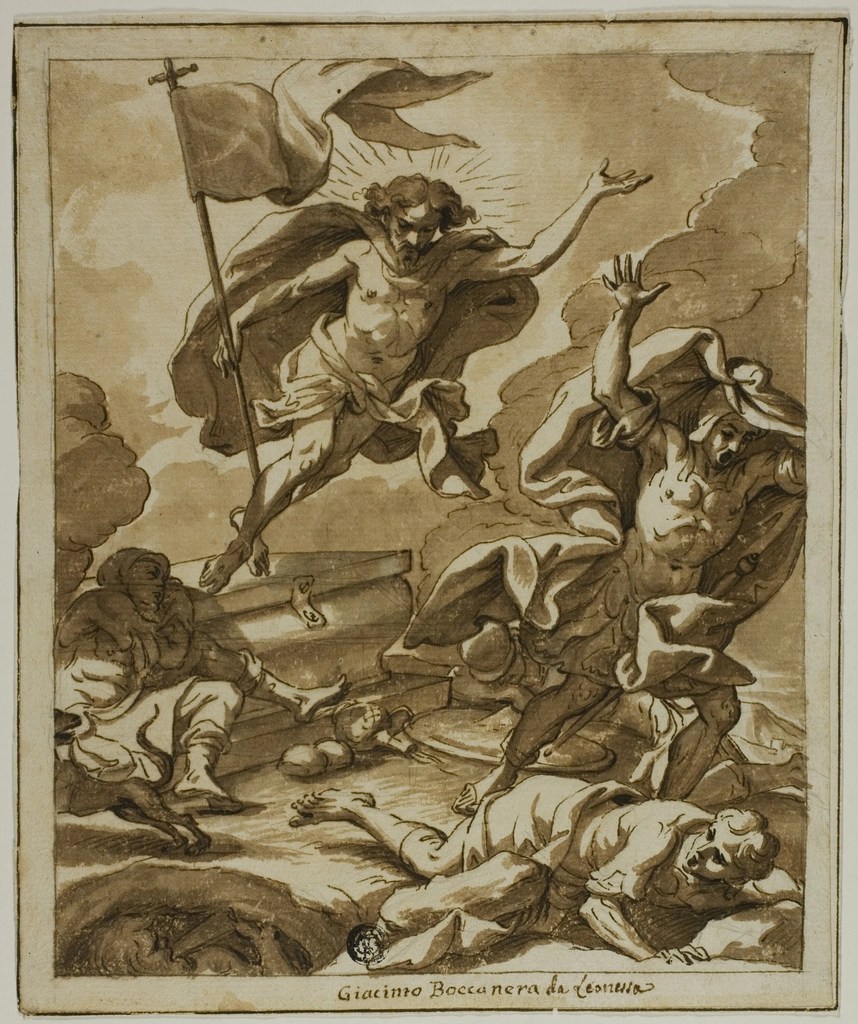
And what of the mighty Roman guards? “And for fear of him the guards trembled and became like dead men.” (Matthew 28:4, ESV). These were the elite guards of the Roman Empire, and yet they collapsed in fear and trembling. They “became like dead men” lying flat on their faces. Do you see the irony? Those who came to guard the dead now look dead themselves, while the one they came to contain has risen in power! This is what happens when the glory of God confronts the arrogance of men. Thrones tremble. Walls fall. The strong are humbled, and the risen Christ stands in victory.
“But the angel said to the women, He is not here, for he has risen, as he said. Come, see the place where he lay. Then go quickly and tell his disciples that he has risen from the dead, and behold, he is going before you to Galilee; there you will see him. See, I have told you.’” (Matthew 28:5–7, ESV)
Then the angel speaks, “Do not be afraid, for I know that you seek Jesus who was crucified.” (Matthew 28:5, ESV). He names their pain. He acknowledges their sorrow. But then comes the turn, the holy reversal, the sentence that shattered hell and set heaven roaring, “He is not here, for he has risen, as he said” (Matthew 28:6, ESV). Don’t rush past those words. Let them thunder in your soul. He is not in the grave. The tomb is empty. The stone is rolled. The King is alive. He has risen. Not only that, but he has risen, “as he said.” This was not plan B. This was not divine improvisation. This was fulfillment. Jesus had told them. The Scriptures had declared it. The prophets had pointed to it. And now, in dazzling reality, it has come to pass.
Then the angel gives a series of instructions for the women. First he calls them to “come and see” (v. 5). This is a reminder to us all that faith is not a blind leap but an active journey toward the Light. We are urged to approach, to inspect, to see for ourselves that these things are true. Next, we are commanded to “go quickly” (v. 6). This is not news to be hoarded or pondered in isolation; it is a message that burns like wildfire, demanding urgency and passionate proclamation. The grave has been conquered, and the world must know without delay that death has lost its hold. Finally, the angel exhorts, “tell His disciples” (v. 7). The angel’s words burst forth with the promise, “He is going before you to Galilee; there you will see him” (v. 7). The women obey. They run. Hearts pounding. Tears streaming. Scripture says they departed “with fear and great joy” (v. 8). What a mixture! Fear, because they’ve encountered the holy. Joy, because death has been undone.
And then Jesus Himself appears. No fanfare. No trumpet. Just a simple word: “Greetings.” The word is so ordinary. And yet from His lips, it becomes extraordinary. It’s as if He says, “Hello again.” As if to say, “It’s Me. Just as I promised.” And what do the women do? They fall at His feet. They cling to Him. They worship. And Jesus says what heaven has already said: “Do not be afraid.” And then “go and tell my brothers.” He calls the disciples “my brothers.” These were the same men who had fled in fear. Peter had denied Him. Thomas would doubt Him. But the first word from the risen Christ is not rebuke, it is good news and relationship. “Go tell my brothers.” The resurrection is not only about victory over death. It’s about the restoration of sinners. It’s about the embrace of mercy. It’s about the God who comes back not in wrath but in love.
II. The Resistance to the Resurrection
Now one would imagine that if a man rose from the dead, the world would stand still. That every skeptic would drop to their knees, and every doubter would be silenced by awe. But, as history shows us, this is not always so. The resurrection of Jesus Christ was not met with universal wonder. Yes, there was worship. But there was also resistance. Not all rejoiced. Not all believed. And the forces that nailed Him to the cross did not vanish when He stepped out of the grave.
Matthew writes, “While they were going, behold, some of the guard went into the city and told the chief priests all that had taken place” (v. 11, ESV). Even before the women could deliver the glad tidings to the disciples, a different message was already making its way to Jerusalem. The guards, Roman soldiers appointed to watch the tomb, rushed not to Pilate, but to the religious leaders who had commissioned their post.
These men had been stationed by Roman authority, but at the request of the very ones who cried for Jesus’ death. As Matthew records earlier, the chief priests and Pharisees warned Pilate, “Sir, we remember how that impostor said, while he was still alive, ‘After three days I will rise’” (Matthew 27:63, ESV). And now, with the earth shaken, the angel appearing, the stone rolled away, and the tomb gloriously empty, they report it all. Not just part of the event. Not a sanitized version. They told them everything.
And yet, faced with this staggering testimony, what do the leaders do? Do they pause? Do they ponder? Do they fall to their knees and repent? No. They double down. “And when they had assembled with the elders and taken counsel, they gave a sufficient sum of money to the soldiers and said, ‘Tell people, “His disciples came by night and stole him away while we were asleep’” (vv. 12–13, ESV).
Here, the power of sin reveals its true face. Confronted by the brilliance of truth, they conspire in darkness to smother it. Instead of surrendering to the risen Christ, they attempt to erase His rising. The council convenes once more, not to seek God, but to plot against Him. Just as they paid Judas to betray Jesus, now they pay the guards to betray the truth.
And what a laughable lie it is. “Say His disciples stole the body while you were asleep.” Think about that. If they were truly asleep, how could they know who came? Then there was the issue of the large stone that sealed the tomb, which would have required multiple people to move it. Doing so silently, without waking sleeping guards, is implausible at best. And beyond that, these were Roman soldiers under imperial orders, sleeping on duty wasn’t a minor offense, it was a capital one. Had they truly failed their post, their lives would have been forfeit.
And even as their lie falls apart under scrutiny, the resurrection account is bolstered by the testimony that followed. The lives of the disciples themselves stand as powerful, enduring testimonies to the reality of the resurrection. They were ordinary men who had once fled in fear when Jesus was arrested, who had hidden behind locked doors after His crucifixion, who had lost hope and scattered. But something changed.
After the resurrection, these same men became bold, fearless witnesses. They spoke openly in the very city where Jesus was crucified, proclaiming not only that He died, but that He rose again. They preached this truth before the same religious leaders who condemned their Lord, and they did so knowing it could cost them their lives.
What could explain this transformation? Not wishful thinking. Not delusion. And certainly not a lie. Liars make poor martyrs. Yet history tells us that nearly all of the apostles faced persecution, imprisonment, and death, and none of them recanted. Peter was crucified, James was executed by the sword, and others were stoned, beaten, imprisoned, or exiled. No one dies for what they know is a lie. But people may die for what they know is true.
These men were not defending a philosophy. They were proclaiming a fact: “We have seen the Lord.” The resurrection wasn’t a metaphor for them. It was a memory. A moment. A man who had once been dead, now alive, eating with them, speaking with them, commissioning them. Their courage, their message, their willingness to suffer, these are not the marks of deceivers, but of witnesses.
Ultimately the tale of the stolen body collapses under its own weight. It is not built on truth, but desperation. Lies try to chain the truth, but the truth was already out. The stone had been moved, not by mortal strength, but by heaven’s hand. The tomb was empty, not because of theft, but because Jesus lives! And when hearts are hardened, when pride is at stake, logic and reason are quickly sacrificed.
It is then that we see the machinery of corruption at work. “And if this comes to the governor’s ears, we will satisfy him and keep you out of trouble” (v. 14, ESV). The leaders promise protection, not for the innocent, but for the liars. They offer shelter, not for the risen Lord, but for the ones who would spread deceit. What began as religious opposition has become a political cover-up. They would shield the soldiers who distort the truth, but they would not shield the Savior who embodies it.
This is the cost of clinging to power. When influence matters more than integrity. When reputation is prized above repentance. When people fear losing control more than they fear God’s judgment. Is this not still the world we live in? Lies are defended. Truth is distorted. Power is preserved at all costs. Yet no bribe can seal the tomb again. No hush money can reverse the resurrection. No manipulation can undo what God has already accomplished.
The guards take the money. They sell the truth for a temporary gain. And from that day forward, the lie spreads. A counterfeit gospel begins its long shadow. Even as Matthew pens his Gospel, he notes that this false report still circulates. And today? It circulates still. The resurrection is denied, dismissed, explained away. They say it’s a myth. A metaphor. A fabrication. But falsehoods, however loud, are not eternal. The grave is still empty. And no narrative, no bribery, no revisionist tale can put Jesus back in the ground.
So what should we do in response? We do what the women did. We run. We tell. We proclaim. For though the resistance continues, the resurrection remains. Though men scheme, Christ reigns. Though darkness shouts, light still shines. Truth has walked out of the tomb. Hope cannot be silenced. And glory cannot be buried.
III. The Authority and Mission of the Risen Christ
As we begin to draw our message to a close, we turn to see the King issue His command. This final scene opens not in Jerusalem, the city of kings and priests, but in Galilee. Galilee is where Jesus began His public ministry (Matthew 4:15), and now it is where He launches His global one. The eleven, still wounded by Judas’s betrayal and their own failures, go where Jesus told them to go. Though they had earlier scattered in fear, they now gather again in hope.
Then we read, “And when they saw him they worshiped him, but some doubted.” (Matthew 28:17, ESV). Here we come to one of the most honest and human verses in the entire Gospel. “They worshiped him, but some doubted.” They saw Him, risen, glorified, and they fell to their knees in adoration. But some doubted. The Greek word here is a word that means hesitation, not rejection. It’s not the unbelief of a hardened heart, it’s the trembling of a heart overwhelmed by wonder. These are not skeptics, they are worshipers struggling to grasp glory.
And isn’t that often the experience of faith? To worship with wonder, and still wrestle with questions? To see Christ, and still tremble under the weight of it all? Matthew does not hide their doubt, he includes it. Matthew wants to show us that even the called, even the commissioned, can struggle to comprehend the majesty of Jesus. And yet, Jesus does not rebuke them. He does not disqualify them. He speaks to them. He entrusts them with the greatest mission the world has ever known. Faith is not the absence of questions, it is the decision to follow Jesus even when we do not yet see clearly.
Jesus steps forward, not as a humble rabbi, but as the risen King. He makes no small claim. He declares “all authority” not just spiritual influence, not partial jurisdiction, but total, universal dominion. This is the fulfillment of Daniel 7:14, where the Son of Man is given dominion, glory, and a kingdom that shall never pass away. Jesus had hinted at this authority throughout His ministry. He healed with a word, forgave sins, cast out demons. But now, following His resurrection, His authority is unveiled in full.
“All authority in heaven and on earth has been given to me.” That means the heavens and all they contain, angels, powers, thrones. That means the earth and everything in it; governments, empires, cultures, hearts. All of it belongs to Him. And Church, this is where our mission begins. Not with our plans, not with our cleverness, not with a denominational program, but with the sovereign authority of Christ. We go because He reigns. We proclaim because He rules. Our confidence in mission is rooted not in ourselves, but in the King who has all authority.
Then, with sovereign authority comes the divine commissioning of His Church: “Go therefore and make disciples of all nations.” This is not just a call to tell people the good news. It is a call to lifelong discipleship, a call to form followers of Jesus who are shaped by His Word and sent by His love. How do we do this?
First, we “go” not waiting for the world to come to us, but stepping into its needs of those around us with boldness and compassion. Some have argued that a better translation is “as you go” or “wherever you go.” The point being that if you are a Christian, you are never not on the mission field.
Secondly, we “baptize.” When someone chooses to follow Christ we welcome them into the covenant community. When we baptize a new believer we as a church take them under our watch and care. Baptism is not a finish line; it’s the beginning of a new life in Christ.
Finally, we “teach” not simply facts or theology, but obedience. Jesus doesn’t say, “teach them to know,” but “teach them to observe all that I have commanded you.” Christianity is not an event, it is transformation. It is not a one-time decision, it is a lifelong journey of becoming like Christ. And the scope of this commission is “all nations.” No tribe, no language, no border is beyond His reach. The good news of Jesus is not for one people, it is for all people.
And if you feel overwhelmed by this calling, know that Jesus never calls you to do it alone. He not only brings you into the Church, but also He guarantees you His presence in your life: “And behold, I am with you always, to the end of the age.” (Matthew 28:20b, ESV)
What a promise! As the disciples receive their mission, Jesus doesn’t end with more commands. He ends with comfort. “I am with you always.” He truly is Emmanuel, “God with us” (Matthew 1:23), not only in Bethlehem’s manger, not only on the Sea of Galilee, not only at the cross, but here, now, forever. “I am with you” not in theory, but in presence. “Always” not occasionally, not when we feel it, not when we’ve had a good week, but always.
And for how long? “To the end of the age.” Until the curtain falls on human history and the King returns in glory, Jesus will be with His people . He does not send us into the world alone. He walks with us, strengthens us, and sustains us.
Conclusion:
Christ is risen. He is risen indeed. The tomb is empty. Death is defeated. Forgiveness is offered. And the risen Jesus now calls you, not just to believe, but to follow. So come, bring your doubts, your failures, your fears, and receive grace. Go, make disciples, shine light, and live with resurrection hope. And know, He is with you, always, even to the end of the age. Let us not just celebrate the resurrection. Let us live it. Amen.
Daily Devotionals:
Monday: Dawn of the New Creation
Scripture:
Matthew 28:1–4
Devotional:
The resurrection begins in darkness. Before the sun rises, before clarity arrives, two faithful women walk to the tomb. They do not come expecting joy, they come in grief, still reeling from the events of Friday. And yet, they come. Their devotion in the dark becomes the doorway to revelation. So often in our faith, obedience must precede understanding.
Then the earth quakes. Heaven cannot stay silent. An angel descends, not gently, but with thunder and radiance. The tomb is opened not so Jesus can leave, He is already risen, but so we can look in. It is a holy invitation: Come and see. The stone that once sealed death is now a seat of victory. God has interrupted the natural with the supernatural.
This moment reminds us that God is always working, even in the dark. He moves when we least expect it. He reveals His glory to the humble, the grieving, the faithful few who still come to seek Him. This is how resurrection breaks into the world: not with spectacle, but with a summons to come, see, and believe.
Reflection Questions:
- When have you experienced God’s presence in a time of darkness?
- Why do you think God chose the women to be the first witnesses?
Prayer:
Risen Lord, thank You for meeting us in the shadows. Thank You that even when we cannot see clearly, Your power is already at work. Give us the courage to walk in faith, to show up in devotion, and to trust that You are moving behind the scenes. Help us to see the empty tomb with wonder. Amen.
Tuesday: He Is Not Here—He Has Risen
Scripture:
Matthew 28:5–7
Devotional:
The angel’s words are some of the most powerful ever spoken: “He is not here, for He has risen.” In that single sentence, history shifts. Death has been dethroned. Sin has been silenced. Despair has been undone. The angel doesn’t offer a metaphor or a myth. He offers a fact: Jesus, who was crucified, is no longer in the tomb.
But there’s more. “As He said.” Jesus had promised this all along. The resurrection was not a backup plan. It was always the plan. God’s Word had foretold it, and now, standing in a garden at sunrise, heaven affirms its truth. The angel does not call the women to blind belief, but to inspect, to witness, to go and tell. Faith begins by seeing the empty place where death once claimed victory.
This is the turning point of the gospel. Jesus has risen. And because He lives, everything changes. Fear is answered with peace. Sorrow is answered with joy. Death is answered with life. Our call is the same as theirs: Come and see. Go and tell.
Reflection Questions:
- How does the resurrection confirm the trustworthiness of Jesus’ words?
- What areas of your life are still marked by fear that the resurrection speaks against?
- Who in your life needs to hear the message of “He is risen”?
Prayer:
Lord Jesus, You are alive, just as You said. Let those words echo in my heart today. Silence the voice of fear in my life. Strengthen my faith, that I may both see and share the good news. Use my voice to proclaim that death has been defeated, and life has won. Let the power of Your resurrection shape every part of who I am. Amen.
Wednesday: Encountering the Risen Christ
Scripture:
Matthew 28:8–10
Devotional:
The women ran from the tomb with a mix of “fear and great joy.” Isn’t that how we often feel when God moves? We are in awe, humbled, thrilled, but overwhelmed. And then Jesus meets them. Not with flashes of glory, but with a word as ordinary as “Greetings.” How gentle. How personal. In that moment, grief gives way to worship.
They fall at His feet. They do not ask for proof. They do not analyze. They worship. Jesus then entrusts them with a mission: “Go and tell my brothers.” These are not just instructions, they are words of grace. The disciples had failed. They had fled. And yet Jesus calls them “brothers.” The resurrection brings not only victory, but restoration.
We all carry failure. We all know the sting of regret. But Jesus’ resurrection meets us with mercy. His first act as the risen King is not to judge, but to gather. Not to punish, but to forgive. His grace calls us “brother,” “sister,” “beloved.” Come to His feet today, and worship the One who still says, “Do not be afraid.”
Reflection Questions:
- Why is it significant that Jesus appears first to the women?
- How does Jesus’ greeting and commission speak to His heart toward the broken?
- How can you worship Christ more fully today?
Prayer:
Jesus, thank You for meeting us where we are. Thank You that Your first words are peace, not condemnation. Thank You for calling us brothers and sisters, even when we’ve failed. Let my heart cling to You in worship today. Fill me with courage to go and tell of Your mercy and love. Amen.
Thursday: The Resistance to Resurrection
Scripture:
Matthew 28:11–15
Devotional:
Not everyone celebrates the resurrection. Even as the women run to tell the disciples, another message begins to spread, a lie. The guards, terrified by the angel, report what they saw. The religious leaders do not deny it. Instead, they cover it up. The truth is too threatening to their power. They would rather silence heaven than surrender.
This is the world we live in. Lies often wear the robe of credibility. Truth is costly, and many would rather preserve their position than confess their need for grace. But no bribe can roll the stone back into place. No scheme can bury the Savior again. The resurrection happened. The tomb is still empty. And truth, once risen, does not lie down.
So what is our role? To be people of light in a world of spin. To tell the truth with love. To resist the pressure to remain silent. The world may resist the resurrection, but the Church must not. Let our lives be living proof that Jesus lives; bold, unashamed, radiant with hope.
Reflection Questions:
- Why do you think the resurrection is still so resisted today?
- Where are you tempted to stay silent about the truth of Jesus?
- How can you reflect the power of the risen Christ in your daily life?
Prayer:
God of truth, give me courage to speak and live boldly. Strengthen me when I face resistance. Help me to trust that no scheme of man can undo Your victory. Let my life be a living witness that Jesus lives and that His love is stronger than the grave. Amen.
Friday: The Doubt That Meets Worship
Scripture:
Matthew 28:16–17
Devotional:
This verse is a gift to every believer who has ever wrestled with questions. The disciples saw Jesus. Risen. Glorious. And they worshiped, but some doubted. That’s not the doubt of rebellion, it’s the doubt of wonder. The kind that trembles in the presence of glory. The kind that says, “This is too much to take in.”
What does Jesus do? He doesn’t send them away. He doesn’t scold them. He commissions them. Jesus entrusts the Great Commission to people who worship and doubt at the same time. Faith is not having it all figured out. Faith is holding on to Christ even when your heart is overwhelmed.
So if you find yourself in that tension of believing yet wrestling with faith, you are not alone. You are not disqualified. Jesus uses people like you. He sends people like us. Our questions do not cancel our calling. They can become the soil where deeper worship grows.
Reflection Questions:
- When have you felt the tension between faith and doubt?
- What does this passage teach you about Jesus’ patience?
- How can doubt become a doorway to deeper discipleship?
Prayer:
Lord, I believe. Help my unbelief. Thank You for meeting me in my hesitation. Thank You that You don’t cast me out for questioning, but call me closer. Deepen my worship. Strengthen my heart. Let me follow You even when I don’t fully understand. Amen.
Saturday: The Mission and the Presence
Scripture:
Matthew 28:18–20
Devotional:
Jesus’ final words in Matthew are not simply commands, they are a commissioning. He declares His authority over heaven and earth, and then He sends His people out. The gospel is not a private treasure. It is a world-changing call. We are not saved to sit still. We are saved to go, to make disciples, to teach, to baptize, to proclaim.
But Jesus does not send us alone. His promise is as great as His command: “I am with you always, to the end of the age.” This is Emmanuel, God with us, walking beside us every step of the journey. We do not bear witness in our own strength, but in His. We do not make disciples by our own wisdom, but by His Word and presence.
This is resurrection life: bold mission and constant communion. We walk into a broken world with the good news that Christ is risen. And we walk with Christ Himself. So live today with confidence. The tomb is empty. The world needs to know. And Jesus goes with you.
Reflection Questions:
- How does Jesus’ authority give you confidence in your mission?
- What does it mean to you that He is “with you always”?
- Who in your life needs to be discipled or encouraged?
Prayer:
King Jesus, You have all authority, and yet You choose to be with me. Send me into the world with courage and compassion. Help me to teach, to disciple, and to love like You. Let Your presence be my strength and Your promise my anchor. May I live and speak as one who knows that You are risen and reigning forever. Amen.
 hardincrowder.com