Sermon Audio: LINK
Scripture Reading:
1 Samuel 1:1–28, ESV
There was a certain man of Ramathaim-zophim of the hill country of Ephraim whose name was Elkanah the son of Jeroham, son of Elihu, son of Tohu, son of Zuph, an Ephrathite. He had two wives. The name of the one was Hannah, and the name of the other, Peninnah. And Peninnah had children, but Hannah had no children.
Now this man used to go up year by year from his city to worship and to sacrifice to the LORD of hosts at Shiloh, where the two sons of Eli, Hophni and Phinehas, were priests of the LORD. On the day when Elkanah sacrificed, he would give portions to Peninnah his wife and to all her sons and daughters. But to Hannah he gave a double portion, because he loved her, though the LORD had closed her womb. And her rival used to provoke her grievously to irritate her, because the LORD had closed her womb. So it went on year by year. As often as she went up to the house of the LORD, she used to provoke her. Therefore Hannah wept and would not eat. And Elkanah, her husband, said to her, “Hannah, why do you weep? And why do you not eat? And why is your heart sad? Am I not more to you than ten sons?”
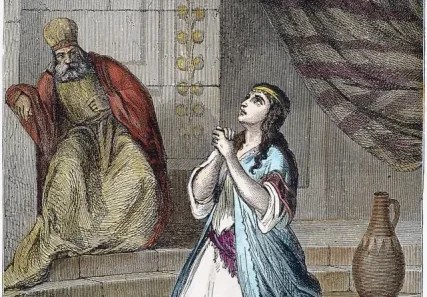
After they had eaten and drunk in Shiloh, Hannah rose. Now Eli the priest was sitting on the seat beside the doorpost of the temple of the LORD. She was deeply distressed and prayed to the LORD and wept bitterly. And she vowed a vow and said, “O LORD of hosts, if you will indeed look on the affliction of your servant and remember me and not forget your servant, but will give to your servant a son, then I will give him to the LORD all the days of his life, and no razor shall touch his head.”
As she continued praying before the LORD, Eli observed her mouth. Hannah was speaking in her heart; only her lips moved, and her voice was not heard. Therefore Eli took her to be a drunken woman. And Eli said to her, “How long will you go on being drunk? Put your wine away from you.” But Hannah answered, “No, my lord, I am a woman troubled in spirit. I have drunk neither wine nor strong drink, but I have been pouring out my soul before the LORD. Do not regard your servant as a worthless woman, for all along I have been speaking out of my great anxiety and vexation.” Then Eli answered, “Go in peace, and the God of Israel grant your petition that you have made to him.” And she said, “Let your servant find favor in your eyes.” Then the woman went her way and ate, and her face was no longer sad.
They rose early in the morning and worshiped before the LORD; then they went back to their house at Ramah. And Elkanah knew Hannah his wife, and the LORD remembered her. And in due time Hannah conceived and bore a son, and she called his name Samuel, for she said, “I have asked for him from the LORD.”
I. A Family in the Shadow of Barrenness
In our passage this morning we are first introduced to Elkanah, a man from Ramathaim-Zophim in the region of Ephraim, a descendant of Zuph. In that time, a person’s heritage and hometown carried weight. However, as far as I could find in my studies in preparing this sermon, there’s nothing particularly extraordinary about these names.
Ramathaim-Zophim (also called Rama) was a small town near the border of Ephraim and Benjamin, just a few miles from Jerusalem. Zuph was a Levite whose only other appearance in scripture was a passing reference to him in 1 Chronicles 6:26. Neither one of these details seems all that significant. However, the lack of importance may ironically be exactly what makes them meaningful.
As we see in so many places in scripture, God often works through people and places that the world tends to overlook. Lest we forget, Jesus himself was born in the little town of Bethlehem, and spent most of his life in the backwoods town of Nazareth. Maybe the fact that Elkanah was seemingly a nobody of no real importance is the very point God was trying to make.
But what else do we know about Elkanah? We read in the next verse, “Elkanah had two wives. The name of the one was Hannah, and the name of the other, Peninnah. And Peninnah had children, but Hannah had no children” (1 Samuel 1:2, ESV). Here, we’re introduced to a tension in Elkanah’s home. Now, the Bible records many instances of polygamy, but we must always remember that the Bible never approves of the practice. In fact, more often than not, polygamy in scripture is a sign that something dysfunctional has happened in the family, and it always brings heartache.
Hannah is named first, likely indicating she was the first wife. Her name means “grace” while Peninnah’s name means “fruitful.” One wife had children, the other wife had favor. While it is not outright stated, it is not hard to infer that Elkanah loved Hannah deeply and may have only married Peninnah because Hannah couldn’t give him children. That does not make it ok or acceptable. In fact, it only made poor Hannah’s heartache worse. She had to live with a woman who forever reminded her of what she was unable to do for her husband.
II. A Woman Broken in Spirit
Then, in 1 Samuel 1:4–8, we catch a glimpse of Hannah’s life during the family’s annual journey to Shiloh, the religious center of Israel at the time. They went to worship and offer peace offerings, as was their custom. It was meant to be a joyful occasion; a celebration of blessing, unity, and devotion before the Lord.
But for Hannah, it was anything but joyful. Scripture tells us, “Elkanah would give portions to Peninnah his wife and to all her sons and daughters. But to Hannah he gave a double portion, because he loved her…” (vv. 4–5).
Hannah had Elkanah’s heart. Peninnah had his children. Elkanah tried to ease her sorrow with affection; offering more food, more kindness, more attention. But no gesture, however loving, could fill the space in her heart that longed for a child. And the text doesn’t let us miss the source of her sorrow: “the Lord had closed her womb.”
That’s a hard truth. It’s one thing to suffer from circumstance, another to suffer from God’s own hand. And yet, as the early church father Chrysostom wrote, “It was not out of hatred… but to open to us the values the woman possessed… that we might see the riches of her faith.”
God wasn’t punishing Hannah. He was preparing her. Her barrenness wasn’t meant to break her, it was meant to build in her a deeper, tested faith. In our culture of instant answers and quick fixes, this can feel harsh. But God is more interested in our holiness than our comfort. He will allow what hurts if it forms what heals. Even now, He may use heartache to shape Christlikeness in us.
Yet even as Elkanah tried to comfort Hannah, Peninnah made her pain worse: “And her rival used to provoke her grievously to irritate her… So it went on year by year… Therefore Hannah wept and would not eat” (vv. 6–7).
Notice how Peninnah is introduced, not as “the other wife,” but as Hannah’s rival. The Hebrew word suggests imitation, envy, provocation. Peninnah did all three. She couldn’t win Elkanah’s love, so she competed with children. She saw Hannah’s sorrow and poured salt into the wound. And where did she do it most? At Shiloh. In the very place meant for worship.
That’s often where spiritual wounds cut the deepest, not in the world, but in the sanctuary. When you come hoping for healing, and instead find hostility or misunderstanding. That’s what happened to Hannah. Just when she should have been comforted, she was crushed. “She wept and would not eat.” She wasn’t just sad, she was undone.
Elkanah, trying again to help, says: “Hannah, why do you weep? And why do you not eat? And why is your heart sad? Am I not more to you than ten sons?” (v. 8). He means well. He loves her deeply. But his words, though sincere, miss the point. Sometimes those who love us most still don’t fully understand us. Elkanah tries to reason with her pain, not realizing it’s not logical. It’s spiritual. Emotional. Deep. This wasn’t just about a child. It was about identity, purpose, and a hope that felt endlessly deferred.
You may have had moments like that, when you’re surrounded by love, yet still feel alone in your ache. Or maybe you’ve been in Elkanah’s place, watching someone you care about suffer, unsure how to help. In either case, here is our hope: God hears what others can’t. He understands the groans too deep for words. Where human compassion falls short, His comfort reaches deeper still.
III. A Prayer That Pierces Heaven
Now there comes a point in many believers’ lives when the pain is too deep to explain and too heavy to carry alone. Words fail, but the soul keeps speaking. That’s where we find Hannah. She has wept. She has been mocked. She has been misunderstood. And now she rises, not in bitterness toward God, but with a prayer that pierces heaven.
In verse 9, Hannah stands and goes to the temple. She rises not because she feels strong, but because she is desperate. She goes not to speak to the priest, but to reach the King. She walks right past Eli the priest because she needs more than a religious mediator, she needs divine intervention.
And where is Eli? “Sitting on the seat beside the doorpost of the temple of the Lord” (v. 9). The priest is seated. Watching. Passive. But Hannah, the barren woman, is on her feet. Praying. Pouring herself out. It’s not a small detail. God is showing us something. Renewal won’t come through Eli or his sons. It will come through the faith of a woman who stood alone in prayer!
Verse 10 tells us, “She was deeply distressed and prayed to the Lord and wept bitterly.” This is not a polished prayer. It’s not tidy or composed. It’s raw. It’s prayer through tears. Prayer that comes from affliction, not articulation.
And yet, what she says is stunning: “O Lord of hosts, if You will indeed look on the affliction of Your servant… but will give to Your servant a son, then I will give him to the Lord all the days of his life, and no razor shall touch his head” (v. 11).
She invokes the name “Lord of Hosts,” only the second time in Scripture this name is used. It’s the title of the God who commands angel armies. Why that name? Because to Hannah, her barrenness didn’t just feel like sorrow, it felt like spiritual warfare. Like an attack she couldn’t win. So she calls on the only One who could fight for her.
And three times, she calls herself His servant: “If You will look on the affliction of Your servant… and not forget Your servant… but will give to Your servant…” This is full surrender. And notice, her prayer isn’t just for personal relief. It’s a vow. “If You give him to me, I’ll give him right back.” She doesn’t ask for a child to keep. She asks for a child to give to the Lord.
“All the days of his life… no razor shall touch his head.” That’s a Nazirite vow. A life set apart for God; no wine, no haircuts, no compromise. She hasn’t even conceived, and yet she’s already dedicating him completely. No one asked her to. But that’s faith. That’s worship. That’s surrender before the answer comes.
I believe Hannah’s story is a model for every believer who has ever cried out through pain. Sometimes God does His greatest work through private suffering. Sometimes the most powerful prayers come from the most wounded hearts. Sometimes the next move of God doesn’t start with a king or a priest, but with someone standing in prayer.
Hannah also shows us that prayer is more than asking. It’s offering. She didn’t just request a child, she offered her whole motherhood. And that’s the kind of prayer God delights to answer. So if you’re in that place today, if your prayers have been soaked in tears, if you feel forgotten, don’t stop praying. Don’t stop rising. God is not deaf to the brokenhearted. The same God who heard Hannah hears you. And what you place in His hands in surrender, He can use in His unfolding plan of redemption.
IV. A Priest Misjudges, A God Blesses
We read in verse 12, “As she continued praying before the Lord, Eli observed her mouth.” But instead of recognizing the sincerity of her worship, Eli assumes the worst: “He took her to be a drunken woman” (v. 13).
It’s a tragic irony. The high priest of Israel, tasked with representing the people before God, completely misreads a faithful woman’s cry as the behavior of a drunk. In a culture where outward, vocal prayer was common, Hannah’s silent, anguished devotion seemed suspect to him. But Eli’s mistake reflects something deeper: true spiritual desperation is often misunderstood.
We shouldn’t be surprised when real worship makes religious people uncomfortable. Sometimes the most powerful moments in God’s presence don’t look polished, they look messy. Sometimes it’s not strength that fills the room, but weakness. But while Eli was watching her mouth, God was listening to her soul. Others may misread your pain. Even spiritual leaders may not see your heart. But God hears the groanings too deep for words. He sees the faith others overlook.
Hannah responds with grace and clarity: “No, my lord, I am a woman troubled in spirit… I have been pouring out my soul before the Lord” (v. 15). Then she adds something easy to miss but important: “Do not regard your servant as a worthless woman” (v. 16). The word translated “worthless” here is a phrase that, in the next chapter, is used to describe Eli’s own sons. The irony is striking. The one wrongly labeled corrupt is the one truly faithful, while the real corruption lives under Eli’s own roof.
Now do not miss her description of prayer: “I have been pouring out my soul before the Lord.” That’s the heart of true prayer. Not performance, but surrender. Not noise, but honesty. Prayer is less about volume and more about vulnerability. Sometimes, the softest prayers, the tears no one hears, go the farthest in heaven.
“Eli answered, ‘Go in peace, and the God of Israel grant your petition that you have made to him’” (v. 17). He still doesn’t know the specifics of her request, but now he sees her clearly, and he blesses her. And in that blessing, there’s a hidden promise. The Hebrew word Eli uses for “petition” is “sha’al,” the same root used in the name Samuel, which means “asked of God.” So when Eli says, “May God grant your petition,” it sounds like, “May God give you Samuel.” Every time his name is spoken, it will be a reminder: God hears. God answers.
Then something beautiful happens. “Hannah went her way and ate, and her face was no longer sad” (v. 18). Nothing external has changed. She’s not pregnant yet. There’s no visible sign of the miracle to come. But her heart has shifted. Her burden is lifted, not because her circumstances have turned, but because her soul has been heard. She leaves with peace, not proof.
That’s real faith. She didn’t wait for a sign. She didn’t need confirmation. Her confidence wasn’t in the outcome, but in the One who listened. Maybe that’s what some of us need today, not the final answer, not the fulfilled promise, but the quiet confidence that God has heard us. That He sees. That He cares. As the psalmist later wrote: “The Lord is near to the brokenhearted and saves the crushed in spirit” (Psalm 34:18, ESV). Sometimes, peace doesn’t come when the prayer is answered. Sometimes it comes when we finally know we’ve been heard.
V. A Promise Fulfilled, A Child Given Back
Then we read these beautiful words in verse nineteen: “And the Lord remembered her” (v.19). These words echo back to Genesis 30:22 where, “God remembered Rachel, and God listened to her and opened her womb.” Just like Rachel, Hannah had been overlooked by others. Just like Rachel, her name had been synonymous with silence and sorrow. But now, “God remembered her.”
This is not to say that God had forgotten her. No, in the language of Scripture, “remembered” means that God moved to act. He had heard every tearful whisper, and now He answered. “And in due time Hannah conceived and bore a son.” (v.20) Not immediately. Not instantly. But in due time. God’s timing is rarely fast in the way we measure fastness, but never late. The womb that was closed is now opened. And then, “She called his name Samuel, for she said, ‘I have asked for him from the Lord.’” (v. 20).
We read in the next few verses that Hannah raised Samuel until the child was weaned, which in this day and age was around the age of two or three. This wasn’t just about nursing, it was about raising the child to the age when he would be able to be raised under Eli’s care.
As the father of a three year old I cannot imagine how difficult it must have been to entrust Samuel into the care of Eli, but this is what it meant to give him to the Lord’s service as she had promised. And then comes one of the most beautiful scenes in all of Scripture: “And she said, ‘Oh, my lord! As you live, my lord, I am the woman who was standing here in your presence, praying to the Lord. For this child I prayed, and the Lord has granted me my petition that I made to him. Therefore I have lent him to the Lord. As long as he lives, he is lent to the Lord.’” (vv.26–28)
Ultimately, Hannah’s story is not a story of clutching tightly, it is a story of letting go. Hannah returns to the very place she wept bitterly and hands over the one she wept for. The wordplay is intentional: “I have lent him to the Lord.” Again, the Hebrew root “sha’al” here is used. We translate it as “lend” but in Hebrew it is the same verb. Samuel was asked of God, Samuel was given by God, and now Samuel is now returned to God.
Conclusion:
At the close of this chapter, we have a woman whose tears have turned to testimony. A home that has become a vessel for national renewal. A boy whose name whispers prayer and promise every time it’s spoken. Samuel will go on to lead a nation, anoint kings, and speak for God in dark times. But his story began in a faithful woman’s vow, and it was sealed in her obedience.
Sometimes the most powerful act of worship is not in what we receive, but in what we release. Let us bring Him our longings. Let us dedicate our best, our first, our deepest desires, not because we must, but because we know: Everything we have was asked of God, and given by grace.
Closing Prayer:
Gracious and faithful God, we come before You now, just as Hannah once did, with hearts open, longings laid bare, and trust placed fully in Your hands. Thank You for hearing the prayers we are sometimes too broken to speak aloud. Thank You that You are near to the crushed in spirit, tender toward the weary, and faithful to fulfill Your promises in Your perfect time.
Lord, today we ask for the courage to rise and pray, even when it feels like all strength is gone. We ask for the faith to surrender our deepest desires to You, knowing that You are good, even when the way is hard. Teach us, like Hannah, not just to seek blessing, but to offer back to You everything we hold dear. Form in us the kind of trust that is not dependent on outcomes, but rooted firmly in Your character.
We leave here today remembering that You hear, You see, and You remember. May our lives, like Hannah’s, become living testimonies of Your grace and faithfulness. And as we walk from this place, may we carry the quiet confidence that, even now, You are at work, in the waiting, in the weeping, and in the answering. We pray all of this in the mighty name of Jesus, Amen.
Daily Devotionals:
On Sunday, we looked at the story of Hannah from 1 Samuel 1 and saw how God often begins His greatest works through overlooked people and painful places. We saw how Hannah, though deeply loved by her husband, carried a sorrow that human affection could not heal, and how her broken spirit led her to rise in desperate, surrendered prayer. Though she was misunderstood even by the priest, God heard her cries and, in His perfect timing, answered her prayer with the gift of a son. We saw that Hannah’s faith did not stop with receiving God’s blessing; she fulfilled her vow and returned Samuel back to the Lord, teaching us that true worship is found not just in what we receive, but in what we release. Through Hannah’s story, we were reminded that God hears, God remembers, and God uses our surrender to fulfill His greater plans.
Monday: The God Who Sees the Overlooked
Scripture Reading:
“There was a certain man of Ramathaim-zophim of the hill country of Ephraim whose name was Elkanah the son of Jeroham, son of Elihu, son of Tohu, son of Zuph, an Ephrathite. He had two wives. The name of the one was Hannah, and the name of the other, Peninnah. And Peninnah had children, but Hannah had no children.” – 1 Samuel 1:1–2 ESV
Devotional:
At the beginning of 1 Samuel, we meet Elkanah, a seemingly ordinary man from a small, unremarkable town, Ramathaim-Zophim. His lineage and home do not stand out in the grand story of Scripture. Yet it is here that God chooses to begin a new chapter of His redemptive work. Over and over again in the Bible, God bypasses the famous, the powerful, and the influential, working instead through those the world often overlooks.
This truth should both humble and encourage us. It reminds us that no place is too small, no background too plain, and no story too simple to be used by God. Just as Jesus came from Bethlehem and lived in Nazareth, Elkanah’s uncelebrated background sets the stage for God’s mighty hand to move. What the world deems insignificant, God declares valuable.
Today, you might feel like your life is lived far from the spotlight, tucked away in quiet routines and unseen acts of faithfulness. Take heart. God sees, values, and uses the faithfulness of the forgotten places and people. Your story matters deeply to Him.
Reflection Questions:
1. In what areas of your life do you feel overlooked or unseen?
2. How does it encourage you to know that God works through the seemingly insignificant?
3. What small acts of faithfulness can you offer to God today, trusting He will use them?
Prayer:
Lord, thank You that You see and know every detail of our lives, even when the world passes us by. Help me to remember that my worth is not in the eyes of others but in Your calling. Use my quiet faithfulness for Your glory, and let my heart rest in the truth that You delight in using what seems small to accomplish what is great.
Tuesday: When Blessings Are Divided and Hearts Are Broken
Scripture Reading:
“Now this man used to go up year by year from his city to worship and to sacrifice to the Lord of hosts at Shiloh, where the two sons of Eli, Hophni and Phinehas, were priests of the Lord. On the day when Elkanah sacrificed, he would give portions to Peninnah his wife and to all her sons and daughters. But to Hannah he gave a double portion, because he loved her, though the Lord had closed her womb.” – 1 Samuel 1:3–5 ESV
Devotional:
In Elkanah’s household, love and pain lived side by side. Though he loved Hannah deeply, her inability to bear children brought sorrow to their marriage and led to difficult choices. In the ancient world, a woman’s worth was often measured by her ability to produce heirs, and Hannah’s empty arms must have felt like a heavy public shame. Elkanah’s gifts and double portions could not soothe the deeper ache within her heart.
Hannah’s pain reminds us that sometimes, the people who love us most still cannot fill the places where we feel broken. Their kindness, though genuine, cannot reach the hidden wounds of the soul. There are griefs in life that only God can truly understand and heal.
You may be in a season where even the good things cannot quiet your longing or dry your tears. If so, take courage. God is not distant from your sorrow. He knows the weight you carry and stands ready to meet you not just with blessings, but with Himself.
Reflection Questions:
1. Have you ever experienced a time when human comfort was not enough?
2. What desires or dreams do you need to lay before God in prayer today?
3. How does it change your perspective to know that God understands your deepest sorrows?
Prayer:
Father, thank You for loving me in the places where no one else can reach. Help me to trust You with the longings and disappointments that weigh heavily on my heart. Remind me that while human love may fail to fully comfort, Your love never will. Meet me in my need and carry me with Your peace.
Wednesday: Rising to Pray in the Midst of Pain
Scripture Reading:
“After they had eaten and drunk in Shiloh, Hannah rose. Now Eli the priest was sitting on the seat beside the doorpost of the temple of the Lord. She was deeply distressed and prayed to the Lord and wept bitterly. And she vowed a vow and said, ‘O Lord of hosts, if you will indeed look on the affliction of your servant and remember me and not forget your servant, but will give to your servant a son, then I will give him to the Lord all the days of his life, and no razor shall touch his head.'” – 1 Samuel 1:9–11 ESV
Devotional:
There came a moment when Hannah could no longer simply endure her pain. She rose from her place and went directly to the temple, desperate not for human intervention but for divine help. Her prayer was not polished or rehearsed. It was raw, born out of deep anguish, and filled with an earnestness that can only come from a broken heart.
In her prayer, Hannah not only asked for a son, but vowed to give him back to God. This shows the purity of her heart in suffering. Her greatest desire was not to possess a blessing, but to see God’s purposes fulfilled through her life. It was not about personal gain, but about kingdom impact.
When our pain drives us to prayer rather than despair, powerful things can happen. God does not ask us for perfect prayers. He desires honest hearts. Like Hannah, we are invited to rise, even when it hurts, and pour out our souls to the One who fights for us.
Reflection Questions:
1. What is one area of your life where you feel the need to rise and pray today?
2. How does Hannah’s example challenge the way you approach God in prayer?
3. What would it look like to offer your requests back to God with open hands?
Prayer:
Lord of Hosts, I come to You in my weakness and need. Teach me to pray not just for my desires, but with a heart ready to surrender everything to You. Help me rise in faith even when it feels easier to sit in despair. I trust that You are listening, even to my broken words.
Thursday: Misunderstood but Not Unseen
Scripture Reading:
“As she continued praying before the Lord, Eli observed her mouth. Hannah was speaking in her heart; only her lips moved, and her voice was not heard. Therefore Eli took her to be a drunken woman. And Eli said to her, ‘How long will you go on being drunk? Put your wine away from you.’ But Hannah answered, ‘No, my lord, I am a woman troubled in spirit. I have drunk neither wine nor strong drink, but I have been pouring out my soul before the Lord. Do not regard your servant as a worthless woman, for all along I have been speaking out of my great anxiety and vexation.’ Then Eli answered, ‘Go in peace, and the God of Israel grant your petition that you have made to him.’ And she said, ‘Let your servant find favor in your eyes.’ Then the woman went her way and ate, and her face was no longer sad.” – 1 Samuel 1:12–18 ESV
Devotional:
As Hannah prayed, Eli the priest misunderstood her deep, silent anguish and accused her of being drunk. It is a painful reminder that even in the most sacred places, and from the most spiritual people, our heartache can be misread. But while Eli watched her lips, God was listening to her heart.
Hannah responded with humility and honesty, correcting the misunderstanding without anger. She knew that ultimately, it did not matter if Eli saw her. What mattered was that God had heard her. In that moment, a blessing was spoken over her, and though nothing had yet changed externally, her heart found peace because she trusted she had been heard.
Sometimes, the greatest gift is not the immediate answer to our prayer, but the assurance that our prayer has been received. When others misjudge us, God understands us. When others miss our pain, God gathers every tear.
Reflection Questions:
1. Have you ever felt misunderstood in your time of suffering?
2. How does it comfort you to know that God hears even what others cannot see?
3. How might you respond with grace the next time someone misunderstands your heart?
Prayer:
God who hears the silent cries, thank You that when others misjudge or overlook me, You never do. Teach me to rest not in human understanding, but in Your perfect knowledge of my heart. Fill me with peace as I pour out my soul to You, trusting that You are near to the brokenhearted.
Friday: Trusting the Timing of God
Scripture Reading:
“They rose early in the morning and worshiped before the Lord; then they went back to their house at Ramah. And Elkanah knew Hannah his wife, and the Lord remembered her. And in due time Hannah conceived and bore a son, and she called his name Samuel, for she said, ‘I have asked for him from the Lord.'” – 1 Samuel 1:19–20
Devotional:
The Scripture says, “The Lord remembered her.” It does not mean He had forgotten Hannah, but rather that He chose to act in His perfect time. After years of longing, after countless tears and prayers, Hannah conceived and gave birth to Samuel, whose name would forever testify that he was “asked of God.”
God’s timing is often different from our own. We long for immediate answers, but God often allows waiting to refine our faith and deepen our dependence on Him. When the answer comes, it is sweeter for the struggle, more precious for the patience it required.
If you are in a season of waiting, do not lose heart. Trust that God has not forgotten you. He sees every prayer, every tear, every hope. In due time, He will act, and when He does, you will know that it was His faithful hand that brought it to pass.
Reflection Questions:
1. In what areas of your life are you still waiting for God to move?
2. How can remembering Hannah’s story help you persevere in your waiting?
3. What does it mean for you to trust God’s timing even when you do not see immediate results?
Prayer:
Faithful God, help me trust that You are never late, even when my heart feels tired of waiting. Strengthen my faith in the waiting, and help me cling to the truth that You remember me. May my hope be rooted in Your goodness and my heart find peace in Your promises.
Saturday: The Beauty of Surrendered Blessings
Scripture Reading:
“And she said, ‘Oh, my lord! As you live, my lord, I am the woman who was standing here in your presence, praying to the Lord. For this child I prayed, and the Lord has granted me my petition that I made to him. Therefore I have lent him to the Lord. As long as he lives, he is lent to the Lord.’ And he worshiped the Lord there.” – 1 Samuel 1:26–28 ESV
Devotional:
After receiving the very blessing she had longed for, Hannah fulfilled her vow and gave Samuel back to God. She did not cling to the gift, but entrusted him fully into God’s service. In doing so, Hannah teaches us that true worship is not just receiving from God, but offering everything back to Him.
It must have been an incredibly painful and beautiful act of surrender. Yet Hannah trusted that the God who gave Samuel to her could care for him better than she ever could. Her heart was not centered on holding tight to blessings, but on honoring the Giver.
In your own life, God may be calling you to offer something precious back to Him. It may feel costly, but remember: whatever we release into His hands becomes part of His greater story. Nothing surrendered to God is ever wasted.
Reflection Questions:
1. Is there something God is asking you to release back to Him today?
2. How does Hannah’s story encourage you to trust God with your most precious gifts?
3. What would it look like to worship through surrender in your current season?
Prayer:
Gracious Giver of every good gift, thank You for Your faithfulness and kindness. Teach me to hold my blessings with open hands, ready to offer back to You whatever You entrust to me. Give me the courage to surrender, the faith to trust, and the joy to worship You in all things.
 hardincrowder.com