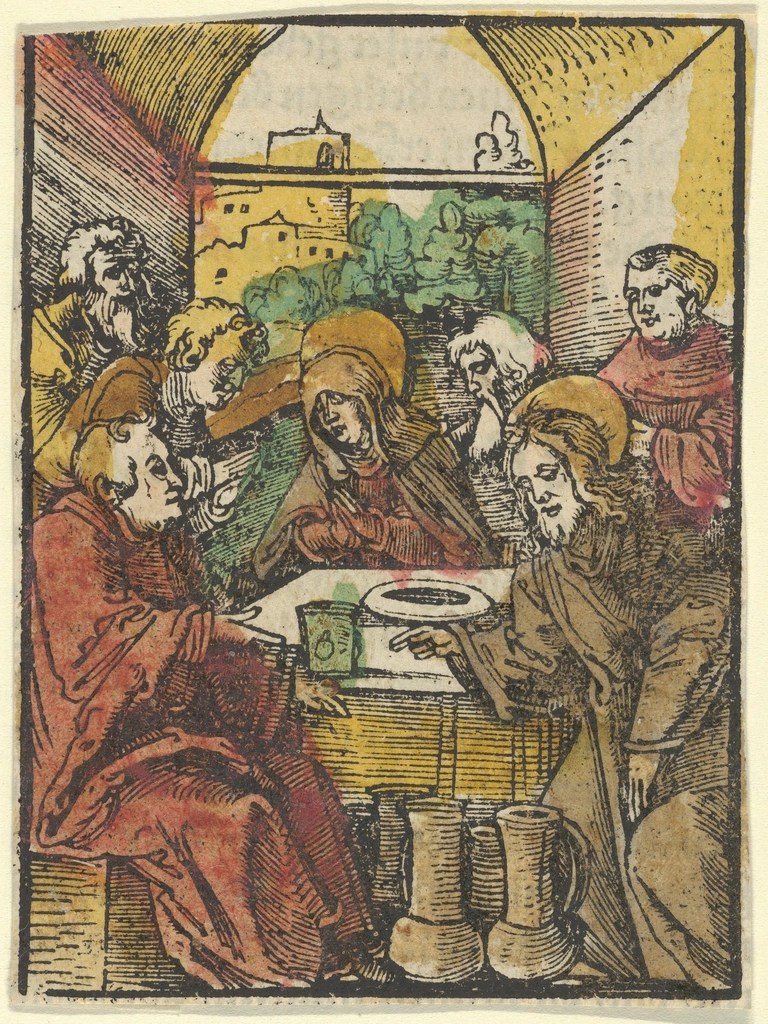
I. A Wedding in Cana (John 2:1–2)
John begins this account with what seems like a simple phrase: “On the third day…” (John 2:1). At first glance, it might appear to be nothing more than a chronological note. However, “the third day” recalls the resurrection, the climactic moment when Jesus rose from the grave, revealing the fullness of His glory. Could John be offering a subtle preview of that final triumph? It is certainly possible. The Gospel of John often layers meaning in this way.
However, a more immediate and grounded connection links this moment to the conversation Jesus had with Nathanael just a few verses earlier. In John 1:50 to 51, Jesus says, “You will see greater things than these… Truly, truly, I say to you, you will see heaven opened, and the angels of God ascending and descending on the Son of Man.” These words are rich with Old Testament imagery and eschatological hope. They suggest that something greater is about to begin, a revelation of divine glory through the person and work of Christ. And now, three days later, the first of Jesus’ signs appears, confirming the promise. Nathanael sees the first glimpse of the “greater things” Jesus had foretold.
Still, it is not the setting that I believe carries the most theological weight: “There was a wedding at Cana in Galilee” (John 2:1). Cana was a small, inconspicuous village tucked away in the hills of Galilee. It was not famous, influential, or spiritually prominent. And that is precisely what makes it significant. Jesus chooses to unveil His glory not in the courts of Jerusalem or the temple precincts, but at a humble wedding feast in a quiet village. He steps into the realm of the ordinary. He sanctifies the everyday.
Cyril of Alexandria, one of the early church’s most prominent voices, recognized the significance of this location. He noted that this first miracle did not take place in the holy city, but in what Isaiah had described as “Galilee of the Gentiles.” Cyril connected it to Isaiah 9:1, which says, “In the former time he brought into contempt the land of Zebulun and the land of Naphtali, but in the latter time he has made glorious the way of the sea, the land beyond the Jordan, Galilee of the nations.” The prophet Isaiah had spoken of a time when light would dawn in this darkened region. And here, in Cana, that light begins to shine. The Word made flesh chooses to manifest His glory not among the elite, but among the common and the overlooked. The Messiah reveals Himself in the margins of society, not at its center.
There is a detail in this passage that can be easily overlooked. John writes, “Jesus also was invited to the wedding with His disciples” (John 2:2). At first, it seems like a casual note. But it holds deep meaning. The One who spoke the universe into being, the Creator of man, woman, and marriage itself, does not remain distant from our celebrations. He is not detached from our joys. If anyone had the right to remain aloof from earthly customs and pleasures, it was Jesus. Yet He accepts the invitation. He comes. He attends the wedding. And more than that, He blesses it with His presence. He dignifies human love by entering into it with divine attention.
This matters. It speaks to the heart of the incarnation. Jesus does not despise the things of earth. He does not disdain family, or joy, or marriage. He affirms them, and in so doing, He elevates them. His first public act is not a sermon, not a demonstration of political power, but simply showing up to a wedding. He enters into human celebration to reveal divine glory. Joy matters. Community matters. Marriage, when ordered rightly in love and faithfulness, is a holy thing.
And this wedding, though real and historical, offers a glimpse into the union between Christ and His people, the Church. Just as Adam was given a bride in the garden, so the second Adam, Christ, comes to redeem and restore His bride. He enters into our humanity, takes on our nature, and prepares us for a greater wedding still to come. Ultimately, the wedding at Cana foreshadows the great marriage supper described in Revelation 19, when the heavenly Bridegroom will be joined to His people in everlasting joy.
In Cana, Jesus gives us more than wine. He gives us a sign that God is with us in our everyday lives. He sanctifies the ordinary with His extraordinary presence. The first miracle is a quiet but glorious whisper of the kingdom that is coming, the joy that awaits, and the Bridegroom who has come to claim His bride.
II. The Wine Runs Out
A Jewish wedding in first-century Galilee was no small event. These celebrations were the highlight of village life. Weddings were joyful, extended gatherings that could last an entire week. There was music and dancing, storytelling and singing, abundant food, and of course, flowing wine. Hospitality was not optional; it was essential. Weddings were public declarations of honor and unity, not only between bride and groom but also between families and their wider community. To host a wedding was to stake your reputation on your ability to provide and celebrate well.
From what we can gather, this wedding in Cana was likely a more modest affair. The couple may have given everything they had to make it a joyful day. It is not that they were careless, more likely, they were simply limited. They spared no expense, but had very little expense to spare. And yet Jesus shows up. He is not above attending such an event. He comes willingly to share in their joy. He brings with Him a small band of newly gathered disciples, likely five or six men at this point: Andrew, Peter, Philip, Nathanael, and perhaps John along with another unnamed follower.
John also gives us this quiet detail: “The mother of Jesus was there” (John 2:1). Some have speculated that the family may have been related to Mary, or that she may have had a role in helping with the arrangements. Scripture does not tell us precisely how the hosts knew Jesus or His mother. What we do know is that Jesus, Mary, and His disciples were all invited. They were meant to be there.
By the time Jesus arrives, the celebration is in full swing. Laughter rings through the house. Music plays. Children dance. Guests mingle and toast. The wine flows. And then, somewhere behind the scenes, a quiet crisis emerges. The wine has run out.
Today, if a wedding reception runs short on drinks or appetizers, it might cause a few raised eyebrows or awkward glances. But people would likely shrug it off and move on. Not so in the ancient Jewish world. In this culture, running out of wine at a wedding was a devastating failure. Wine symbolized joy, blessing, and abundance. To run out was more than a logistical misstep, it was a public embarrassment, a deep shame for the hosts, and a breach of the sacred duty of hospitality. In a tightly knit village, it could tarnish a family’s reputation for years.
This is the moment when Mary speaks. She does not panic. She does not command. She simply turns to Jesus and says, “They have no wine” (John 2:3). Notice what she does not say. She does not demand a miracle. She does not offer a solution. She merely presents the need. It is the quiet confidence of a mother who has walked many years with her son. By this point, we are not told that Jesus has worked any public miracles. His birth was certainly surrounded by the miraculous. Shepherds, magi, angels, Simeon, Anna—all bore witness. Mary had treasured these things in her heart. But the text gives no indication that she had seen a miracle since. Yet she trusts. She knows His character. She believes that wherever Jesus is, needs can be met.
The Reformation theologian Martin Bucer offers a beautiful insight here. He suggests that Mary, in this simple phrase, teaches us how to pray. She speaks a few words, but they are full of trust. She does not bargain or plead. She brings the concern to Jesus and leaves it with Him. This is the very essence of Christian prayer, not twisting God’s arm, but placing our cares in His hands with quiet confidence.
Then comes Jesus’ reply: “Woman, what does this have to do with me? My hour has not yet come” (John 2:4). To modern ears, that can sound sharp, even dismissive. But the Greek phrase here is nuanced and difficult to translate directly. It is not disrespectful, especially in the cultural setting. “Woman” in this context is not harsh. It is formal and distancing, yes, but not rude. Jesus will use the same word when He speaks to Mary from the cross: “Woman, behold your son” (John 19:26). Even in His dying breath, He honors her.
Why then does He say “woman” instead of “mother”? I believe it is because Jesus is reminding Mary, and all who would hear, that He is no longer simply her child. His mission is now fully in view. He is the Son of God. He will honor her, but He will not be managed by her. As John Calvin explains, Jesus responds in such a way that clarifies His divine calling: “I act according to the will of My Father, not according to human agendas.” This is not a cold rebuke but a gentle reorientation. The time has come for Mary to relate to Jesus not just as her son, but as her Lord.
Jesus continues: “My hour has not yet come.” In the Gospel of John, “the hour” always points forward to the cross, the resurrection, and His glorification (John 7:30; 8:20; 12:23; 13:1; 17:1). So when Jesus says this, He is not simply delaying a miracle. He is saying, “I will act, but in a way that anticipates something far greater. I have not come just to provide wine for a wedding. I have come to offer the wine of the new covenant, sealed in My blood. I have come for a better feast, a better bride, and a better joy.”
Jesus is revealing that every sign points beyond itself. Every miracle is a window into His ultimate mission. As the early church father Irenaeus wrote, “With Jesus, nothing is incomplete or done at the wrong time.” The Lord who created time is never hurried and never late. His actions unfold according to the perfect will of the Father.
And yet, despite all of this, Mary responds with faith. She turns to the servants and says, “Do whatever He tells you” (John 2:5). That is the last recorded line Mary speaks in the Gospels. What a legacy. She does not insist. She trusts. And she invites others to do the same.
Here we see the heart of discipleship. Bring your needs to Jesus, and then yield to His wisdom. He is the sovereign Lord. We may come freely, but we do not command. We present our needs, and we wait in faith. Jesus will act, not always as we expect, but always as is best. He may provide more than we hoped, or in ways we never imagined. But He will never fail.
He is the one who brings joy where shame once loomed. He is the one who transforms water into wine, and sorrow into song. And He begins His ministry not by calling down fire from heaven, but by quietly rescuing a family from disgrace, and turning their ordinary celebration into a sign of eternal joy.
II. Water Becomes Wine (John 2:6–10)
John tells us, “Now there were six stone water jars there for the Jewish rites of purification, each holding twenty or thirty gallons” (John 2:6). These weren’t ordinary vessels. They were stone jars used for ritual cleansing, designed to comply with the ceremonial purity laws of the Mosaic covenant. People would use these to wash their hands, utensils, and other items before eating, not primarily for hygiene, but as a symbolic act of religious devotion. They were an outward sign of inward holiness.
But there’s an irony embedded in this scene. These stone jars, standing quietly at the edge of a celebration, represented a system that could only cleanse the outside, never the heart. They were signs of human effort toward holiness. These jars speak to the limitations of the old covenant. They could contain water, but they could not produce life. They could purify the surface, but they could not change the soul.
And what does Jesus do with them? He does not rebuke the practice. He does not smash the jars or call them obsolete. He fills them. He redeems them. He takes the old and infuses it with new. He does not come to abolish the law, but to fulfill it (Matthew 5:17). He takes what had symbolized preparation for cleansing and uses it to showcase true transformation.
The sheer scale of this act is staggering. Each jar holds between twenty and thirty gallons. Multiply that by six, and you have between 120 and 180 gallons of wine. That is not moderation. That is abundance. That is the language of the kingdom of God, grace upon grace, as John had already written (John 1:16). This is a flood of blessing. The old covenant was sufficient for its time, but the new covenant overflows.
Jesus now gives a simple command: “Fill the jars with water” (John 2:7). And the servants obey. They fill them “up to the brim,” a quiet yet significant detail. There is no room left for anything else. They have obeyed completely, holding nothing back. And then, without drama or spectacle, the transformation occurs. No hand is raised. No word is recorded. There is no thunder from heaven. And yet the water has become wine.
This is often how Jesus works. He works in quiet authority, in stillness and power. The same Word that said in Genesis 1, “Let there be light,” now says to water, “Become wine.” And it obeys. No fermentation. No time lapse. Just creative authority, the Creator at work again, doing what only God can do. Water cannot become wine by its own effort. But by the word of Christ, it does. And so it is with the human heart. We bring nothing but emptiness, and Christ supplies everything.
The servants now draw some out and bring it to the master of the feast. His job is to preserve the dignity of the celebration, to ensure that the bridegroom is honored. He takes a sip and is astonished. Not only is there wine, but it is excellent wine. In fact, it is the best wine of the night. He calls over the bridegroom, puzzled and impressed, and says: “Everyone serves the good wine first, and when people have drunk freely, then the poor wine. But you have kept the good wine until now” (John 2:10).
The master of the feast speaks better than he knows. He is thinking only in terms of wedding etiquette, but his words point to a deeper truth. This is how the world gives: it dazzles early, then diminishes. Sin promises joy at first, but it leaves bitterness. The world front-loads its pleasures. It sparkles in the beginning, but always ends in emptiness. That is the pattern of the flesh. It offers the good wine first, then brings out the cheap substitute.
But with Jesus, it is the reverse. He saves the best for last. His blessings begin quietly. The more we walk with Him, the more we see that His goodness deepens. The best is never behind us, it is always ahead.
This sign, then, is more than a miracle of generosity. It is a revelation. The water of the Law has given way to the wine of the Gospel. The jars of purification are now filled with the wine of celebration. The old covenant pointed to cleansing. The new covenant brings rejoicing. Jesus does not discard what came before. He fulfills it, transforms it, and surpasses it.
This miracle is a signpost to the greater joy of the kingdom. It declares that the Messiah has come to bring something new, something abundant, something better. The wine of Jesus is not only the fruit of the vine. It is the joy of salvation, the wine of the messianic banquet, the symbol of His blood poured out for many. The first public sign of His glory points forward to the cross, where He would provide a better wine still.
And notice that the miracle happens quietly. The guests do not know. The master of the feast does not know. Only a few are aware; Mary, the servants, the disciples. But it does not make the miracle any less real. Often, the works of Christ are done in hidden places, unnoticed by the crowds. The world may miss it, but those who have eyes to see will know: the kingdom of God has come, and it is full of joy.
V. Glory Revealed, Faith Awakened (John 2:11)
John brings the account to a close with a sentence full of weight and wonder: “This, the first of his signs, Jesus did at Cana in Galilee, and manifested his glory. And his disciples believed in him” (John 2:11).
Notice John’s language: he does not call this a “miracle,” though it most certainly is one. He calls it a “sign.” That distinction is important. A miracle can amaze. A sign must also reveal. Signs are purposeful. They point beyond themselves to something greater. So what does this sign reveal?
Jesus could have chosen a very different way to begin His public ministry. He could have healed a blind man or raised the dead. He could have driven out a demon or cleansed a leper. But He chose instead to quietly turn water into wine at a village wedding. Why begin here? Because this first sign was meant to give us a preview of His mission and of the nature of the kingdom He brings.
This sign is not merely about divine power, it is about divine identity. It is not simply a display of what Jesus can do, but a revelation of who Jesus is. What does He reveal?
He reveals that He is the Creator, for only the Creator can speak to the elements and have them obey. The same Word that brought the universe into being now brings wine from water with no process and no passage of time.
He reveals that He is Lord, because the elements submit to His authority. Nature itself bends to His command. The water does not resist. The transformation is instant and complete.
He reveals that He is Grace, because what He gives is not just sufficient, it is superabundant. It is better than what came before. He does not simply replenish what was lost; He exceeds it. He gives the good wine last, because His blessings do not diminish over time, they increase.
And He reveals that He is the fulfillment of the Law and the bringer of the New Covenant. The stone jars were used for rites of purification under the Mosaic system. They symbolized law, ritual, and obligation. But Jesus takes what belonged to the old covenant and fills it with the joy of the new. Wine in Scripture is a symbol of joy, of celebration, of covenant blessing. The Law could clean the outside, but grace changes the inside. Jesus does not discard the old. He fulfills it and transforms it.
This is not only a change in beverage. It is a shift in covenant substance. It is a sign that something greater than the temple is here. A new era has dawned. Grace has come in person.
John then writes: “And his disciples believed in him.” Did they not already believe? In one sense, yes, they had followed Him. But their faith was still forming. Their understanding was still shallow. This sign deepens their trust. It opens their eyes a little more. It stirs their hearts toward deeper confidence and reverence. As is so often the case, faith does not leap fully formed. It grows through revelation. It matures as we behold His glory.
And note this: Jesus does not speak a word during the miracle itself. He commands the servants to fill the jars, but He says nothing when the transformation occurs. He does not proclaim His power or announce His identity. But the wine speaks volumes. This is the purpose of the sign, not just to meet a need, but to reveal the glory of Christ and awaken faith in those who see it. As John later writes, these signs are recorded “so that you may believe that Jesus is the Christ, the Son of God, and that by believing you may have life in his name” (John 20:31).
 hardincrowder.com