Sermon Audio: LINK
I. The Majesty of the Mundane (1 Samuel 9:1–10:16)
This morning I’d like to begin with a simple encouragement: Don’t overlook the ordinary. God often hides His greatest works in the quiet corners of daily life. Heaven doesn’t always announce its mission with trumpets, and angels don’t always sing above open fields. More often than not, the divine moves through the unnoticed and the everyday.
Just ask Saul, son of Kish. There was no thunder on a mountaintop for him. No burning bush. No dream in the night. Just a father’s command and some lost donkeys.
“Now the donkeys of Kish, Saul’s father, were lost. So Kish said to Saul his son, ‘Take one of the young men with you and arise, go and look for the donkeys.’” (1 Samuel 9:3)
That’s it. A missing animal report. A simple errand. But behind it God is moving in unseen ways. Don’t despise small beginnings. Saul set out chasing donkeys, and returned with the oil of kingship dripping from his forehead. God turned a mundane task into a divine appointment. When His hand is in it, the ordinary becomes sacred.
C. S. Lewis once noted that, while mothers often focus on nurturing and safety in the home, fathers are more focused on preparing their children for life beyond it. That is what Kish was doing. When he told Saul to go find the donkeys, he wasn’t just assigning a chore. He was giving Saul an opportunity to prove himself.
Saul was given responsibility, and he would have to demonstrate initiative and courage to complete the task. A small step, but a real one, into manhood. What Kish could not have known is that God was going to use that simple errand to place his son on a path toward kingship:
Fathers, you’re not just raising good citizens. You’re raising warriors. Saints. Leaders. Kish didn’t know that “Go find the donkeys” was a launch into destiny. The task looked simple, but it demanded grit, patience, and faith. And that’s the training ground for kings. Our children don’t grow strong on comfort; they grow strong on mission.
Meanwhile the Lord had spoken to the prophet Samuel:
“Tomorrow about this time I will send to you a man from the land of Benjamin, and you shall anoint him to be prince over my people Israel.” (1 Samuel 9:16)
Saul wandered. He searched. He came back with nothing in hand. But God wasn’t measuring the success of the mission by donkey retrieval. While Saul was looking for livestock, God was looking for Saul.
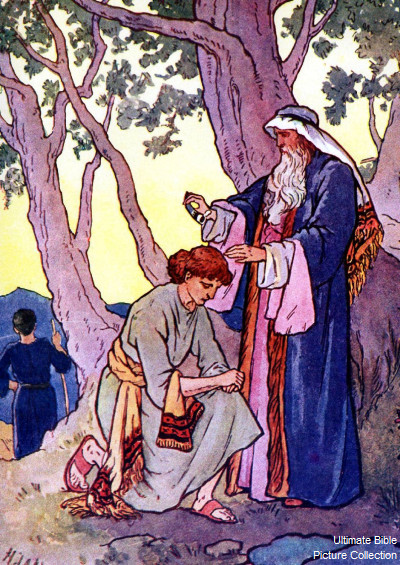
Then came the meeting with Samuel. And with it, a word from heaven. Saul enters the village and Samuel speaks:
“Here is the man of whom I spoke to you. He it is who shall restrain my people.”(1 Samuel 9:17)
Stunned, Saul tried to excuse himself:
“Am I not a Benjaminite, from the least of the tribes of Israel? And is not my clan the humblest of all the clans?” (1 Samuel 9:21)
Yes, Saul, you are small. But your God is not. Fathers, don’t lose heart if your child seems unsure, awkward, or behind. You’re not responsible for greatness, only godliness. The crown doesn’t go to the flawless, but to the faithful.
When Saul is anointed, he receives three signs:
The donkeys are found — God takes care of the past.
Bread is given by strangers — God provides in the present.
The Spirit rushes upon him — God empowers for the future.
“Then the Spirit of the Lord will rush upon you, and you will prophesy with them and be turned into another man.” (1 Samuel 10:6)
This is how God works. He doesn’t wait for you to be ready. He makes you ready. He doesn’t call the equipped, He equips the called. And when the Spirit moves, we are changed.
So, men of God: fathers, mentors, grandfathers, and even great grandfathers, know that your whispered prayers at night, your honest work, your faithfulness when no one sees, these are not forgotten. They are seeds. And the God who sees in secret will reward openly.
And to those without children, don’t think this message skips you. There are many young souls in need of guidance, adrift without anchor. Perhaps your call is to be a spiritual father.
If I can speak plainly for a moment, we are facing a crisis. Too many young men are drifting. Graduation rates among young men are falling. Employment looks fine on paper, but six to eight percent of young men are not even looking for work. The CDC reports that although overall suicide is 11th leading cause of death across all age groups, it is the second-leading cause among young men ages 10-34.
If I can be blunt, young men as a whole are not ok. They are drifting through life. Many are isolated, angry, and searching for meaning in all the wrong places. They are shaped more by the internet than by fathers or mentors. They are being fed rage, not truth.
The solution is not found on the internet, it is found in presence. Godly masculinity is formed through Scripture, service, community, and sacrifice. When a man shows up with humility, ready to love, serve, and honor Jesus, people notice. That kind of man changes everything around him. But men like that are not born. They are formed. They are discipled. They are shaped by others who are willing to care, show up, and invest.
That is what Jesus did. He chose twelve young men. He taught them, walked with them, poured into them, and prepared them to do the same. You may not be able to mentore twelve young men, but maybe you can mentor one.
And remember Saul. He did not become king when he found the donkeys. He became king when he obeyed his father’s simple request. Faithfulness in small things opens the door to everything else. Be present. Show up. Love deeply. Lead humbly. That is how men are formed. That is how lasting legacies are built.
II. When Hiding Feels Easier Than Leading (1 Samuel 10:17–27a)
Now returning to the text, what began with lost donkeys has now moved to a national gathering. Saul obeyed his father’s simple instruction. That step of faith led to an encounter with Samuel, a private anointing, and the stirring of a divine call. But the private anointing of Saul was never meant to remain private. What God begins in quiet, He brings into the open.
Israel had gathered at Mizpah before. It was a place of fasting and repentance, a place where Samuel prayed and God answered with thunder. A place of rescue and renewal. Now it becomes a place of confrontation and coronation. Through Samuel, God speaks to His people:
“I brought up Israel out of Egypt, and I delivered you from the hand of the Egyptians and from all the kingdoms that were oppressing you. But today you have rejected your God, who saves you from all your calamities and your distresses.” (1 Samuel 10:18–19, ESV)
As we saw before, Israel’s demand for a king was not a new beginning. It was a turning away. They did not want to follow the invisible God. They wanted someone they could see. But even in rejection, God remains merciful. He does not walk away. He stays involved. The tribes are called. The casting of lots begins. What seems random is not.
“The lot is cast into the lap, but its every decision is from the Lord.” (Proverbs 16:33, ESV)
First the tribe of Benjamin is chosen. Then the clan of Matri. Then the man: Saul, son of Kish. But Saul is nowhere to be found. They ask the Lord again. And He answers:
“Behold, he has hidden himself among the baggage.” (1 Samuel 10:22, ESV)
Saul, the man called by God to be the first king of Israel, is hiding. He is afraid. He knows what is at stake. And like many of us, especially many men, he doesn’t feel ready. He doesn’t feel worthy. He’s not resisting God’s will. He’s just not sure he belongs in it.
This moment speaks to fathers, husbands, mentors, leaders. Many do not reject their calling because they are lazy or unwilling. They just don’t believe they have what it takes. So they hesitate. They shrink back. But here’s the truth: God knows exactly where His people hide. He sees every trembling heart. He hears every silent doubt.
God brings him out. Because His purposes do not depend on our confidence. They depend on His faithfulness. Saul stands up. He is tall. Impressive. He looks the part.
Samuel asks, “Do you see him whom the Lord has chosen?” And the people shout, “Long live the king!” (1 Samuel 10:24, ESV)
But Samuel doesn’t bask in the moment. He immediately reminds the people: kingship is not about image. It is about obedience. The king is not above God’s law. He must read it daily. He must live with humility. He must not build his kingdom with wealth, women, or weapons. Even the crown must bow to God. Some cheer for Saul. Others scoff.
“But some worthless fellows said, ‘How can this man save us?’ And they despised him and brought him no present. But he held his peace.” (1 Samuel 10:27, ESV)
So what does this tell us? That calling is often terrifying. That doubt does not disqualify you. That hiding does not mean you are unchosen. That God calls people not because they are ready, but because He is merciful. Because He is with them. Because He equips as they walk.
This ties back to everything we’ve seen.
Some men are like Kish: faithful in the background, sending sons into futures they cannot see.
Some are like Samuel: spiritual fathers, teaching truth, steady in prayer.
Some are like Saul: unsure, hiding, caught between fear and destiny.
And yet God still calls. God still equips. And God still knows where to find the ones He has chosen. So if you feel like you’re in over your head, take heart. Faithfulness in small things opens the door to everything else. God uses it all. Do not wait until you feel ready. Show up. Say yes. Step out. God will meet you there. And when He does, you won’t stand alone.
III. Saul Proclaimed King (Again) (1 Samuel 10:27b – 11:15)
The anointing was real. The oil had flowed. God had called Saul. But the people were not yet convinced. Ceremony had come and gone. Now comes the first moment of testing.
In 1 Samuel 11, Nahash the Ammonite laid siege to Jabesh-gilead. This was not just warfare. It was humiliation.
“Gouge out your right eyes,” he demanded, “and bring reproach on all Israel” (1 Samuel 11:2, ESV).
In ancient combat, the right eye was vital because warriors held their shields with the left hand, leaving the right eye exposed for visibility, aiming, and awareness in battle. Blinding it severely impaired a soldier’s ability to fight, stripping him of depth perception and combat readiness. It also symbolized honor and strength, so to lose it meant both personal disgrace and military disqualification. Nahash’s demand in 1 Samuel 11:2 wasn’t just cruel, it was a calculated attempt to humiliate and weaken Israel as a nation.
Word spread, the people wept but the Spirit of the Lord came upon Saul:
“And the Spirit of God rushed upon Saul when he heard these words, and his anger was greatly kindled.” (1 Samuel 11:6, ESV)
This was not pride. It was holy fire. Not selfish rage, but righteous indignation. Just as Samuel had promised, the Spirit had turned him into another man (1 Samuel 10:6).
Saul acted. He cut up his oxen and sent the pieces throughout Israel:
“Whoever does not come out after Saul and Samuel, so shall it be done to his oxen” (1 Samuel 11:7, ESV).
We then read that the fear of the Lord swept the land. And for the first time, the tribes stood together.
At Bezek, 330,000 men assembled. At dawn, under Saul’s command, they struck. By midday, the Ammonites were crushed. Jabesh was saved. And Saul was no longer just anointed. He was affirmed.
Saul had overcome his first trial as king of Israel. His approval was at an all time high. The people loved Saul so much that they began to hate anyone who had dared to question Saul’s kingship. We read that the people began to say amongst themselves:
“Who questioned Saul’s reign? Bring them forward that they may die.” (1 Samuel 11:12, ESV)
But Saul wisely refused revenge:
“Not a man shall be put to death this day, for today the Lord has worked salvation in Israel.” (1 Samuel 11:13, ESV)
That is what godly leadership looks like. Power with restraint. Courage with compassion. A man who leads because he is led.
Samuel, once burdened by the people’s demand for a king, now calls them to renew the kingdom:
“Come, let us go to Gilgal and there renew the kingdom.” (1 Samuel 11:14, ESV).
So they came. Sacrifices were made. Joy erupted. Saul, once hiding among baggage, now stood in the open. Chosen by God. Confirmed by the people. Crowned in the fear of the Lord.
However, a strong start is not the same as a faithful finish. One moment of courage does not define a life. True leadership is not revealed in a flash of glory, but over the long road of obedience.
Conclusion:
So what does this passage say to us today, especially as we take time to honor fathers this day? I believe Saul’s story speaks to every man called to lead, guide, protect, and bless. It reflects the struggle of trust that feels too fragile. How many fathers feel the weight of their role, yet shrink under it? How many feel the pull of responsibility, but hide behind fear? How many seem strong to the world, yet wrestle in silence with the pressure of hidden expectations?
Let Saul be both a warning and an invitation. The calling of a father, like the calling of a king, is not fulfilled by natural ability or outward skill. It is fulfilled by inward grace. God is not looking for men who are full of themselves. He is looking for men who know they need Him. Men who understand they cannot lead unless God first leads them.
So do not look at Saul and say, “I need to do better.” Look to Christ and say, “I need to trust more.” Because where Saul failed, Christ prevailed. Christ did not lead by fear, but by faith. He did not cling to power, but embraced the cross. He did not act out of pride, but out of perfect obedience to the Father. He, the true Son, became the model for every earthly father. Fathers, you are not called to be flawless. You are called to be faithful. You do not need to be strong in yourself. You need to be humble and dependent on Christ.
Closing Prayer
Gracious Father, thank You for working through everyday moments to fulfill Your eternal plan. You see us when we’re lost, call us when we hide, and strengthen us when we feel unworthy. Today we thank You for fathers, those who lead quietly, give selflessly, and follow You even when the path is unclear. Give us courage. Remind us we are not called to be perfect but present, not to rely on our strength but Yours. Fill us with Your Spirit. Lead us in faith. Change us with Your love. May our lives reflect Jesus, who gave everything so we could truly live. In His name we pray. Amen.
Daily Devotionals:
Monday: Ordinary Steps, Extraordinary Call (1 Samuel 9:1–10:16)
Scripture Reading:
God often moves through the ordinary. Saul was not looking for a throne. He was looking for donkeys. Yet through that search, God was leading him toward his calling. Saul obeyed his father’s request without knowing it would shape his future. – 1 Samuel 9:3–10:1
Devotional:
Sometimes we assume that spiritual purpose is revealed only through dramatic moments. But Scripture often shows God working through errands, delays, and simple obedience. What seems insignificant to us may be sacred in God’s plan. Saul was faithful in a small task, and that became the pathway to a much larger calling.
This week, do not overlook the mundane. God uses these moments to shape character, build faith, and prepare us for what comes next. Faithfulness in small things is never wasted in the hands of a faithful God.
Reflection Questions:
- What “ordinary” responsibility might God be using to shape your life?
- How does Saul’s obedience challenge your view of calling?
- Are you open to God redirecting your path through simple acts of obedience?
Prayer:
Lord, help me to be faithful in the small things. Remind me that no moment is wasted when it is lived for You. Lead me, even when I do not see the full picture. Use my ordinary days for Your extraordinary purposes. Amen.
Tuesday: When God Sees What We Miss (1 Samuel 10:2–10:16)
Scripture Reading:
“Then the Spirit of the Lord will rush upon you, and you will prophesy with them and be turned into another man.” – 1 Samuel 10:6
Devotional:
Saul did not feel qualified to lead. When Samuel told him of God’s call, Saul’s response was not ambition, but disbelief. He saw only his tribe, his background, and his limits. But God saw what Saul would become through His Spirit.
God often calls us into spaces where we feel weak. His goal is not to spotlight our ability, but to display His. He changes who we are by His presence. When the Spirit came upon Saul, he was transformed. God equips as He calls.
When you feel inadequate, remember that God is not asking you to lead alone. His Spirit goes with you. His presence changes you. You do not need to be ready. You need to be willing.
Questions:
- What areas of life make you feel unqualified?
- How might God be using those very areas to reveal His power?
- What would change if you trusted God to equip you rather than waiting to feel ready?
Prayer:
God, thank You for seeing more in me than I see in myself. Fill me with Your Spirit. Change what needs to be changed. Shape me into who You are calling me to be. I trust You. Amen.
Wednesday: Hiding and the Call to Courage (1 Samuel 10:17–22)
Scripture Reading:
“Behold, he has hidden himself among the baggage.” – 1 Samuel 10:22
Devotional:
Saul had been called, anointed, and confirmed by God, yet when the moment came to stand before the people, he hid. This scene is painfully human. Many of us shrink from leadership or calling not because we are unwilling, but because we are afraid.
God does not abandon Saul in his fear. He reveals where he is hiding and calls him forward. God does not expect instant confidence, but He does invite obedience. He meets us in our weakness and brings us forward, not through shame, but with grace.
What baggage are you hiding behind? Fear, comparison, insecurity? God knows where you are. He calls you still. Do not let fear keep you from stepping into what God has prepared.
Questions:
- What fears or insecurities cause you to hide from God’s calling?
- How does God’s response to Saul’s hiding encourage you?
- Where might God be calling you to step forward in faith?
Prayer:
Father, I often hide behind excuses and fear. But You know me. You call me. Give me the courage to step out, even when I feel unsure. Meet me in my weakness and strengthen me with Your grace. Amen.
Thursday: Relying on God’s Strength, Not Appearance (1 Samuel 10:23–27)
Scripture Reading:
“Do you see him whom the Lord has chosen? There is none like him among all the people.” -1 Samuel 10:24
Devotional:
Saul looked the part. Tall, strong, and impressive. The people cheered. But Samuel was not interested in appearances. He reminded them that kingship would still require obedience to God. The crown was not a substitute for character.
Today, we are often drawn to charisma over integrity. But God does not work through outer strength alone. He works through humble hearts, willing to be led. Saul would later stumble, not because of his height, but because of his heart.
Let this be a reminder to look beyond image. In your own life, and in those you follow, seek God’s presence over performance. True leadership begins with obedience.
Questions:
- How do you define success or leadership?
- Are there areas where you rely more on appearance than obedience?
- What can you do to develop a heart that seeks God first?
Prayer:
God, help me to value character over image. Teach me to lead with humility and to follow with discernment. Let Your Word shape my heart more than the world shapes my view. Amen.
Friday: Strength in the Spirit (1 Samuel 11:1–11)
Scripture Reading:
“And the Spirit of God rushed upon Saul when he heard these words, and his anger was greatly kindled.” – 1 Samuel 11:6
Devotional:
When Saul heard of the threat to Jabesh-gilead, he could have ignored it. But something happened. The Spirit of God moved him. What followed was swift, righteous action. He led Israel into battle, not for personal glory, but to protect and deliver.
This is a picture of Spirit-filled leadership. God does not only call us to feel compassion. He calls us to act. When injustice or need arises, we are not meant to stand still. The Spirit stirs courage, unity, and bold obedience.
Let Saul’s early example remind you: godly leadership defends the vulnerable and unites the people. If you feel overwhelmed by the needs around you, ask for the Spirit’s strength to act.
Questions:
- When have you felt stirred to act for someone else?
- What role does the Holy Spirit play in your leadership or service?
- How can you be more responsive to the Spirit’s prompting?
Prayer:
Lord, stir my heart to act when You call. Fill me with boldness and compassion. Teach me to lead by serving, and to serve with courage. Use me to bring peace, hope, and healing. Amen.
Saturday: The Real Test of Leadership (1 Samuel 11:12–15)
Scripture Reading:
“Not a man shall be put to death this day, for today the Lord has worked salvation in Israel.” – 1 Samuel 11:13
Devotional:
After victory, Saul had every reason to retaliate against those who doubted him. But he refused. Instead of vengeance, he pointed to God’s deliverance. His restraint revealed the kind of leadership God honors.
Power tests the heart. Saul’s first test showed humility and perspective. He knew the battle belonged to the Lord. That clarity kept his ego in check. It is not enough to lead well in public moments. True leadership shows in how we respond to both criticism and success.
As you reflect on your own influence, big or small, ask yourself: Are you using your strength to serve others? Are you quick to forgive? Do your victories point back to God?
Questions:
- What does Saul’s restraint teach us about godly leadership?
- How do you typically respond to praise or criticism?
- How can you give credit to God in your successes?
Prayer:
God, thank You for every victory. Keep my heart humble. Help me use any influence I have to serve, not to boast. Teach me to forgive quickly and to lead with love. Amen.
 hardincrowder.com