I. Saul’s First Mistake: He Did Not Wait on God (1 Samuel 13:1-23)
We all know how difficult it can be to wait on God. We probalby know how hard it is to wait on a job offer, a diagnosis, or direction in life. Waiting tests us like nothing else. 1 Samuel 13 is about such a test, and Saul failed it. Israel stood at a critical crossroads. God had granted their request for a king. Saul, chosen by divine appointment, stood tall both literally and figuratively. To human eyes, he embodied leadership. He was charismatic, commanding, full of promise. But Scripture reminds us: “For the LORD sees not as man sees: man looks on the outward appearance, but the LORD looks on the heart” (1 Samuel 16:7, ESV).
Saul’s inauguration as king marked a new chapter, but a strong start does not guarantee a faithful finish. Would Saul walk by faith or stumble in fear? Trust God’s word or chase human wisdom? Obey patiently or act impulsively?
At first, Saul’s reign showed promise. But inner cracks of mistrust, insecurity, and self-reliance waited beneath the surface. Then came the pressure that woudl break King Saul. The Philistines gathered “thirty thousand chariots and six thousand horsemen, and troops like the sand on the seashore” (1 Samuel 13:5, ESV). Israel panicked. Soldiers fled. “The fear of man lays a snare, but whoever trusts in the LORD is safe” (Proverbs 29:25, ESV).
At Gilgal, Saul’s defining test came. Samuel had given clear instructions: wait seven days for him to arrive and offer sacrifices (1 Samuel 10:8, ESV). Saul waited, at least at first. However, as troops dwindled and fear grew, he took matters into his own hands, offering the burnt offering himself. It may have seemed practical, but it was profane. Saul crossed a sacred line, he confused spiritual leadership with spiritual authority. Saul’s actions flowed from fear, not faith. He performed the ritual, but his heart strayed from dependence on God.
The Psalmist would later write:
“Wait for the LORD; be strong, and let your heart take courage; wait for the LORD!” (Psalm 27:14, ESV).
Saul did not. He gave in to fear.
This reveals a vital truth: waiting is a difficult yet formative test. It shows whether we truly trust God or only follow Him when it’s easy. In Exodus 32, when Moses delayed on the mountain, Israel grew impatient and demanded a golden calf. They could not wait, so they turned to idolatry.
Likewise, Saul’s impatience led him to violate a sacred boundary. This is not the last time a King would make a mistake like this. In 2 Chronicles 26, King Uzziah also overstepped, entering the temple to burn incense. God struck him with leprosy. In both accounts we see that waiting on God is about trust and obedience, and to run ahead of God always ends in tragedy.
Only in Christ are kingship and priesthood perfectly and eternally united. He is both sovereign and sacrifice, ruler and redeemer.
For Saul, impatience had a high price. Two years into his reign, he lost the chance at a dynasty. Waiting, though difficult, is never wasted. It deepens our dependence on God.
“Be still before the LORD and wait patiently for him… those who wait for the LORD shall inherit the land” (Psalm 37:7-9, ESV).
“But they who wait for the LORD shall renew their strength… they shall run and not be weary; they shall walk and not faint” (Isaiah 40:31, ESV).
God’s timing is perfect. Those who wait on Him will not be disappointed.
When Samuel finally arrived, Saul offered excuses: “I said, ‘Now the Philistines will come down against me… So I forced myself, and offered the burnt offering’” (1 Samuel 13:12, ESV). He spoke with piety, but his heart lacked reverence. Saul wrongly assumed urgency excused disobedience. But urgency never overrides God’s word.
Samuel’s rebuke was sharp: “You have done foolishly… the LORD has sought out a man after his own heart” (1 Samuel 13:13–14, ESV). Saul lost the kingdom, not for incompetence, but unbelief. We readt that his army shrank to six hundred. The Philistines raided freely. Israel’s morale crumbled.
Saul wore the crown and used God’s name, but his heart lacked trust. This reminds us of an important truth. Hollow religion without surrender offends God more than outright rebellion. Saul’s faith was a performance, not power.
This is the warning in his story: God seeks hearts that wait, trust, and obey. The true test is not how we start, but how we endure in faith. When pressure rises, will we cling to God or scramble for control? When the enemy presses in, will you wait on God or will you waver in worldly wisdom?
Now as we turn the page to 1 Samuel 14, we might expect a course correction. After such a stark warning, surely Saul would have learned. But the next chapter does not bring redemption, it deepens the tragedy. Instead of growing in faith, Saul doubles down in folly.
II. Saul’s Second Mistake: A Rash Oath (1 Samuel 14:1-52)
We see in 1 Samuel 14 that the Philistines were everywhere. They were armed, oppressive, overwhelming. God’s people, once confident, now cowered in silence. Hiding in caves and thickets, they waited. And their king, Saul, the anointed one, slumped under a pomegranate tree at Migron with six hundred men. He was paralyzed, passive, and afraid.
Ironically, in chapter 13, Saul refused to wait when God commanded him to. Driven by fear of the people scattering, he disobeyed and offered the sacrifice himself. But now, in chapter 14, there is no such command. No divine restriction. It is a moment for leadership. Yet Saul waits. This time, he uses the appearance of reverence to justify inaction. He doesn’t move toward God. He doesn’t move with God. He just doesn’t move.
However, while Saul was paralized by fear, Jonathan walked in obedience. Saul’s silence smothered hope but Jonathan’s faith stirred action.
In that same hour, one man rose. Jonathan, Saul’s son, looked beyond the threat to the Lord. Like Caleb before him (Numbers 13:30; 14:6-9), he saw not the giants, but the God who dwarfs them. “Come, let us go over to the garrison of these uncircumcised,” he said. “It may be that the LORD will work for us, for nothing can hinder the LORD from saving by many or by few” (1 Samuel 14:6, ESV).
Jonathan trusted not in numbers but in the name of the Lord. His courage was not bravado but belief. He acted not to prove himself, but to honor God. His faith lifted him above fear. It was not blind risk, but holy trust-a theology of possibility rooted in God’s character. Like Hebrews 12:2 urges, Jonathan fixed his eyes on the Author and Finisher of faith.
While Saul waited, Jonathan acted. While Saul hesitated, Jonathan believed. He and his armor-bearer climbed up, hand and foot on faith, and struck down twenty men. Then the earth quaked. Panic erupted. “There was a panic in the camp, in the field, and among all the people… and it became a very great panic” (1 Samuel 14:15). God moved because faith moved.
Only then did Saul stir. Belated and impulsive, he called for the ark, but interrupted the priest in haste. Again, he acted not in faith but in reaction. And as the Philistines fled, Israelites emerged from hiding. Even defectors returned. But Scripture is clear: “So the LORD saved Israel that day” (1 Samuel 14:23, ESV).
Even in victory, Saul stumbled. He imposed a foolish oath: “Cursed be the man who eats food until evening and I am avenged on my enemies” (1 Samuel 14:24, ESV). Note his words-not “until the LORD is honored,” but “until I am avenged.” He made divine war about personal vengeance.
Jonathan, unaware, tasted honey and was strengthened. The army, faint with hunger, later sinned by eating meat with blood (Leviticus 17). Jonathan broke the oath in ignorance; the army broke it willfully. Both sins shared one root: Saul’s reckless command.
The lesson is clear: Never impose what God has not commanded. Saul turned preference into precept, burdening the people and leading them into sin. Legalism always deforms. It binds where God has given freedom and misrepresents His heart.
In modern times, this might looks like leaders insisting on spiritual practices or standards that God never mandated: requiring specific styles of dress as tests of holiness, equating political loyalty with spiritual fidelity, or demanding certain types of music or worship styles as the only valid form of worship.
This sin shows up when we condemn others for not following our traditions as if they were God’s commands. Legalism adds weight to grace and restricts what God has left open. It is creating man-made fences where God has built bridges. It is the sin of the pharisees that Jesus continually condemned, and here Saul falls into the same pattern and it almost cost him his own son.
Saul sought God again, but heaven was silent. The lot exposed Jonathan. He stepped forward: “Here I am; I will die.” But the people intervened: “Shall Jonathan die, who has worked this great salvation in Israel? Far from it!… he has worked with God this day” (1 Samuel 14:45, ESV).
In Jonathan, faith gave life. In Saul, religion drained it. Jonathan moved with God. Saul manipulated God for control. One trusted the Lord to act; the other trusted himself to appear spiritual.
This moment strips us bare. Are we Saul-frozen under our tree of comfort, performing piety but resisting responsibility? Or are we Jonathan, climbing with faith, even when the odds are stacked?
God does not need many. He is content to work through the faithful. He still works through those who believe. So let us ask: When others wait, will you rise? When others fear, will you believe? When others hide, will you climb? God is still willing to shake the ground for those who dare to climb the hill.
III. Saul’s Third Mistake: Partial Obedience (1 Samuel 15:1-35)
As we have seen, Saul’s descent did not begin with blatant rebellion. It began with subtle shifts, minor deviations that masked a major drift. 1 Samuel 13, impatience drove him to offer a sacrifice he was not permitted to offer. In chapter 14, his pride made him swear a rash vow that nearly killed his own son. These were not isolated incidents. They were early cracks in a collapsing character. His heart, once positioned under the authority of God, began inching toward self-will and self-reliance.
Now comes the defining moment. God’s command comes clearly to Saul. It is unmistakable: “Strike Amalek. Devote to destruction all that they have. Leave nothing. Spare no one.” This is not capricious cruelty but long-delayed justice. God had announced this judgment generations earlier in Exodus 17:14. The Amalekites had preyed on the weakest of Israel. God remembered, though He waited. As Nahum 1:3 declares, “The Lord is slow to anger but great in power.” Divine wrath may wait, but it never forgets.
Saul is not asked to analyze this command. He is not invited to edit it. He is called to obey it. Fiercely. Fully. Faithfully.
At first glance, he does just that. He marches out. He wages war. He declares victory. But then comes the compromise. He spares Agag, the Amalekite king. He saves the best sheep, the most valuable oxen. And when confronted, he cloaks his disobedience in spiritual garb. “We saved them for sacrifice,” he claims. But God is not fooled. This is not worship. This is willfulness. This is rebellion camouflaged as religion.
Samuel’s voice slices through the facade like a surgeon’s blade: “To obey is better than sacrifice. To listen than the fat of rams. Rebellion is as witchcraft. Presumption is idolatry.” God does not want ritual. He wants reverence. He desires not performance, but a posture of surrendered love (John 14:21; Ex. 20:6).
Even in confession, Saul exposes his true concern. “I feared the people,” he admits. Then he pleads, “Honor me before the elders.” This is not repentance. This is reputation management. Saul is not grieving over sin. He is scrambling to save face.
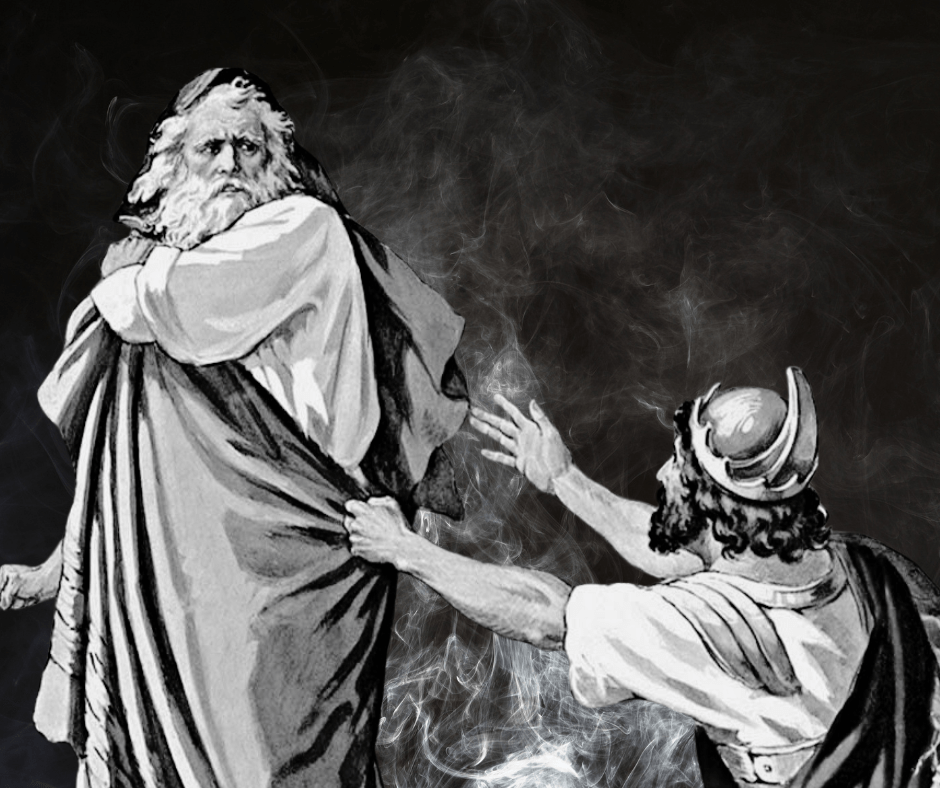
When Samuel turns to go, Saul seizes the prophet’s robe and rips it. In that tear, heaven speaks: “The Lord has torn the kingdom from you and given it to a better man.” The tear was not just cloth. It was covenant unraveling. A king unraveling.
Samuel finishes what Saul would not. He executes Agag, not out of cruelty, but to demonstrate that obedience is not negotiable. God’s holiness requires right action, not just good intentions. God does not wan partial obedience. He want’s full, unwavering, obedience.
And when it is over, there is no triumph. There is only mourning. Samuel weeps. The Lord grieves. The tragedy is complete. This is the sorrow of a squandered calling. Saul had every chance. Every advantage. But he lacked what God desires most: a heart that trembles at His Word (Isaiah 66:2).
So we must ask: What Agag have we spared? What fragments of obedience have we dressed up as sacrifice? Have we obeyed only when it was easy, or surrendered when it was costly?
God does not want fragments. He wants fullness. He calls for wholehearted submission. And where Saul failed, Christ succeeded. Jesus did not offer partial obedience. He obeyed perfectly, even unto death (Phil. 2:8; Rom. 5:19). And through Him, we can be made faithful.
Let us not settle for the appearance of obedience. Let us pursue the heart of it. Let us surrender what is safe and give Him what is sacred, our whole lives.
Conclusion:
Ultimately, Saul reminds us that it is not enough to start well; we must finish well. It is not enough to hear the word of God; we must honor it above every fear, pressure, and ambition. But the gospel gives us hope. There is another King. A better King. Jesus Christ, the Son of David, never disobeyed His Father. Under greatest pressure, He chose obedience and bore our sins.
Because of Christ, there is forgiveness for the arrogant, the impatient, the fearful. But we must not harden our hearts. So I ask you: Are you waiting on God when life is difficult, or only when it is easy? Are you obeying fully, or only when it costs little? Are you wearing a crown, but keeping your heart from the King?
Choose your King. Choose the One who chose the cross for you. Cling to Christ alone, for He alone is the Rock that will not move.
And for those who come to Him, trembling, failing, and desperate, He promises not rejection, but rescue. Not condemnation, but a kingdom that cannot be shaken. The safest place you can be is surrendered at the feet of King Jesus.
DAILY DEVOTIONALS:
Monday – The Struggle to Wait
Scripture:
Saul lived for one year and then became king, and when he had reigned for two years over Israel, Saul chose three thousand men of Israel. Two thousand were with Saul in Michmash and the hill country of Bethel, and a thousand were with Jonathan in Gibeah of Benjamin. The rest of the people he sent home, every man to his tent. Jonathan defeated the garrison of the Philistines that was at Geba, and the Philistines heard of it. And Saul blew the trumpet throughout all the land, saying, “Let the Hebrews hear.” And all Israel heard it said that Saul had defeated the garrison of the Philistines, and also that Israel had become a stench to the Philistines. And the people were called out to join Saul at Gilgal.
And the Philistines mustered to fight with Israel, thirty thousand chariots and six thousand horsemen and troops like the sand on the seashore in multitude. They came up and encamped in Michmash, to the east of Beth-aven. When the men of Israel saw that they were in trouble (for the people were hard pressed), the people hid themselves in caves and in holes and in rocks and in tombs and in cisterns, and some Hebrews crossed the fords of the Jordan to the land of Gad and Gilead. Saul was still at Gilgal, and all the people followed him trembling.
– 1 Samuel 13:1–7 ESV
Devotional:
Waiting on God is never easy. When everything around us feels uncertain or unstable, the urge to act can overwhelm us. Saul faced just such a moment. The Philistines gathered in terrifying numbers. His troops were trembling, hiding, deserting. In human terms, action seemed necessary. But God had already spoken. Through Samuel, He told Saul to wait seven days. That was the test.
Saul waited, but only up to a point. As pressure mounted, he took matters into his own hands and offered the sacrifice. This was not just a mistake, it was disobedience. He assumed necessity justified disobedience. But God’s commands do not bend under pressure. True faith waits even when logic screams otherwise.
We are all tempted to rush ahead of God. Whether in relationships, careers, or crises, we want control. But waiting reveals what we really believe. Saul trusted in timing, not in truth. His actions were religious, but his heart was restless. We must learn to wait, not passively, but in faithful trust.
Reflection Questions:
- What areas of your life feel too urgent to wait on God?
- How do you tend to justify disobedience when fear sets in?
- What spiritual disciplines help you remain grounded while waiting?
Prayer:
Lord, I confess that waiting is hard. I want to fix things, move things, control outcomes. But I know You are faithful and Your timing is perfect. Help me to trust You even when everything around me seems to fall apart. Strengthen my faith to obey, even in silence and uncertainty. In Jesus’ name, amen.
Tuesday – Obedience Under Pressure
Scripture:
He waited seven days, the time appointed by Samuel. But Samuel did not come to Gilgal, and the people were scattering from him. So Saul said, “Bring the burnt offering here to me, and the peace offerings.” And he offered the burnt offering. As soon as he had finished offering the burnt offering, behold, Samuel came. And Saul went out to meet him and greet him. Samuel said, “What have you done?” And Saul said, “When I saw that the people were scattering from me, and that you did not come within the days appointed, and that the Philistines had mustered at Michmash, I said, ‘Now the Philistines will come down against me at Gilgal, and I have not sought the favor of the LORD.’ So I forced myself, and offered the burnt offering.” And Samuel said to Saul, “You have done foolishly. You have not kept the command of the LORD your God, with which he commanded you. For then the LORD would have established your kingdom over Israel forever. But now your kingdom shall not continue. The LORD has sought out a man after his own heart, and the LORD has commanded him to be prince over his people, because you have not kept what the LORD commanded you.” And Samuel arose and went up from Gilgal. The rest of the people went up after Saul to meet the army; they went up from Gilgal to Gibeah of Benjamin. And Saul numbered the people who were present with him, about six hundred men.
– 1 Samuel 13:8–15, ESV
Devotional:
Saul’s real mistake wasn’t impatience alone. It was unbelief. When he saw his army dissolving and Samuel absent, he gave in to fear. He offered the burnt offering himself, overstepping a sacred boundary. This wasn’t a tactical error. It was spiritual failure. Saul honored the ritual but ignored the relationship.
When Samuel arrived, Saul made excuses. He claimed the situation forced him. But God is never pleased with obedience driven by panic. The essence of faith is trusting God’s word when it seems most unwise. Saul tried to keep appearances while his heart wandered.
In moments of crisis, what we truly believe is revealed. Saul believed in appearances and outcomes. He feared people more than he feared God. But true obedience doesn’t cave to fear. It waits. It listens. It trusts. May we learn from Saul’s fall that urgency never justifies disobedience.
Reflection Questions:
- Have you ever compromised spiritually because of outside pressure?
- What does Saul’s excuse reveal about his heart?
- How can you grow in trusting God rather than your own instincts?
Prayer:
Father, I need Your help when pressure rises. Forgive me for the times I’ve moved without Your permission. Teach me to wait with courage and act with faith. Let my obedience be rooted not in fear, but in love for You. In Jesus’ name, amen.
Wednesday – Faith Climbs
Scripture:
One day Jonathan the son of Saul said to the young man who carried his armor, “Come, let us go over to the Philistine garrison on the other side.” But he did not tell his father. Saul was staying in the outskirts of Gibeah in the pomegranate cave at Migron. The people who were with him were about six hundred men, including Ahijah the son of Ahitub, Ichabod’s brother, son of Phinehas, son of Eli, the priest of the LORD in Shiloh, wearing an ephod. And the people did not know that Jonathan had gone. Within the passes, by which Jonathan sought to go over to the Philistine garrison, there was a rocky crag on the one side and a rocky crag on the other side. The name of the one was Bozez, and the name of the other Seneh. The one crag rose on the north in front of Michmash, and the other on the south in front of Geba.
Jonathan said to the young man who carried his armor, “Come, let us go over to the garrison of these uncircumcised. It may be that the LORD will work for us, for nothing can hinder the LORD from saving by many or by few.” And his armor-bearer said to him, “Do all that is in your heart. Do as you wish. Behold, I am with you heart and soul.” Then Jonathan said, “Behold, we will cross over to the men, and we will show ourselves to them. If they say to us, ‘Wait until we come to you,’ then we will stand still in our place, and we will not go up to them. But if they say, ‘Come up to us,’ then we will go up, for the LORD has given them into our hand. And this shall be the sign to us.” So both of them showed themselves to the garrison of the Philistines. And the Philistines said, “Look, Hebrews are coming out of the holes where they have hidden themselves.” And the men of the garrison hailed Jonathan and his armor-bearer and said, “Come up to us, and we will show you a thing.” And Jonathan said to his armor-bearer, “Come up after me, for the LORD has given them into the hand of Israel.” Then Jonathan climbed up on his hands and feet, and his armor-bearer after him. And they fell before Jonathan, and his armor-bearer killed them after him. And that first strike, which Jonathan and his armor-bearer made, killed about twenty men within as it were half a furrow’s length in an acre of land. And there was a panic in the camp, in the field, and among all the people. The garrison and even the raiders trembled, the earth quaked, and it became a very great panic.
– 1 Samuel 14:1–15, ESV
Devotional:
While Saul sat under a tree, frozen in fear, his son Jonathan chose to climb. Jonathan’s words echo with confidence in God: “It may be that the Lord will work for us.” He wasn’t reckless. He was faithful. He trusted not in numbers or position, but in the power of God.
Jonathan’s armor-bearer followed him, and together they struck down twenty Philistines. Their act of faith sparked a divine response. Panic spread in the enemy camp. The ground shook. God moved because someone trusted Him enough to act. While Saul hesitated, Jonathan advanced.
This moment forces a question: are we waiting in fear like Saul, or moving in faith like Jonathan? Sometimes God calls us to stand still. Other times He calls us to climb. Discernment is key. But when God leads, courage must follow. Faith doesn’t need certainty. It just needs God.
Reflection Questions:
- Are there areas where God may be calling you to act instead of wait?
- What does Jonathan’s example teach you about bold faith?
- How can you surround yourself with others who will climb with you?
Prayer:
God, I don’t want to stay stuck in fear when You’ve called me forward in faith. Give me the courage to trust You even when the odds look impossible. Like Jonathan, help me fix my eyes on You and move with boldness. Amen.
Thursday – The Cost of Rash Religion
Scripture:
And the men of Israel had been hard pressed that day, so Saul had laid an oath on the people, saying, “Cursed be the man who eats food until it is evening and I am avenged on my enemies.” So none of the people had tasted food. Now when all the people came to the forest, behold, there was honey on the ground. And when the people entered the forest, behold, the honey was dropping, but no one put his hand to his mouth, for the people feared the oath. But Jonathan had not heard his father charge the people with the oath, so he put out the tip of the staff that was in his hand and dipped it in the honeycomb and put his hand to his mouth, and his eyes became bright. Then one of the people said, “Your father strictly charged the people with an oath, saying, ‘Cursed be the man who eats food this day.’” And the people were faint. Then Jonathan said, “My father has troubled the land. See how my eyes have become bright because I tasted a little of this honey. How much better if the people had eaten freely today of the spoil of their enemies that they found. For now the defeat among the Philistines has not been great.”
They struck down the Philistines that day from Michmash to Aijalon. And the people were very faint. The people pounced on the spoil and took sheep and oxen and calves and slaughtered them on the ground. And the people ate them with the blood. Then they told Saul, “Behold, the people are sinning against the LORD by eating with the blood.” And he said, “You have dealt treacherously; roll a great stone to me here.” And Saul said, “Disperse yourselves among the people and say to them, ‘Let every man bring his ox or his sheep and slaughter them here and eat, and do not sin against the LORD by eating with the blood.’” So every one of the people brought his ox with him that night and they slaughtered them there. And Saul built an altar to the LORD; it was the first altar that he built to the LORD.
Then Saul said, “Let us go down after the Philistines by night and plunder them until the morning light; let us not leave a man of them.” And they said, “Do whatever seems good to you.” But the priest said, “Let us draw near to God here.” And Saul inquired of God, “Shall I go down after the Philistines? Will you give them into the hand of Israel?” But he did not answer him that day. And Saul said, “Come here, all you leaders of the people, and know and see how this sin has arisen today. For as the LORD lives who saves Israel, though it be in Jonathan my son, he shall surely die.” But there was not a man among all the people who answered him. Then he said to all Israel, “You shall be on one side, and I and Jonathan my son will be on the other side.” And the people said to Saul, “Do what seems good to you.” Therefore Saul said, “O LORD God of Israel, why have you not answered your servant this day? If this guilt is in me or in Jonathan my son, O LORD, God of Israel, give Urim. But if this guilt is in your people Israel, give Thummim.” And Jonathan and Saul were taken, but the people escaped. Then Saul said, “Cast the lot between me and my son Jonathan.” And Jonathan was taken.
Then Saul said to Jonathan, “Tell me what you have done.” And Jonathan told him, “I tasted a little honey with the tip of the staff that was in my hand. Here I am; I will die.” And Saul said, “God do so to me and more also; you shall surely die, Jonathan.” Then the people said to Saul, “Shall Jonathan die, who has worked this great salvation in Israel? Far from it! As the LORD lives, there shall not one hair of his head fall to the ground, for he has worked with God this day.” So the people ransomed Jonathan, so that he did not die. Then Saul went up from pursuing the Philistines, and the Philistines went to their own place.
– 1 Samuel 14:24–46, ESV
Devotional:
Victory was already unfolding when Saul inserted himself with a foolish vow: no one could eat until he was avenged. His focus wasn’t God’s glory but personal vengeance. His command, born out of ego and legalism, nearly destroyed his own son and led Israel into sin.
Jonathan, unaware of the oath, ate honey and was revived. Others, famished, later sinned by consuming blood. Saul’s reckless rule turned strength into stumbling. This is the danger of spiritual leadership unanchored from humility. Saul’s words sounded spiritual, but they were self-serving.
We must beware of adding burdens God never placed. Legalism masquerades as holiness but misrepresents God. True leadership lifts burdens, not adds them. Saul’s heart was rigid, while Jonathan’s was alive with trust. Where one saw duty, the other saw delight in God. Which voice are we following?
Reflection Questions:
- How can good intentions still lead to harmful actions?
- Have you ever added spiritual pressure that God never asked of you or others?
- What does it look like to pursue grace over legalism?
Prayer:
Lord, guard me from pride dressed as piety. Help me lead others with grace, not guilt. Teach me to hear Your voice clearly so I do not confuse control with obedience. May I reflect Your heart, not just Your rules. In Christ’s name, amen.
Friday – Half Obedience is Full Rebellion
Scripture:
And Samuel said to Saul, “The LORD sent me to anoint you king over his people Israel; now therefore listen to the words of the LORD. Thus says the LORD of hosts, ‘I have noted what Amalek did to Israel in opposing them on the way when they came up out of Egypt. Now go and strike Amalek and devote to destruction all that they have. Do not spare them, but kill both man and woman, child and infant, ox and sheep, camel and donkey.’”
So Saul summoned the people and numbered them in Telaim, two hundred thousand men on foot, and ten thousand men of Judah. And Saul came to the city of Amalek and lay in wait in the valley. Then Saul said to the Kenites, “Go, depart; go down from among the Amalekites, lest I destroy you with them. For you showed kindness to all the people of Israel when they came up out of Egypt.” So the Kenites departed from among the Amalekites. And Saul defeated the Amalekites from Havilah as far as Shur, which is east of Egypt. And he took Agag the king of the Amalekites alive and devoted to destruction all the people with the edge of the sword. But Saul and the people spared Agag and the best of the sheep and of the oxen and of the fattened calves and the lambs, and all that was good, and would not utterly destroy them. All that was despised and worthless they devoted to destruction.
The word of the LORD came to Samuel: “I regret that I have made Saul king, for he has turned back from following me and has not performed my commandments.” And Samuel was angry, and he cried to the LORD all night. And Samuel rose early to meet Saul in the morning. And it was told Samuel, “Saul came to Carmel, and behold, he set up a monument for himself and turned and passed on and went down to Gilgal.” And Samuel came to Saul, and Saul said to him, “Blessed be you to the LORD. I have performed the commandment of the LORD.” And Samuel said, “What then is this bleating of the sheep in my ears and the lowing of the oxen that I hear?” Saul said, “They have brought them from the Amalekites, for the people spared the best of the sheep and of the oxen to sacrifice to the LORD your God, and the rest we have devoted to destruction.” Then Samuel said to Saul, “Stop! I will tell you what the LORD said to me this night.” And he said to him, “Speak.”
And Samuel said, “Though you are little in your own eyes, are you not the head of the tribes of Israel? The LORD anointed you king over Israel. And the LORD sent you on a mission and said, ‘Go, devote to destruction the sinners, the Amalekites, and fight against them until they are consumed.’ Why then did you not obey the voice of the LORD? Why did you pounce on the spoil and do what was evil in the sight of the LORD?” And Saul said to Samuel, “I have obeyed the voice of the LORD. I have gone on the mission on which the LORD sent me. I have brought Agag the king of Amalek, and I have devoted the Amalekites to destruction. But the people took of the spoil, sheep and oxen, the best of the things devoted to destruction, to sacrifice to the LORD your God in Gilgal.”
– 1 Samuel 15:1–21, ESV
Devotional:
God’s command to Saul was clear: destroy Amalek completely. But Saul chose a partial path. He spared King Agag and kept the best livestock. Then he disguised his rebellion with religious language: “We saved them to sacrifice.” But God is not impressed by excuses wrapped in worship.
Samuel’s rebuke was direct: “To obey is better than sacrifice.” God wants surrendered hearts, not selective obedience. Saul feared people more than he feared the Lord. His confession was shallow. His motive was self-preservation. He obeyed what was convenient and ignored what was costly.
This is a hard truth: delayed or partial obedience is still disobedience. We don’t get to edit God’s commands. Following Him means submitting fully, even when it’s hard. Obedience isn’t about preference; it’s about trust. Are we offering God leftovers while claiming they are our best?
Reflection Questions:
- In what areas are you tempted to offer God partial obedience?
- Why do we often spiritualize our disobedience like Saul did?
- How can we train our hearts to respond to God with immediate and full surrender?
Prayer:
Father, forgive me for the ways I have held back what You asked for. I do not want to offer selective obedience. Help me to trust You more than my convenience. Teach me to listen fully and obey completely. In Jesus’ name, amen.
Saturday – When the Crown Cracks
Scripture:
And Samuel said,
“Has the LORD as great delight in burnt offerings and sacrifices,
as in obeying the voice of the LORD?
Behold, to obey is better than sacrifice,
and to listen than the fat of rams.
For rebellion is as the sin of divination,
and presumption is as iniquity and idolatry.
Because you have rejected the word of the LORD,
he has also rejected you from being king.”Saul said to Samuel, “I have sinned, for I have transgressed the commandment of the LORD and your words, because I feared the people and obeyed their voice. Now therefore, please pardon my sin and return with me that I may bow before the LORD.” And Samuel said to Saul, “I will not return with you. For you have rejected the word of the LORD, and the LORD has rejected you from being king over Israel.” As Samuel turned to go away, Saul seized the skirt of his robe, and it tore. And Samuel said to him, “The LORD has torn the kingdom of Israel from you this day and has given it to a neighbor of yours, who is better than you. And also the Glory of Israel will not lie or have regret, for he is not a man, that he should have regret.” Then he said, “I have sinned; yet honor me now before the elders of my people and before Israel, and return with me, that I may bow before the LORD your God.” So Samuel turned back after Saul, and Saul bowed before the LORD.
Then Samuel said, “Bring here to me Agag the king of the Amalekites.” And Agag came to him cheerfully. Agag said, “Surely the bitterness of death is past.” And Samuel said, “As your sword has made women childless, so shall your mother be childless among women.” And Samuel hacked Agag to pieces before the LORD in Gilgal.
Then Samuel went to Ramah, and Saul went up to his house in Gibeah of Saul. And Samuel did not see Saul again until the day of his death, but Samuel grieved over Saul. And the LORD regretted that he had made Saul king over Israel.
– 1 Samuel 15:22–35, ESV
Devotional:
When confronted by Samuel, Saul begged not for forgiveness but for honor. “Honor me before the elders,” he said. He cared more about saving face than saving his soul. This is the tragedy of spiritual pride. It blinds us to true repentance and locks us in self-preservation.
The kingdom was torn from Saul, not because he made a single mistake, but because he consistently refused to surrender. His story is not just a warning about failure, but about the heart. Saul wanted power without purity. God wanted obedience without excuse.
Our comfort is Christ. Where Saul failed, Jesus succeeded. He obeyed perfectly, even when it cost Him everything. Through Him, our hearts can be made new. If we’ve wandered, we can return. The broken crown of Saul reminds us: God’s mercy is still available, but we must bow our hearts before we lose the throne of our souls.
Reflection Questions:
- Are you more concerned with how others view you than with what God sees in you?
- What does true repentance look like in your life?
- How does Jesus’ obedience give you hope today?
Prayer:
Lord, strip me of pride. I don’t want to wear a crown with a cracked heart. Search me and restore me. Help me to repent truly and trust You fully. Thank You for Jesus, who never failed where I often do. Make me more like Him. Amen.
 hardincrowder.com