Standing Strong in the Valley of Fear
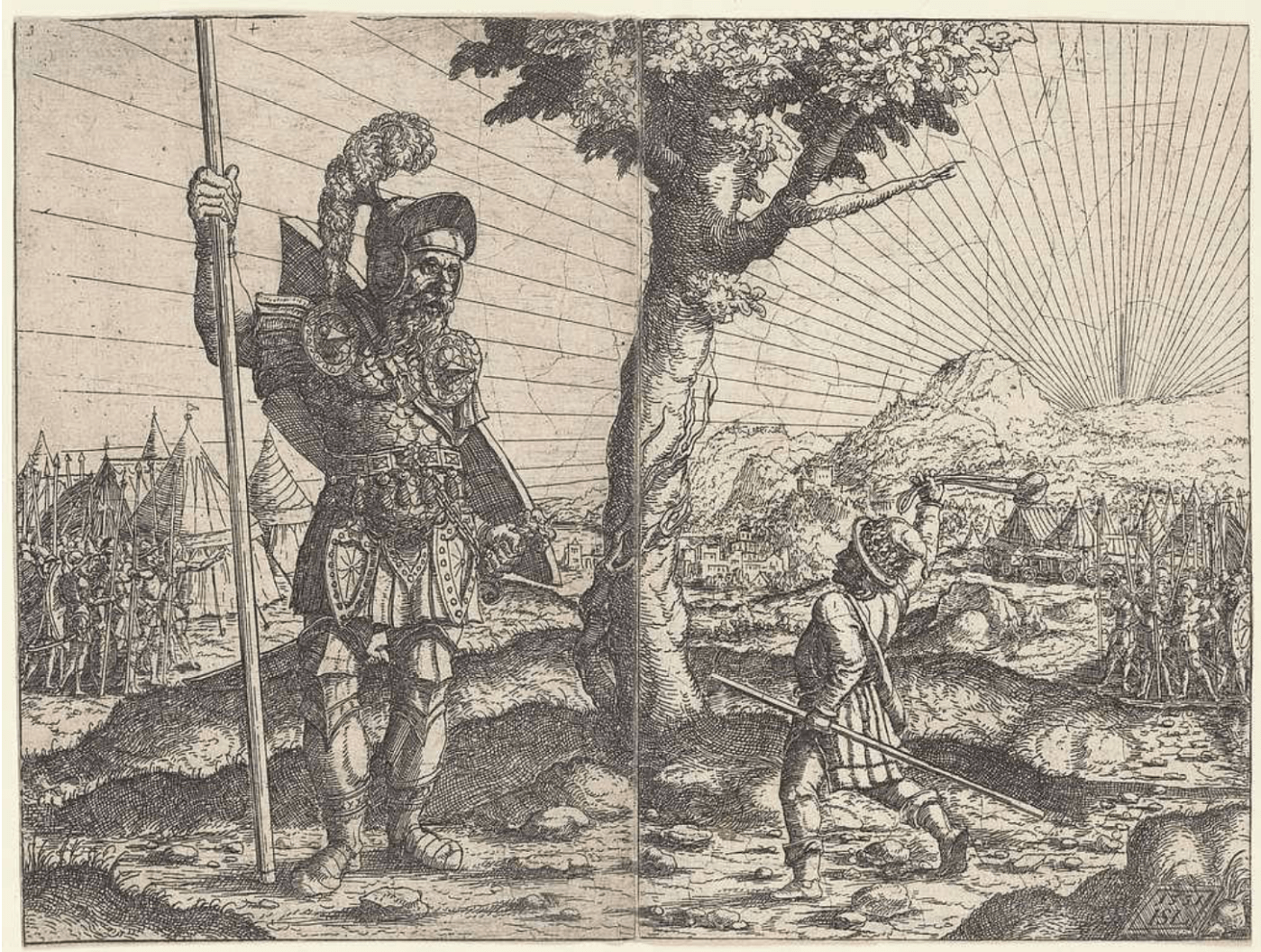
Imagine standing on the sun-scorched hillside of Elah. The air wavers with heat. Dust clings to the sandals of Israel’s trembling warriors. Across the ravine, stands Goliath of Gath, a human fortress armored in bronze. His voice bellows taunts across the valley, crashing like thunder against the hills of Judah. The battle hasn’t started, but already, Israel is losing. Their hearts are breaking under the weight of fear.
First Samuel 17 opens with a battlefield in the promised land.This wasn’t neutral territory; it was holy ground. Socoh belonged to Judah, but more than that, it was God’s land. Yet the enemy stood on it, mocking not just Israel’s army but Israel’s God.
God’s Word takes a moment to zoom in on Goliath in verses 4 through 7. He was between seven and nine feet tall. He wore a cuirass of bronze weighing 125 pounds. A spearhead like an anvil. But worse than Goliath’s size or his weapons was his words. “Am I not a Philistine, and are you not servants of Saul?” Do you hear it? He reframes their identity. Not “the army of the living God.” Just servants of a man. That is what the enemy does. He belittles who you are so that fear can feel bigger than your faith.
Then Goliath issues his challenge in verse 10: “I defy the ranks of Israel this day. Give me a man, that we may fight together.” And what is the response? “When Saul and all Israel heard these words of the Philistine, they were dismayed and greatly afraid” (1 Samuel 17:11).
Fear took command. The same men who laced up their armor that morning now stood frozen. The same king who stood head and shoulders above the rest, Saul, was trembling like the rest of his army. This is the power of fear when faith goes silent. It rewrites your reality. It tells you the story is over. It blinds you to the miracles behind you: the parting of the Red Sea, the manna from heaven, the crumbling walls of Jericho. It deafens you to the promises still ahead.
Isn’t that how fear works in us? One diagnosis. One pink slip. One betrayal. One broken promise. And suddenly the God who was faithful yesterday seems silent today. Suddenly, the God who calls you “child” is drowned out by the enemy who calls you “servant.”
Goliath is not just history. He’s a pattern. He comes today wearing many faces: addiction, shame, debt, and doubt. He stands tall, dressed in fear and speaking words of dread.I’ve heard his voice. And maybe, like me, you have too. He doesn’t always come with armor and a sword. For me, Goliath has shown up as long spells of depression. His voice is loud and drowns out everything else in my mind. He creeps in when I’m tired. He lingers when I should be rejoicing. He tells me I’m not enough, that I’m a burden, that nothing I do will make a difference.
He doesn’t fight fair. He doesn’t come once and leave. Like Goliath, he steps forward again and again, morning and evening, daring me to hope. Daring me to pray. Daring me to believe that joy could return. And just like Goliath tried to redefine Israel, depression has tried to rename me. Not “child of God,” but “failure.” Not “beloved,” but “broken.” Not “called,” but “useless.” Maybe you know that voice. Maybe you’ve felt that weight.
But here’s what I’ve come to learn, God doesn’t wait for me to be strong enough to face my giant. He doesn’t need me to wear Saul’s armor. He just wants me to pick up a stone. One promise. One prayer. One moment of obedience. Because the battle was never mine to win in the first place. It’s His.
So if today you’re standing in your own Valley of Elah, know this: you are not alone in the valley. The Lord of hosts is there. And He has never lost a fight.
From the Pasture to the Battlefield
Now, there is a rhythm to the way God works. He often calls the unlikely to do the unimaginable. He chooses the quiet-hearted over the headline-worthy, the faithful over the flashy. And in the shepherd-boy David, God found His champion.
Verse 12 reintroduces us to David: “Now David was the son of an Ephrathite of Bethlehem in Judah, named Jesse, who had eight sons” (1 Samuel 17:12, ESV). Notice this humble introduction. David was the youngest son of a farmer from a forgotten town. Yet God was moving through David. Not because David was strong, but because he was surrendered.
While Saul trembled and Israel’s army cowered, David was delivering bread and cheese. Running errands. Obeying his father. What looked like a chore was actually a commission. To the world, David was just delivering lunch. But heaven knew he was walking into destiny. Let that sink in. Sometimes the path to courage begins with carrying cheese. The road to the frontline runs through the pasture. Do not despise the small acts of obedience.. Private obedience is God’s preparation for public victory. David’s heart was shaped when no one was watching so it could stand firm when everyone was looking.
When David arrived at the battlefield, he heard the voice of Goliath, bellowing defiance. But this time, someone new was listening. And David, trained not by crowds but by communion, answered with holy fire: “Who is this uncircumcised Philistine, that he should defy the armies of the living God?” (v. 26, ESV).
Did you catch that? David does not say the armies of Saul or even the armies of Israel. He names them rightly, the armies of the living God. This is what it means to see with the eyes of faith. Others saw a giant. David saw a blasphemer. Others saw a threat. David saw an offense against heaven. Goliath was not just mocking a nation; he was insulting a Name. And David’s heart burned. Not for fame, not for glory, but for God.
But faith rarely walks unchallenged. Eliab, David’s older brother, mocked him: “Why have you come down? And with whom have you left those few sheep?” (v. 28, ESV). That stings. Sometimes the voice that wounds most is not the enemy’s; it is your brother’s. The people who should affirm your calling question your character. The ones who know your past cannot see your purpose.
Have you been there? Misunderstood. Dismissed. Accused. And all you were trying to do was obey?
But David answered with quiet strength: “Was it not but a word?” (v. 29). He did not fight to defend his reputation. He stayed the course. Private obedience is God’s preparation for public victory.
Word of David’s courage reached Saul. And now the shepherd stands before the king. One was anointed by man. The other was anointed by God. One had a throne but no courage. The other had a sling and unshakable faith.
David said, “Let no man’s heart fail because of him. Your servant will go and fight” (v. 32, ESV). It must have sounded absurd. A youth against a giant? But David was not relying on the math of men. He was standing on faith: “The LORD who delivered me from the paw of the lion and the paw of the bear will deliver me from the hand of this Philistine” (v. 37, ESV). That is courage. Not fearlessness, but faith forged in the fires of past deliverance. This was boldness born from God’s proven faithfulness.
Saul offered his armor, bronze, heavy, and impressive. But David gently refused. “I cannot go with these, for I have not tested them” (v. 39). He knew what many still have to learn: you cannot face today’s battles wearing someone else’s armor. You cannot borrow conviction. You cannot inherit obedience. You cannot imitate anointing or manufacture courage.
So David laid aside what did not fit. He picked up five smooth stones. And he stepped forward, not pretending to be a warrior, not performing for the crowd, but simply and fully the shepherd God had formed in secret.
In young David we see that private obedience is God’s preparation for public victory, even if we cannot understand how in the moment. One day, the giant will roar, and you must remember the lions and bears that God has already delivered you from, the victories that are already behind you. You must remember that the battle is not yours, but the Lord’s. So let me ask you: What has God already brought you through? What deliverance in your past is now the fuel for your faith?
The Sling, the Stone, and the Sovereign Hand
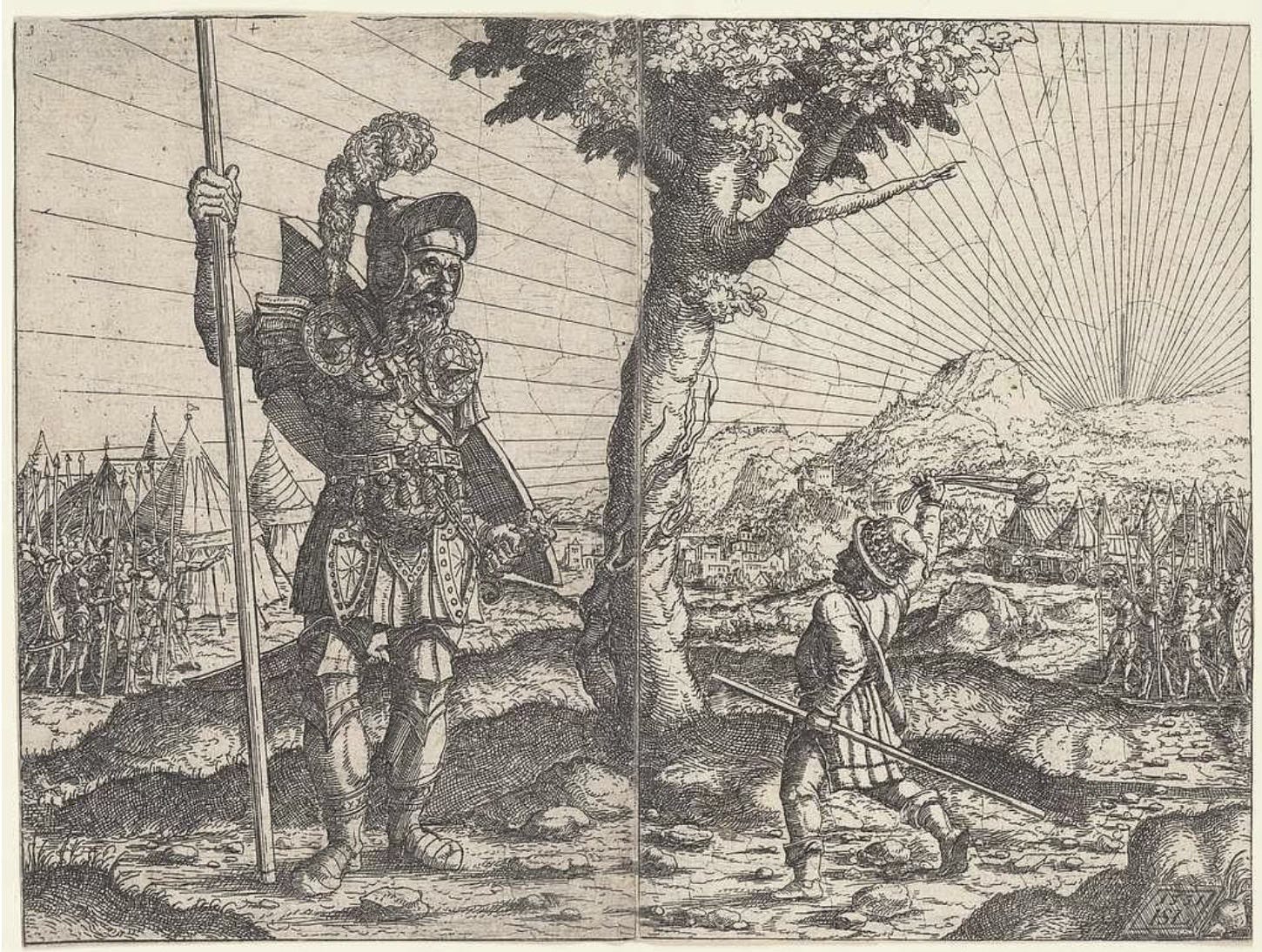
In verse 40, we see David preparing for battle. But it is not a preparation anyone expected. Just a staff, five smooth stones from a nearby brook, a shepherd’s pouch, and a sling. But David’s true weapon was not in his hand, but in his heart.
As David approached the battlefield, Goliath continued to mock Israel. Clad in armor, with a shield-bearer leading him, he looked at David and scoffed. “Am I a dog, that you come to me with sticks?” he jeered (v. 43, ESV). Goliath saw a boy. But heaven saw a champion. And David, unshaken, declared with fierce clarity, “You come to me with a sword and with a spear and with a javelin, but I come to you in the name of the LORD of hosts, the God of the armies of Israel, whom you have defied” (v. 45, ESV).
In that moment, the battlefield shifted. This was no longer a contest between a giant and a boy. This was a demonstration of divine sovereignty. David was not fighting for personal honor. He was fighting for the glory of God. “This day the LORD will deliver you into my hand,” he said, “that all the earth may know that there is a God in Israel” (v. 46, ESV). He continued, “For the battle is the LORD’s, and he will give you into our hand” (v. 47, ESV). This is what it means to win God’s way, by God’s power and for His name.
With unwavering courage, David ran toward Goliath. He reached into his pouch, pulled out a stone, and slung it with purpose. The stone struck its mark. The giant fell face down to the ground. This was a divinely guided blow. The one who defied God lay defeated before Him. Even his fall spoke volumes. Face down, as if forced into reverence before the Lord of hosts.
David rushed forward, drew Goliath’s own sword, and finished the fight. The enemy was brought down by his own weapon. God had indeed used the weak to shame the strong. The men of Israel and Judah, who had cowered in fear for forty days, now surged forward with a battle cry. Verse 52 says, “And the men of Israel and Judah rose with a shout and pursued the Philistines” (ESV). Fear gave way to faith. Paralysis gave way to pursuit. One act of trust unleashed a tide of courage across the people of God.
This is the ripple effect of faith. When one person stands in confidence, others find the courage to do the same. David’s victory was not just personal. It was communal. His faith turned the tide of a nation. The Israelites chased the Philistines as far as Gath and Ekron, scattering the enemy and plundering their camp. The battle, once marked by fear, now served as a testament to the faithfulness of God.
As the chapter closes, Saul asks, “Whose son is this youth?” (v. 55, ESV). Though David had already served in Saul’s court, the king now sees him with fresh eyes. No longer just a harpist. No longer just a servant. David stands as a vessel of divine courage.
And David replies simply, “I am the son of your servant Jesse the Bethlehemite” (v. 58, ESV). No pride. No boasting. Just humility and clarity. He remains the same shepherd boy who trusted God in the fields and now trusted Him on the battlefield.
So what does this mean for us?
First, God does not require mighty weapons. He only asks for willing hearts.
Second, courage does not come from the absence of fear, but from the presence of faith.
Third, your obedience can awaken courage in others.
Your giant may wear another name. Fear. Addiction. Loss. Financial strain. Cultural pressure. Do not run. Do not cower. Stand as David did and declare, “The battle is the LORD’s.” Pick up the sling of prayer. Choose the stones of God’s Word. Step forward in faith, and watch the living God bring victory. Because the triumph of trust is not in what you carry in your hand. It is in who you carry in your heart. And when you walk in faith, you walk in step with the God who never loses.
Conclusion:
As we draw this sermon to a close, I want us to shift our focus. Not to David. Not to Goliath. Not even to ourselves or the giants we face. I want us to fix our eyes on Jesus Christ, the true and greater Son of David.
David’s victory over Goliath was never meant to stand alone. It was more than a personal triumph. It was a preview, a shadow of something far greater. It was a representative victory, pointing forward to a Champion who would fight for us in ways David never could.
If we are honest, we are not David in this story. We are the trembling army on the hillside, paralyzed by fear, unable to overcome what stands before us. We are the ones in need of rescue. And the good news is that a Champion has come. Not simply in the pattern of David, but in the fullness of Christ.
Where David stepped onto a battlefield with a sling, Jesus stepped onto a hill called Calvary with a cross. Where David conquered a giant, Jesus conquered sin, death, and the grave. Where David struck down his enemy with a stone, Jesus crushed the head of the serpent through His sacrifice.
Just as Israel shared in David’s victory without lifting a single weapon, we now share in Christ’s victory without shedding a single drop of our own blood. His battle became our breakthrough. His triumph became our testimony.
This is the gospel. The battle belongs to the Lord, and the Lord has already won.
So let us lift our eyes to our Champion. Let us worship Him not only for the victory He accomplished, but for the rescue He has secured for us. And let us trust Him, not only when the giants fall, but even when they roar. Because the same God who stood with David now stands with us.
 hardincrowder.com