From the Tax Booth
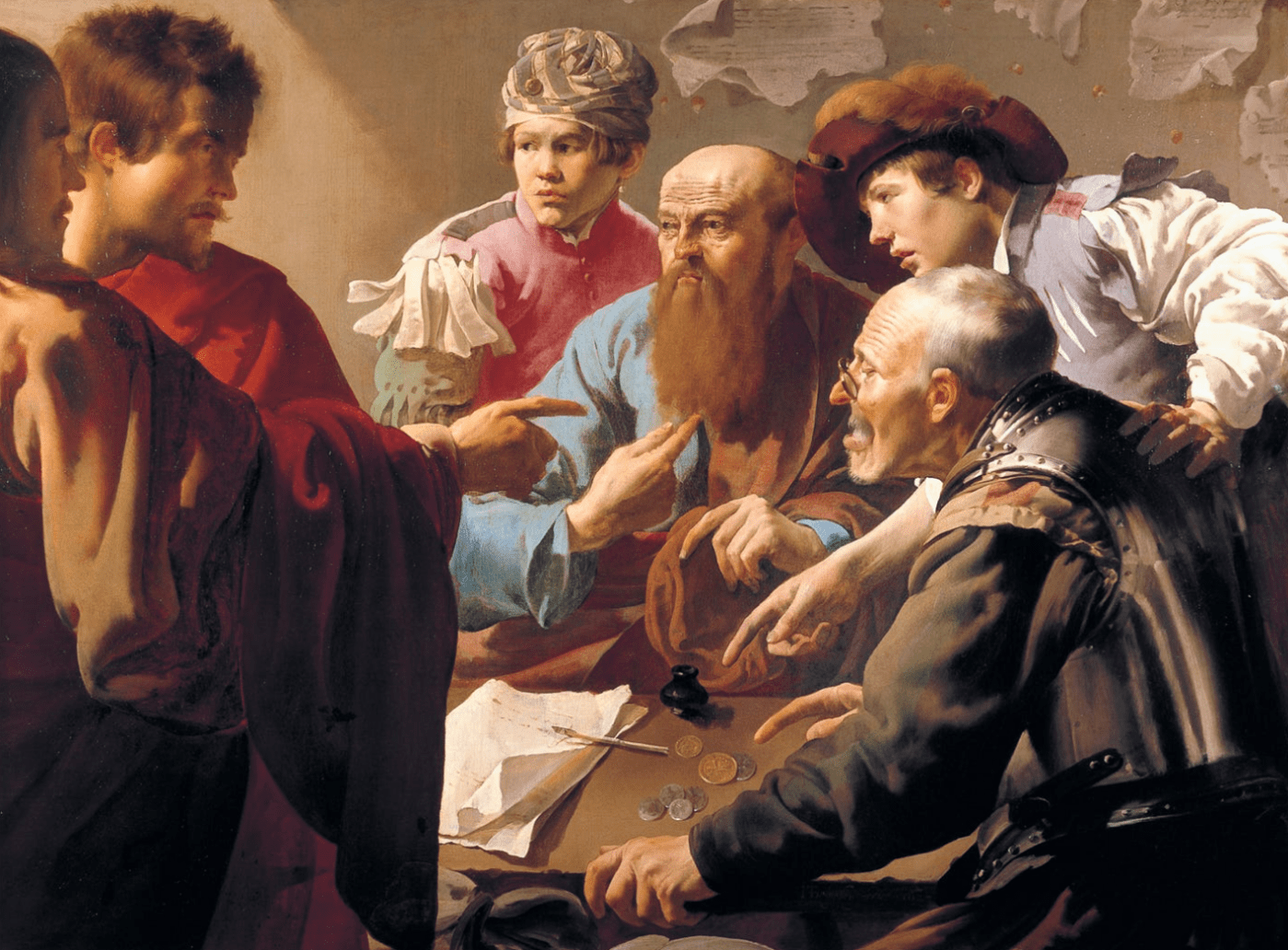
Imagine a busy seaside road in the region of Galilee. Beside the road sits a small table equipped with a ledger, a set of scales, a Roman seal, and a box for coins. Levi, the son of Alphaeus, is collecting tolls and taxes for the Roman Empire at his booth. Although born as Levi, he prefers the name Matthew, as noted in his gospel account.
We do not know the reason he chose that name, but I have an educated guess. His birth name is derived from Israel’s priestly tribe, while his occupation served Rome. The name “Levi,” which translates to “to be joined” in Hebrew, reflects a sense of community and connection. However, in the context of his role as a tax collector for the Roman Empire, Levi would have faced significant ostracism from his fellow Israelites. Tax collectors were often seen as traitors, collaborating with the occupying forces to collect duties from their own people, leading to widespread disdain and rejection. In contrast, the name “Matthew” carries the meaning “gift of God.” Though his neighbors likely did not perceive his presence as a blessing, renaming himself Matthew sidesteps the uncomfortable inconsistency of a tax collector sharing a name with the priestly tribe of Israel.
Matthew’s role as a tax collector meant that he was in charge of collecting taxes and tolls on things like fish, grain, and cloth. The people he taxed were the children of Israel, and the taxes he collected went directly towards financing the empire that oppressed them. This action made him unpopular among the people. To make matters worse, tax collectors had a reputation for being swindlers and thieves. The old Roman tax system was particularly easy to exploit; it was an open secret that many collectors overcharged the citizens and kept the excess for themselves. Rome appeared indifferent to this corruption, as long as the taxes were paid on time.
Mark writes, “As he passed by, he saw Levi.” Let’s focus on the phrase “he saw.” Grace does not begin with our search for God; it starts with God turning toward us. Levi understood how others perceived him. They saw a man who had sacrificed his place among God’s people for a better income. If he hoped for anything from Jesus, it was to be ignored. However, Jesus turned to him. This act represents the first kindness of the gospel. We might think we are unworthy of God’s attention or that if He saw us, He would feel ashamed or disgusted by our sin. But that’s not what we observe in Jesus’ encounter with Matthew.
After Jesus turns to Matthew, he says just two words, “Follow me.” I want you to notice a few things about how Jesus called his first disciples. He does not put them to a test to prove their worthiness. He does not give them an interview to see if they are going to be useful or a liability to His ministry. He does not call Matthew to a probationary period where Jesus will test him and see if he’s a good fit for the ministry. He does not even ask if Matthew wants to follow Him; Jesus simply gives the command, “Follow Me.”
We talked about this before when Jesus called the disciples. When a Rabbi called a student to follow him, that was a big honor. Usually, a Rabbi would pick from the best and brightest, but Jesus seems to take the opposite approach. Calling fishermen was an odd choice, because fishing was the work of uneducated and low-class men, but calling a tax collector was absolutely unheard of. Matthew was the exact opposite of everything a Rabbi would desire in a student, but he received the calling.
I love the way Charles Spurgeon commented on this passage:
“If a Jew had passed by and seen a learned rabbi or a Pharisee, it would have given respectability to his band of followers. But Jesus does not care about that sort of respectability at all. He is so respectable in himself, in the highest sense of being respected, that he has honor enough and more to spare for all his people. And he can condescend, without hazard, to call into his immediate company, to be one of his personal followers, this man Matthew even though he was a collector of the Roman taxes. It was equal condescension when he called you and me! All believers in Christ should wonder at the condescending love that chose them to be Christ’s followers.”
Now watch Matthew move. Mark says, “He rose and followed.” Luke adds the weight of it. “Leaving everything, he rose and followed.” Those short lines carry a lot of meaning. Matthew stands up from the ledger. He leaves coins on the table. He steps away from the little booth that belonged to Caesar and follows toward Jesus, the greater King.
For the crowd that gathered, this was a living metaphor of repentance. It begins with God turning toward us and giving us a calling. We then receive the calling and abandon our old, sinful ways of living to walk with Jesus. Now, every disciple Jesus called was a work in progress, but I want you to see that the relationship begins before the growth in holiness. We don’t get our life in order before we come to Jesus; we just come to Jesus and trust that He will guide us along the way.
No one’s past disqualifies them from receiving salvation. Jesus still calls everyone to leave behind what owned them and to follow him. As Christians, we need to be careful that we do not screen out the “Matthews” in our communities. We should expect messy beginnings. We should be careful not to confuse neatness with holiness.
To the Banquet
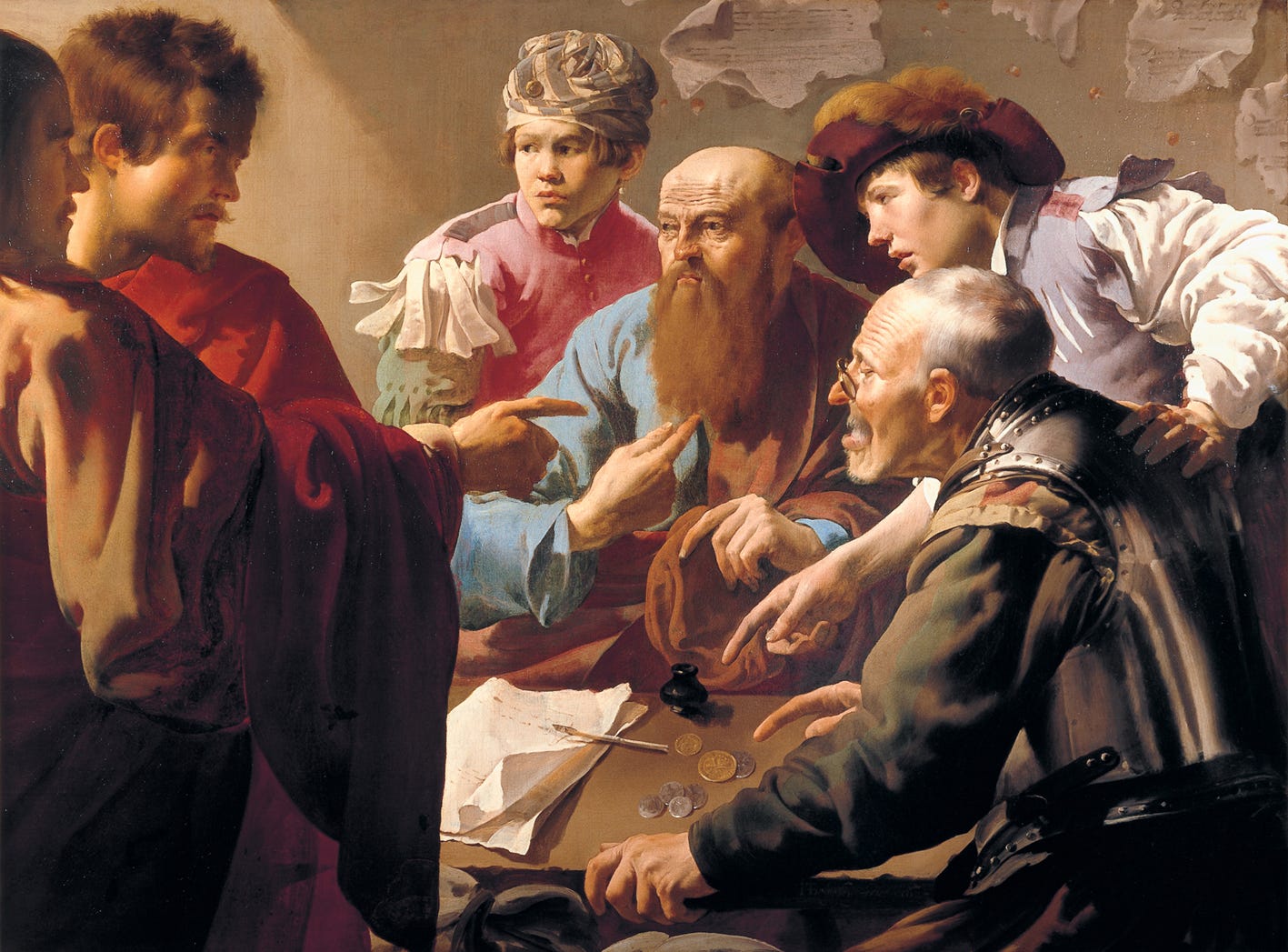
Matthew writes, “As Jesus reclined at table in the house, behold, many tax collectors and sinners came and were reclining with Jesus and his disciples” (Matt. 9:10, ESV). Luke adds the additional detail that there was “a great feast in his house” (Luke 5:29, ESV).
Look at the guest list. It is full of people most religious folks kept at arm’s length. “Tax collectors and sinners” was a common label for people with marked reputations, people whose jobs or choices put them on the margins. The kingdom is at work across this table, and it spreads person to person like good conversation spreads in a lively room.
Now the food on that table likely came from crooked gain, yet Jesus did not stay away because the gain to be had was greater. He “shared the same roof and the same table” with people who had gone astray, because that is what a physician does. He stays close to the sick to make them well.
Later critics would call Jesus “a friend of tax collectors and sinners” (Matt. 11:19, ESV), but He willingly bore this slander to bring healing. Jesus drew people back through presence, friendship, and honest talk. If he had shown only the terror of the Holy Judge, they would have been crushed. So he veiled his majesty in real humanity to welcome the guilty and lift the weak.
Now notice how Jesus engages the room. He is not compromising his holiness by sitting with the unholy. He is living his mission. He is the physician who makes house calls, and tonight the clinic is in Levi’s dining room. He does not endorse sin with his nearness. He offers himself to sinners. That difference matters.
This scene also points the way for us. It is good to say, “Come to my church.” It may be even better to start with, “Come over to my house.” Church can feel big and unfamiliar to someone far from God. Your home is close and warm. Your table can be the bridge that brings them to Jesus. When they do come to church with you, they will already know a face and a story, and they will know they belong.
So let’s not only invite people to church. Let’s invite them into our lives. What if one way we measured maturity was by how many chairs we add to our tables? Hospitality is a Christian practice worth recovering. Let your home and your table become a small clinic of grace where the Physician still meets sinners and makes them well.
Through the Backlash
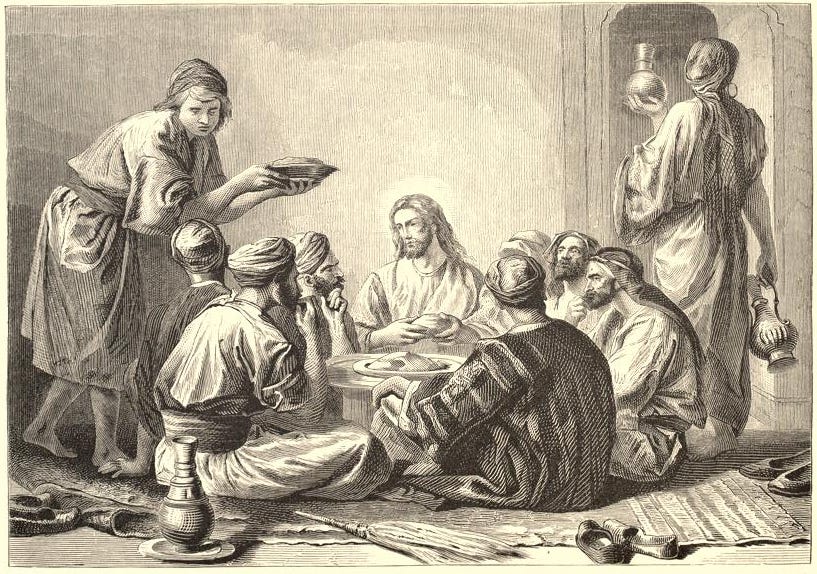
Not everyone cheered the feast at Levi’s house. Luke tells us, “And the Pharisees and their scribes grumbled at his disciples, saying, ‘Why do you eat and drink with tax collectors and sinners?’” (Luke 5:30, ESV). The question sounds like concern for holiness. In truth, it was about control and reputation.
Remember that the Pharisees were obsessed with religious cleanliness. If you did not keep their man-made-rules or if you spent time with the wrong people you were labeled a “sinner.” By that measure, many ordinary people were shut out. Because Jesus welcomed those very people, they marked him guilty by association.
Jesus answered with a metaphor: “Those who are well have no need of a physician, but those who are sick” (Matt. 9:12, ESV). You don’t rush to the hospital if you are in perfect health. If you know you are sick, you call and make an appointment. If you are about to die then you call an ambulance. You drop everything and rush to get to the doctors as quickly as possible. Our urgency rises with our need. It works the same way with the soul. Sin is not just a case of the spiritual sniffles. It is life and death. Each of us carries enough sin to condemn us. So we should run to Jesus as quickly as we would run to the hospital during a heart attack.
No one has a clean bill of health under the diagnosis of the law. In fact, apart from Jesus, all of us have a terminal illness of the soul. The law cannot heal our sickness, it can only provide the diagnosis. Jesus is the cure and he came for all, which means everyone needs the soul healing that he alone can provide.
Back in the room, Jesus keeps pressing the lesson. He quotes the prophet Hosea to the rule keepers: “Go and learn what this means, ‘I desire mercy, and not sacrifice’” (Matt. 9:13a, ESV; Hos. 6:6, ESV). The people in Hosea’s day kept rituals with cold hearts. They offered sacrifices while ignoring love and knowledge of God. The Pharisees were repeating that mistake. They guarded their reputation and image while neglecting the needs of the people.
Then Jesus states his mission in one clear line: “For I came not to call the righteous, but sinners” (Matt. 9:13b, ESV). Luke adds the aim, “I have not come to call the righteous but sinners to repentance” (Luke 5:32, ESV). That is the heart of it. In mercy, Jesus calls needy sinners to stop trusting their own righteousness and to follow him. Those who turn and believe find forgiveness and life..
So how do we apply this today?
First, repent of the Pharisee in us. How often have we made faith about keeping the rules and guarding appearances instead of loving our neighbors? Most of us can name someone, or a kind of someone, we would rather not be seen with. Confess that pride. Ask God to help you pray for that person and to show simple acts of love and kindness. If your instinct is to avoid, ask the Lord to replace that reflex with mercy.
Second, grow in mercy. When someone’s mess disrupts your schedule, remember Hosea. God desires mercy, not sacrifice (Hos. 6:6, ESV). I guarantee that your life will change if you go through your days looking for opportunities to show mercy to others. It might be slowing down to hear someone’s story, covering a small offense instead of replaying it or getting even, or simply lending quiet help to someone in need without recognition.
Third, join the Great Physician’s healing ministry. Notice who is hurting near you. Invite them to a table or to go get some coffee and take Jesus with you. I’m not asking you to try to rope hurting people into an evangelism conversation. I am saying that we all should be looking for hurting people that we can love, serve, and pray over. That is just a part of faithfully following Jesus.
I think we should also check our church reflexes. Are we more like a country club or an emergency room? Clubs keep track of who belongs and who does not. Clinics open the doors to everyone in need. Clubs protect appearances. Clinics treat patients. If we follow Jesus, our tables and our pews should feel more like clinics than clubs.
Here is the good news every sinner needs to hear. The Physician is in. He will see you now. The bill has already been paid. Jesus tells us why he came: “I have not come to call the righteous but sinners to repentance” (Luke 5:32, ESV). At the cross he said, “It is finished” (John 19:30, ESV). So come, bring your needs, take his mercy, and then carry that mercy to someone else in need this week.
 hardincrowder.com