One of the defining marks of our shared American culture is the idea of “rugged individualism”, the idea that being self-reliant and independent from any need for outside help is virtuous and morally good. We love the self-made man, the lone ranger hero type, the person who takes charge and takes responsibility for their own success.
There is truth to this idea. The author of Proverbs, for example, had much to say about the virtue of hard work and being a self-starter.
“Go to the ant, O sluggard;
Proverbs 6:6-8, ESV
consider her ways, and be wise.
Without having any chief,
officer, or ruler,
she prepares her bread in summer
and gathers her food in harvest.”
“A slack hand causes poverty, but the hand of the diligent makes rich.”
Proverbs 10:4, ESV
“The soul of the sluggard craves and gets nothing, while the soul of the diligent is richly supplied.”
Proverbs 13:4, ESV
The Apostle Paul himself had to contend with early Christians who wouldn’t work, not because they were unable but rather because they were lazy, and yet they still expected others to pull twice their weight to meet their needs! The famous adage “if any would not work, neither should he eat” originated in the Bible in 2 Thessalonians 3:10, and there is a reason why the hardworking attitude that America was known for for many decades was referred to as “The Protestant Christian Work Ethic”.
While all of this fine and good, there are ways in which we can take this idea too far. One of the downsides of glamorizing hard work and self-reliance is that we tend to see those who are dependent on others or unable to take care of themselves as somehow less valuable than those who can. Sometimes we wrongly find ourselves thinking that it is our place to judge. When we see someone in need of a helping hand, instead of seeing it as an opportunity to show grace, we think “why don’t they just help themselves.” We sometimes make the mistake of thinking that we are only as valuable as what we contribute, but that’s not the way God sees us.
Jesus began his famous Sermon on the Mount by declaring:
“Blessed are the poor in spirit, for theirs is the kingdom of heaven.”
Matthew 5:3, ESV
To be “poor in spirit” is just another way of saying “to be spiritually needy”.
Paul would later explain that…
“While we were still weak, at the right time Christ died for the ungodly”
Romans 5:6, ESV
And would even go so far as to say…
But he said to me, “My grace is sufficient for you, for my power is made perfect in weakness.” Therefore I will boast all the more gladly of my weaknesses, so that the power of Christ may rest upon me.
2 Corinthians 12:9, ESV
So what does all this mean? It means that, while laziness is a vice, neediness is not. It is not wrong to need help, or to ask for it. In fact, recognizing our spiritual need and asking for help is how we become Christians in the first place. We have to recognize that we are sinners in need of a savior, and we have to trust Jesus to meet our need for righteousness, a need that we cannot meet ourselves. The good news is that God does not look down on us, expecting us to save ourselves. No, he comes to us as our savior. God helps us when we are unable to help ourselves, and that is good news!
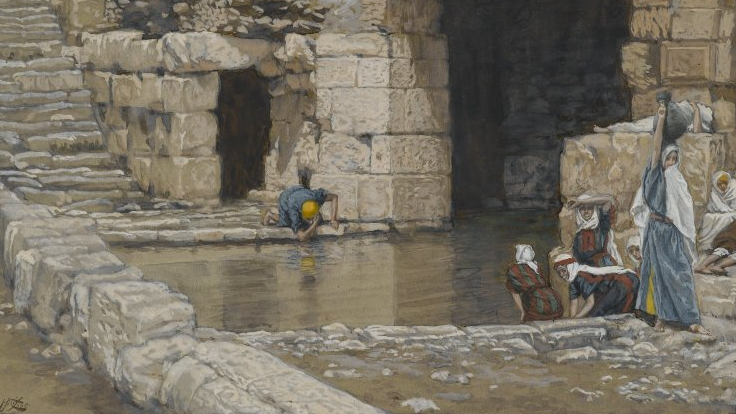
Our passage today highlights this point, and is found in John 5:2-18. If you wish, you can go ahead and be turning there in your bibles while I set the scene. This account takes place at the famous pool at Bethesda, which was a well-known location among the Jews of Jerusalem. The “pool” was actually two pools surrounded by four porticoes (imagine a covered walkway), with a fifth portico situated between them. Under these porticoes were usually a large number of sick or crippled people waiting for the “stirring up of the water.” There was a local superstition that said when the spring bubbled up fresh water, an angel was stirring the pool and people could find healing in the waters. This belief was so strong that even after Jerusalem was conquered by Rome, the Romans built a temple to their God of medicine next to the pools. With that understanding in mind, let’s begin by reading the first few verses of John 5, starting in verse 2.
Do You Want To Be Healed?
2 Now there is in Jerusalem by the Sheep Gate a pool, in Aramaic called Bethesda, which has five roofed colonnades. 3 In these lay a multitude of invalids—blind, lame, and paralyzed. 5 One man was there who had been an invalid for thirty-eight years. 6 When Jesus saw him lying there and knew that he had already been there a long time, he said to him, “Do you want to be healed?” 7 The sick man answered him, “Sir, I have no one to put me into the pool when the water is stirred up, and while I am going another steps down before me.”
John 5:2-7, ESV
Jesus came to the pool called Bethesda and was greeted by a scene of desperation, a scene which the people of Jerusalem had probably grown accustomed to seeing. The name “Bethesda” is a combination of two words that mean “House of Pity” or “House of Mercy”, which is appropriate for a gathering place for the sick and weak. This was a place for people who were hoping against hope.
I can remember years ago when a close friend of mine had a loved one battling a deadly illness, I saw that she had purchased a bracelet, still in it’s packaging. It claimed to have healing stones that could transfer some sort of healing energy into the person who wore it. Now in hindsight it really wasn’t any of my business and I shouldn’t have said anything, but I held it up and asked her “do you really believe stuff like this works?” And I still remember the look in her eyes when she told me “at this point we will try anything?” I bring that up because it reminds me that when you are truly desperate, people will try all sorts of things to get the results they hope for.
We are told that those gathered were “a multitude of invalids – blind, lame, and paralyzed.” In the ancient world, people with these ailments had to either rely on their families to financially support them or they had to spend their life begging and hoping that the kindness of strangers would provide enough to make it through the day. There was no work for these people and there was not government system of assistance either. In both the Roman and Jewish world of the first century, it was often assumed that serious injury or ailment was a sign of God (or the gods) disfavor. As a result, while it was seen as noble to give to the poor and disabled, you certainly weren’t required to do so. If you helped them, then that was a testament to your kindness, but if you didn’t then they were just getting what they probably deserved anyways. It was a harsher world, and so people suffering in these ways were desperate for anything that promised even a possibility of healing.
In verse five we are told that “One man was there who had been an invalid for thirty-eight years.” Thirty-eight years is a long time, especially for someone living in the first century. That was actually longer than the average lifespan when you account for how many people died young in the ancient world. We can reasonably assume that this man was probably the oldest person gathered by the pool on this day.
Jesus asks this man a question, but the answer was obvious to anyone within earshot. Jesus asks the man, “Do you want to be healed?” Now remember, this man was identified as an invalid, which means he was probably suffering from some degree of paralysis or had been injured or deformed in a way that made normal movement difficult. Even if that did not make it apparent enough, he was at the pool of Bethesda, a place where invalids like him gathered in hopes of receiving healing.
The man takes Jesus question “Do you want to be healed?” as meaning “Why haven’t you gone into the pool? Don’t you want to be healed?” The man explains “Sir, I have no one to put me into the pool when the water is stirred up, and while I am going another steps down before me.” Here is where I would like to pause for a moment. Jesus asks the man if he wants to be healed, and the man explains in frustration why he isn’t able to heal himself. I don’t know this man’s life story, but if I were to guess I would speculate that during his 38 years as an invalid this man had probably tried all sorts of means to get healing. I’m confident that the pool at Bethesda wasn’t the first thing he tried, and if things had gone differently it probably wouldn’t have been the last thing either. But he was discouraged because whenever he tried to go on someone (probably younger or someone with more mobility) would step in ahead of him.
The man thought Jesus was questioning his sincerity, implying that if he wanted to be healed he needed to pick himself up and get in the pool. What Jesus was actually offering was healing right then and there. Jesus did not come into the world to teach us how to save ourselves. There are thousands of self-help teachers, gurus, and spiritual guides that have claimed to know the way to salvation, to healing, to peace. Jesus didn’t come to teach us a way, he said he was the way.
Jesus said to him, “I am the way, and the truth, and the life. No one comes to the Father except through me.”
John 14:6, ESV
Just as the man by the pool was physically lame and unable to find healing, so too are we spiritually crippled by sin and unable to make our way into the Kingdom of God by our own efforts. There is no magical spell, or ritual, or relic that will make us right with God. Salvation comes to us in a person, Jesus Christ. We are saved by grace through faith, so that we cannot boast in ourselves, but in the work of Christ done on our behalf!
Now, my hope is that everyone hearing my voice this morning knows the spiritual healing that Christ brings to a sick and dying soul. If not then my question for you this morning is the same question Christ asked this man centuries ago, “do you want to be healed?”
When people come to me unsure of their salvation I will usually give them this thought exercise. I ask them to imagine that tonight they died in their sleep and found themselves standing before the throne of God, and God asks them why he should let them into Heaven. What would their answer be? Let me ask you this morning what would your answer be?
If I had to guess, I would say that I’ve probably given that thought exercise to at least fifty people and to my recollection only one has ever given me the right answer. The most common answer I got was “I’m a good person” or “I don’t do X, Y, or Z sins” or “I try to go to church and pray.” Only one person that I can remember gave the right answer, which is “Because of what Jesus did for me.”
Jesus doesn’t come to us in our need to offer us a new philosophy, or a new spiritual practice, or a twelve-step program. He comes as the only sinless the Son of God with the same call he gave to all sinners would listen, “repent, believe the good news, follow me, and be healed.” He is the way, he is the truth, and he is the life. Our hope, our future, and our healing are found in Christ alone. Turn to him and be saved, he is the Son of God, and there is no other.
The Man Who Healed Me
8 Jesus said to him, “Get up, take up your bed, and walk.” 9 And at once the man was healed, and he took up his bed and walked.
Now that day was the Sabbath. 10 So the Jews said to the man who had been healed, “It is the Sabbath, and it is not lawful for you to take up your bed.” 11 But he answered them, “The man who healed me, that man said to me, ‘Take up your bed, and walk.’” 12 They asked him, “Who is the man who said to you, ‘Take up your bed and walk’?” 13 Now the man who had been healed did not know who it was, for Jesus had withdrawn, as there was a crowd in the place.
John 5:8-13, ESV
The scriptures say “at once the man was healed!” Thirty-eight years in captivity to his flesh, and now he was free. This physical miracle is a sign that points us to the truth that Christ has come to strengthen the weak, to empower the powerless, and to raise those who are dead in faith to new life. It wasn’t by miracle water, or special prayers, or anything of the sort that this man was healed. The man was restored because Christ said he was healed.
Now we are told that this took place on the Sabbath day, a holy day for Jews when no work was to be done. By the strictest definition, carrying around the mat that the man had probably sat on for years was technically doing work. It didn’t matter that the man who had been crippled for nearly four decades was now walking about, the people around him were more concerned with whether or not it was proper for a Jew to carry a bed on the Sabbath. That may seem silly to us, but I can almost guarantee that there are some things we hold onto that seem silly in the eyes of heaven. I wouldn’t be surprised at all if angels looked down on us and thought “Those silly humans, don’t they have their priorities all out of order!”
But why did Christ heal this man on the Sabbath? We aren’t told, but some have speculated it was his way of showing that Law had nothing to do with the cure. We are not saved by keeping the Law. No, we are saved by Christ. Salvation is by Christ alone.
When his Jewish neighbors asked the recently healed man about carrying his mat on the Sabbath day of rest, he told them the truth. He was following the words of the man who gave him new life. Now Jesus had apparently made his exit before the healed man could ask his name, but the man had the right idea whether he knew it or not. The man who healed me told me to carry my mat and walk, and I am going to follow him. Obedience to the law had not cured the invalid, it was Christ who did that. In the same way the Law of God can only point us to a righteousness we cannot obtain, we need Christ to set us free from the powers of sin and death.
We are told in the next verse that:
14 Afterward Jesus found him in the temple and said to him, “See, you are well! Sin no more, that nothing worse may happen to you.”
John 5:14, ESV
The first thing to notice here is that Jesus found the healed man in the Temple, presumably praising God for the healing and the new lease on life he had received. This tells me that while the man hadn’t gotten Jesus’ name at first, he knew that it was God who had healed him through Jesus.
The second thing to notice here is Jesus statement “See, you are well! Sin no more, that nothing worse may happen to you.” Some take this to mean that the man’s thirty-eight year infirmity was the result of his sin. Others simply take it to mean that Jesus was warning the man that there are worse things than infirmity. He was calling the man to repent of any sins in his life and not to waste the gift he had been given, a new life, on things that were sinful and not honoring to God.
As Jesus had taught elsewhere:
And if your hand or your foot causes you to sin, cut it off and throw it away. It is better for you to enter life crippled or lame than with two hands or two feet to be thrown into the eternal fire.
Matthew 18:8, ESV
The man had been healed, but the healing would be useless if he did not honor God with his new body. Likewise, we as Christ followers, are rescued from the power of sin not so that we can keep on sinning, but so that we can live lives holy and pleasing to God!
What shall we say then? Are we to continue in sin that grace may abound? 2 By no means! How can we who died to sin still live in it?
Romans 6:1-2, ESV
After the man learned the identity of the one who healed him, he did what all of us who have encountered Jesus are called to do. He went out as a witness to tell others about what he had experienced. But as we will see, instead of praising God for the man’s testimony, many still approached Jesus with skepticism and a heart unwilling to believe.
15 The man went away and told the Jews that it was Jesus who had healed him. 16 And this was why the Jews were persecuting Jesus, because he was doing these things on the Sabbath. 17 But Jesus answered them, “My Father is working until now, and I am working.” 18 This was why the Jews were seeking all the more to kill him, because not only was he breaking the Sabbath, but he was even calling God his own Father, making himself equal with God.
John 5:15-18, ESV
Here we see the opponents of Jesus struggling with a sin that many of Jesus’ critics stumbled over. They were putting their human religious tradition, their interpretation of God’s Law, above the genuine divine calling to show love and compassion for others.
“You shall not go around as a slanderer among your people, and you shall not stand up against the life of your neighbor: I am the LORD. You shall not hate your brother in your heart, but you shall reason frankly with your neighbor, lest you incur sin because of him. You shall not take vengeance or bear a grudge against the sons of your own people, but you shall love your neighbor as yourself: I am the LORD.
Leviticus 19:16-17, ESV
Who embodied the heart of the law if not Christ? Who broke the heart of the law if not Christ’s accusers? Even the Law permitted breaking of the Sabbath rest to help those in dire need, but the critics of Jesus were primarily concerned about following the letter of the law and not the heart of the law. When Jesus says, “My Father is working until now, and I am working,” he implies that he, like his Heavenly Father, is over and above the Sabbath. Jews believe that while God rested from his work of creating on the seventh day, and as a result we too rest one day a week, he did not stop upholding and governing the universe. God does not take a break from being God, and Jesus was saying here that neither does he. His critics were right in saying that Jesus was making himself equal with God, but what they missed was the fact that he was not making any false claims.
They critics committed in their hearts even more to see Jesus put to death, and eventually Jesus would be crucified as those he came to save mocked him, but death and the grave would not hold him. He would rise three days later eternally triumphant and bringing salvation and the forgiveness of sins to all who would come and follow him in faith.
Conclusion
So once again we find ourselves at a time of decision. Perhaps this morning you come with a spiritual wound that has crippled your life, and you need to take it to the great healer. Maybe you have tried everything you can think of only to be disappointed. Self-help isn’t working and you need a miracle. If that is you this morning come to Jesus.
Maybe this morning you realize that, while God has given you new life in Christ, you need to better use this gift for his glory and perhaps you need to take this time to repent and rededicate yourself to your Lord and Savior. If that is you this morning then I say repent and come back to your good and perfect Lord. Follow the giver of life and turn from the paths that lead nowhere.
Regardless, let us go from here this morning praising God for sending his Son Jesus into the world to save us who could not save ourselves, to heal us who could not heal ourselves, and to give new life to those who were lost and dying without hope. May we never grow tired of singing his glorious praises!
 hardincrowder.com